Explore Gerhard Richter's art (b. 1932): abstract & photorealistic paintings, 'Capitalist Realism', color charts & more. A leading German artist influencing contemporary art.
Exploring the Layers of Abstraktes Bild (Rot Blau Gelb) by Gerhard Richter
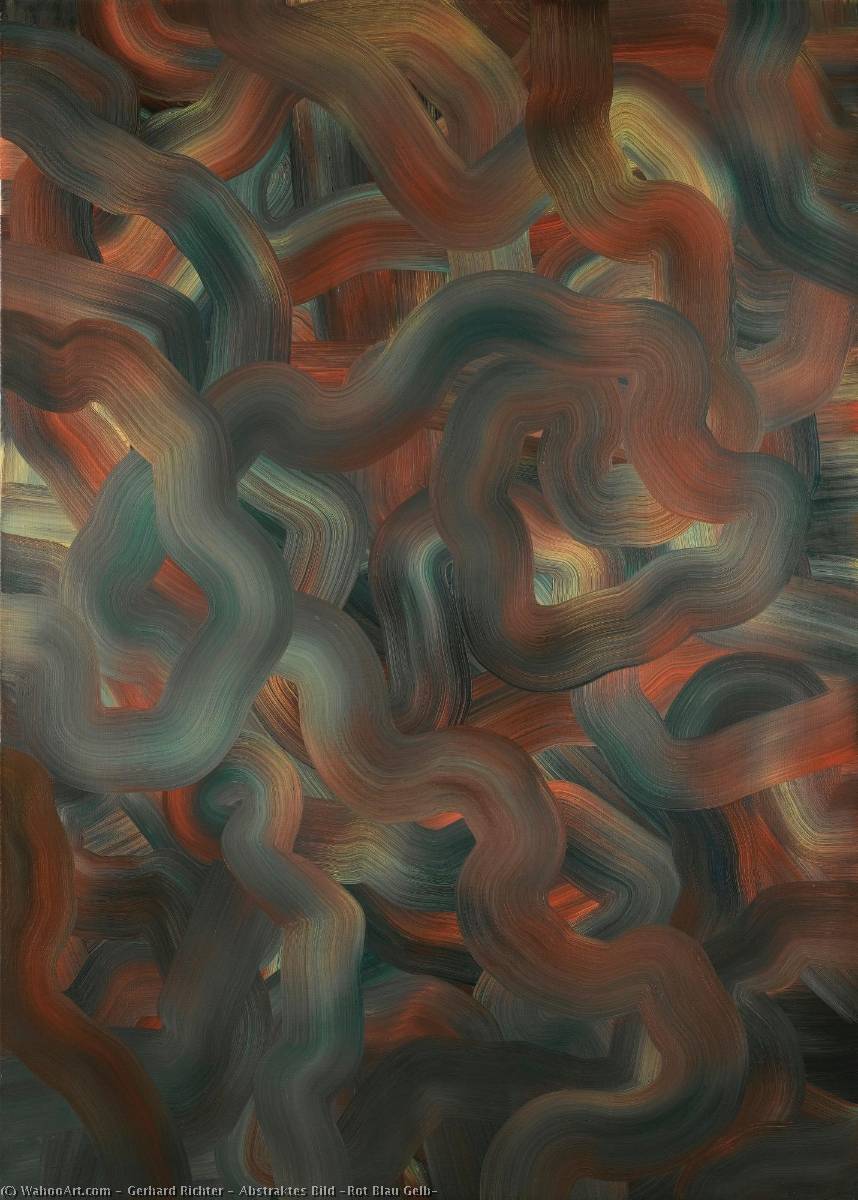
Gerhard Richter’s “Abstraktes Bild (Rot Blau Gelb)” – literally ‘Abstract Image (Red Blue Yellow)’ – transcends mere visual representation; it embodies a profound meditation on perception and memory, reflecting the artist's signature approach to painting. Created in 1973, this piece exemplifies Richter’s masterful manipulation of color and texture, cementing his place as one of Germany’s most influential figures in contemporary art. The artwork itself presents a deceptively simple composition: swathes of crimson, sapphire, emerald green, golden ochre, violet hues, and tangerine shades coalesce across the canvas, blurring into amorphous shapes that resist precise definition.
A Technique Rooted in Uncertainty
Richter’s technique—characterized by multiple layers of translucent acrylic paint applied over a textured surface—is deliberately ambiguous. He employs a process known as ‘gründertechnik,’ where he builds up successive coats of pigment onto a primed canvas, allowing each layer to bleed into the previous one. This method isn't about achieving photographic realism; rather, it seeks to capture not what is seen but how it *feels*. The resulting surface possesses an almost velvety quality, hinting at hidden depths and inviting contemplation. Richter himself famously stated that he doesn’t aim for accuracy but “to represent something that I saw.” This statement encapsulates the core of his artistic philosophy—a rejection of illusion and a commitment to conveying emotional resonance.
Historical Context: The Echoes of Division
The painting's genesis coincides with a pivotal moment in German history – the aftermath of World War II and the subsequent division into East and West Germany. Richter’s formative years were marked by displacement and upheaval, experiences that instilled within him an awareness of fragmentation and instability. This sensibility finds expression in “Abstraktes Bild,” where the blending colors mirror the blurred boundaries between past and present, certainty and doubt. The artwork speaks to a broader artistic preoccupation with confronting trauma and exploring subjective experience—themes prevalent throughout Richter’s oeuvre.
Symbolism Beyond Color
While color itself carries inherent symbolic weight – red representing passion and vitality, blue signifying tranquility and contemplation – in “Abstraktes Bild,” the colors operate on a more nuanced level. They aren't merely decorative; they function as conduits for emotion, conveying a sense of melancholy mingled with acceptance. The swirling forms contribute to this emotional impact, suggesting movement and transformation without offering any concrete narrative. Instead, they encourage viewers to engage in an internal dialogue, prompting them to consider their own perceptions and memories.
Emotional Resonance: A Window into Richter’s Vision
Ultimately, “Abstraktes Bild” succeeds as a powerful artistic statement because it bypasses literal representation. It invites us to inhabit the artist's headspace—to grapple with questions of perception and memory—and to appreciate the beauty inherent in uncertainty. Like much of Richter’s work, this painting is less about depicting an external reality than exploring the inner landscape of consciousness. Its enduring appeal lies in its ability to resonate deeply with audiences who recognize the profound truthfulness of capturing feeling rather than striving for flawless imitation.