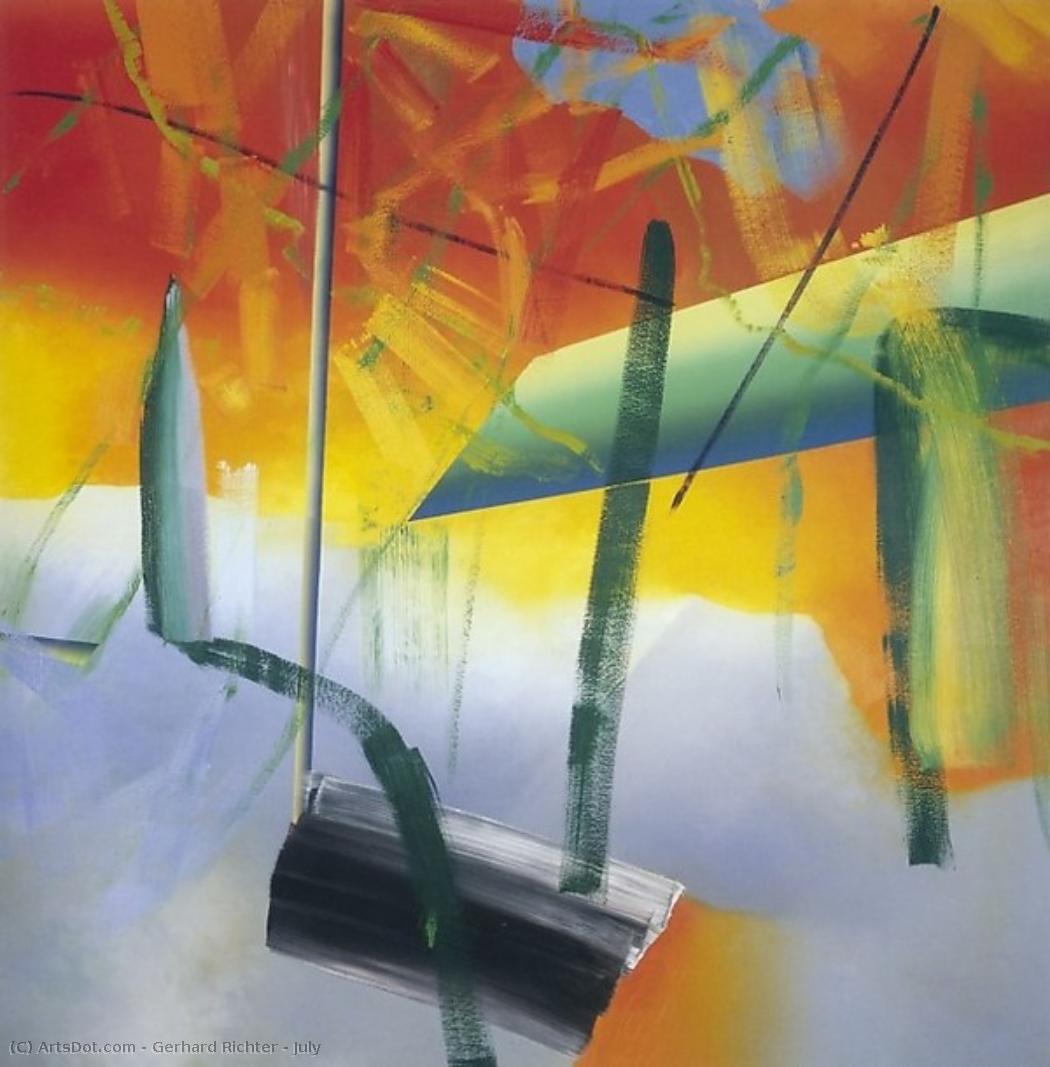
Explore 'July' (1983) by Gerhard Richter, a captivating abstract masterpiece showcasing vibrant colors and dynamic textures. A key work from a leading contemporary artist.
Explore Gerhard Richter's art (b. 1932): abstract & photorealistic paintings, 'Capitalist Realism', color charts & more. A leading German artist influencing contemporary art.
A Symphony of Abstraction: Decoding Gerhard Richter’s “July”
Gerhard Richter's "July," created in 1983, is not a painting that readily reveals its secrets. Measuring an impressive 250 x 250 cm, it commands attention with its sheer scale and the complex interplay of color and texture across its surface. This isn’t a landscape rendered with photographic precision – Richter famously explored both photorealism and abstraction – but rather a distillation of sensation, a visual echo of a summer moment captured not in detail, but in feeling. The painting presents a dynamic composition centered around a vertical element, often described as a pole or stick, which acts as an anchor amidst swirling forms. A boat appears on the right, suggesting a waterscape, while hints of foliage and even avian life emerge from the layered paint. Two figures are subtly integrated into the scene, their presence adding a human scale to the abstract expanse. It’s a work that invites prolonged contemplation, rewarding the viewer with new discoveries upon each encounter.
The Master of Multiple Styles: Richter's Artistic Journey
Born in Dresden, Germany, in 1932, Gerhard Richter has become one of the most significant and influential artists of our time. His life story is deeply intertwined with the tumultuous history of post-war Germany, a context that profoundly shaped his artistic vision. Initially trained as a sign painter and stage-set designer, he later pursued formal studies at the Dresden Academy of Fine Arts. Richter’s early work demonstrated an engagement with abstraction, influenced by artists like Picasso and Arp, but it was his subsequent exploration of photorealism – painstakingly recreating photographs in paint – that first brought him international recognition. However, to define Richter by a single style is to misunderstand his artistic ambition. He deliberately resists categorization, constantly shifting between approaches, blurring the boundaries between representation and abstraction. “July” exemplifies this restless experimentation; it’s part of a series of abstract paintings created in the early 1980s, where he employed squeegees and layered applications of paint to create surfaces that are both chaotic and controlled.
Technique as Exploration: The Squeegee and the Layered Surface
The distinctive visual character of “July” is inextricably linked to Richter’s innovative technique. He doesn't approach the canvas with a preconceived image, but rather allows the painting to emerge through a process of layering and manipulation. Applying paint thickly, he then drags a squeegee across the surface, scraping away portions of the pigment and creating a textured, almost blurred effect. This method introduces an element of chance and unpredictability, challenging traditional notions of artistic control. The resulting surface is rich with depth and nuance, revealing glimpses of underlying colors and forms beneath the top layers. It’s a technique that evokes both the fluidity of water and the density of memory – suggesting that the painting isn't simply *of* something, but rather embodies a process of recollection and reconstruction. This method allows for an incredible amount of depth and complexity within the work, making each viewing experience unique.
Beyond Representation: Symbolism and Emotional Resonance
While “July” doesn’t offer a clear narrative or symbolic program, its emotional impact is undeniable. The painting evokes a sense of atmosphere – perhaps the hazy heat of a summer afternoon, or the fleeting quality of a cherished memory. The ambiguous forms invite viewers to project their own interpretations onto the canvas, creating a deeply personal connection with the work. The presence of figures and natural elements hints at human interaction with the environment, but these elements are fragmented and indistinct, suggesting a sense of alienation or detachment. Ultimately, “July” is not about depicting a specific scene, but rather about exploring the subjective experience of perception and the elusive nature of reality itself. It’s a painting that speaks to the complexities of modern life, inviting us to question our assumptions about representation and meaning.