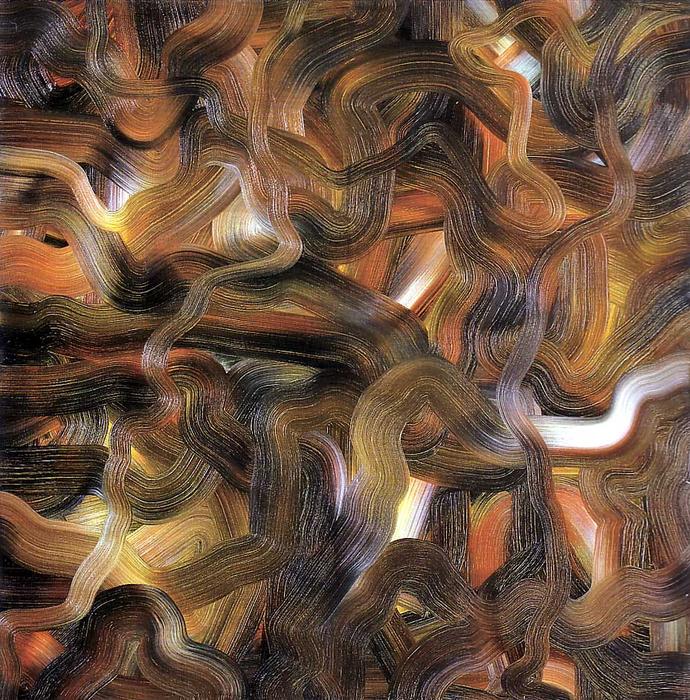
Experience Gerhard Richter's 'Red Blue Yellow' (1972). This abstract expressionist masterpiece blends vibrant colors and dynamic brushstrokes, reflecting Richter’s innovative approach to color and form. Explore its layered composition and profound artistic legacy.
Explore Gerhard Richter's art (b. 1932): abstract & photorealistic paintings, 'Capitalist Realism', color charts & more. A leading German artist influencing contemporary art.
The Enigmatic Dance of Color: Gerhard Richter’s “Red Blue Yellow”
Gerhard Richter's "Red Blue Yellow," painted in 1972, isn’t merely a painting; it’s an immersion into the heart of abstract expressionism and a profound meditation on color itself. Born in Dresden amidst the tumultuous backdrop of post-war Germany, Richter’s early life instilled within him a sensitivity to uncertainty and a deep questioning of representation – qualities that would become central to his artistic exploration for decades to come. This work, created during a pivotal period of experimentation for the artist, embodies this spirit, moving beyond literal depiction towards an evocative realm where color and emotion coalesce. It’s a piece that invites prolonged contemplation, revealing new layers with each viewing.
A Symphony of Brushstrokes: Composition and Technique
The immediate impact of “Red Blue Yellow” is one of dynamic complexity. Richter masterfully employs interconnected lines – not sharply defined outlines, but rather hazy, gestural strokes – to create a layered composition that feels both chaotic and meticulously controlled. These lines vary dramatically in thickness and direction, building depth and suggesting movement across the canvas. The painting isn’t about precise forms; instead, it's about the *process* of applying paint, the tangible evidence of Richter’s hand shaping color into an evocative space. Vibrant hues – a fiery red, a cool blue, a sunny yellow, punctuated by hints of orange and green – are applied with seemingly intuitive abandon, yet the overall effect is remarkably balanced. The artist's technique leans heavily on layering, allowing colors to bleed subtly into one another, creating a sense of atmospheric depth and blurring the boundaries between individual elements. It’s a testament to Richter’s ability to harness the inherent qualities of paint itself – its viscosity, its reflectivity, its capacity for both solidity and dissolution.
Echoes of Neo-Figurative Art and Beyond
While firmly rooted in abstract expressionism, “Red Blue Yellow” also resonates with the emerging movement of Neo-Figurative art. This trend, which arose as a reaction against the purely subjective concerns of earlier abstraction, sought to reintroduce elements of recognizable form while retaining an underlying sense of ambiguity. Richter’s work occupies a fascinating space between these two approaches, refusing to commit fully to either. The painting subtly evokes memories – perhaps of landscapes glimpsed through a hazy recollection, or fragments of color associations—without ever resolving into concrete imagery. It's this deliberate refusal to provide easy answers that contributes to the piece’s enduring power and invites viewers to project their own experiences and emotions onto its surface. Richter was also deeply influenced by the work of artists like Malevich and Newman, whose explorations of pure color and non-representational forms paved the way for his own innovations.
Decoding the Palette: Color as Emotion
Richter’s deliberate choice of colors is far from arbitrary. He wasn't simply interested in creating a visually pleasing arrangement; he was exploring the emotional resonance of each hue. Red, often associated with passion and energy, is tempered by the coolness of blue, suggesting introspection and contemplation. Yellow introduces a sense of optimism and warmth, while the subtle greens hint at growth and renewal. The interplay between these colors creates a dynamic tension—a visual dialogue that mirrors the complexities of human experience. Richter’s series of “inpaintings,” including "Red Blue Yellow," represents a significant shift in his artistic practice, moving away from representational painting towards an exploration of pure color and its expressive potential. It's a bold move that solidified his position as one of the most innovative artists of his generation.
A Legacy of Innovation
“Red Blue Yellow” stands as a pivotal work in Gerhard Richter’s oeuvre—a testament to his willingness to challenge conventions, experiment with new techniques, and delve into the profound mysteries of color and perception. Its influence can be seen in subsequent generations of abstract artists, and its enduring appeal lies in its ability to evoke a wide range of emotions and interpretations. For those seeking a high-quality reproduction of this captivating masterpiece, ArtsDot offers meticulously crafted hand-painted reproductions that faithfully capture the essence of Richter’s vision. To learn more about Gerhard Richter's life and work, we encourage you to explore resources such as the Museum of Modern Art (MoMA) and WikiArt.org.