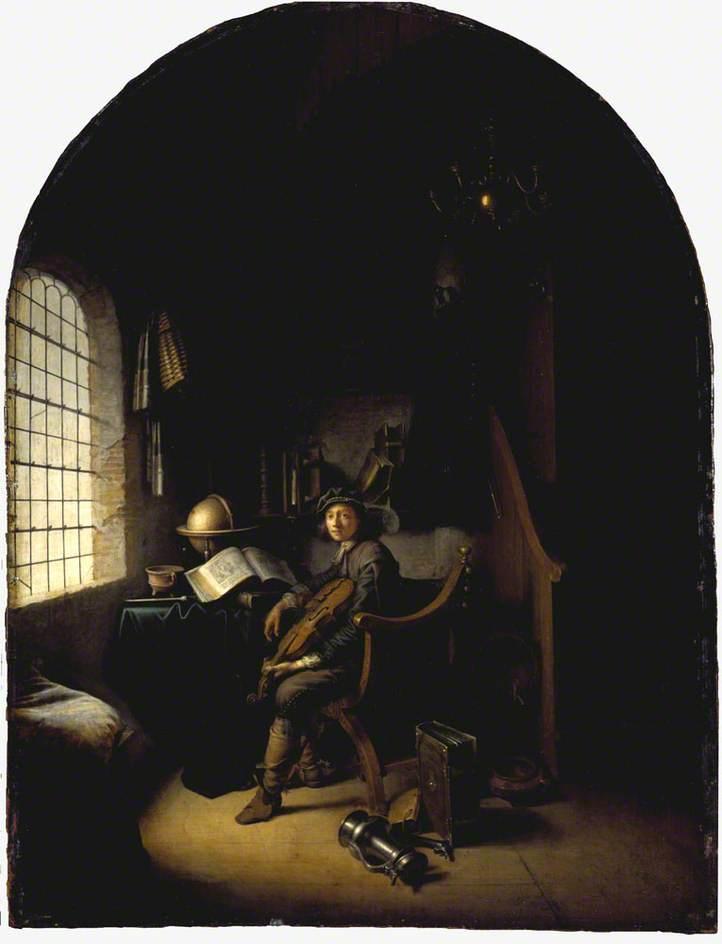
A Moment of Quiet Contemplation: Gerrit Dou’s “Interior with a Young Violinist”
Gerrit Dou's "Interior with a Young Violinist," painted in 1637, isn’t merely a portrait; it’s a carefully constructed tableau of domestic tranquility and intellectual pursuit. Within the dimly lit confines of this Dutch Golden Age scene, we encounter a young man absorbed in his music, surrounded by the subtle intimacies of a scholar's study. Dou masterfully employs chiaroscuro – the dramatic contrast between light and shadow – to draw our eye to the central figure, imbuing him with an almost palpable sense of concentration. The muted palette, dominated by browns, ochres, and deep reds, creates a mood of quiet introspection, inviting us into this private world.
The painting’s technical brilliance lies in Dou's meticulous attention to detail and his innovative approach to capturing light. He utilized a unique technique involving a concave lens and convex mirror, allowing him to render the subtle reflections on surfaces with astonishing accuracy – the polished wood of the furniture, the sheen of the violin, even the glint of candlelight dancing across the young man’s face. This painstaking process resulted in an incredibly realistic depiction, a hallmark of Dou's “fijnschilder” style, which prioritized minute detail and refined textures over bold brushstrokes.
The Symbolism of Harmony and Learning
Beyond its technical mastery, "Interior with a Young Violinist" is rich in symbolic meaning. The young man playing the violin represents not just musical talent but also intellectual curiosity and the pursuit of knowledge – values highly prized during the Dutch Golden Age. The scattered books suggest a life dedicated to learning, while the carefully arranged objects within the room speak to a refined taste and an appreciation for beauty. The inclusion of a bowl, likely containing fruit or nuts, hints at simple pleasures and the comforts of home.
Furthermore, the violin itself carries significant symbolic weight. In the 17th century, music was closely associated with both intellectual and spiritual pursuits. Playing an instrument was considered a noble activity, fostering discipline, concentration, and a connection to the divine. Dou’s depiction elevates this practice, portraying it as a serene and contemplative act of self-expression.
A Window into Dutch Society
To understand “Interior with a Young Violinist,” we must consider its historical context. The painting reflects the burgeoning prosperity and intellectual ferment of the Dutch Republic in the 1630s. The Netherlands was experiencing a golden age of trade, art, and scientific inquiry – a period marked by tolerance, individualism, and a fascination with classical antiquity. Dou’s work embodies these values, offering a glimpse into the refined domestic life of a wealthy merchant or scholar.
Gerrit Dou, born in Leiden in 1613, was a pivotal figure within the Leiden School of painting, known for his ability to create incredibly realistic and luminous images. His work stands apart from the more dramatic styles of Rembrandt and Frans Hals, favoring subtle nuances and intimate scenes. He was a master of capturing fleeting moments of light and shadow, imbuing his paintings with an unparalleled sense of atmosphere and realism. “Interior with a Young Violinist” is considered one of his finest achievements, showcasing his technical skill and artistic vision.
Bringing the Masterpiece Home
Reproductions of Gerrit Dou’s "Interior with a Young Violinist" offer a remarkable opportunity to bring this captivating work into your own space. The meticulous detail and evocative atmosphere of the original are faithfully preserved in high-quality reproductions, allowing you to enjoy the painting's beauty and symbolism every day. Whether adorning a study, a salon, or a private residence, this timeless masterpiece will undoubtedly serve as a source of inspiration and contemplation.