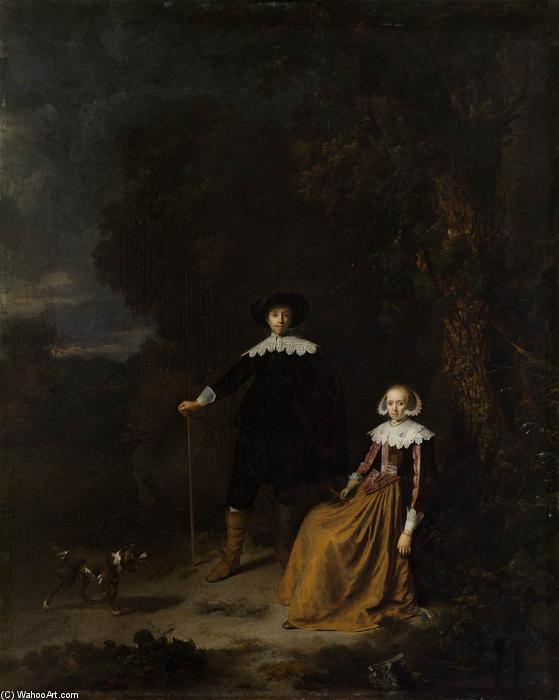
A Window into Dutch Golden Age Dignity: Gerrit Dou’s “Portrait of a Couple in a Landscape”
Gerrit Dou's "Portrait of a Couple in a Landscape," painted circa 1635, is not merely a depiction of two figures; it’s a meticulously crafted window into the quiet dignity and understated elegance that defined the Dutch Golden Age. This small-scale masterpiece, now residing within the Rijksmuseum in Amsterdam, exemplifies Dou's signature style – an almost obsessive attention to detail combined with a profound understanding of light and shadow, creating an atmosphere both intimate and profoundly contemplative. More than just a portrait, it’s a study in restraint, observation, and the subtle language of gesture.
Dou belonged to the Leiden Fijnschilders, a group renowned for their refined technique and ability to capture fleeting moments with remarkable realism. Unlike the grander, more overtly theatrical portraits favored by some contemporaries, Dou's work possessed a quiet intimacy, often focusing on genre scenes or intimate interiors. He was a student of Rembrandt, inheriting his mastery of chiaroscuro – the dramatic interplay of light and dark – but developing a distinctly personal approach. This is immediately evident in “Portrait of a Couple,” where the figures are bathed in a soft, diffused light that seems to emanate from an unseen source, casting delicate shadows across their faces and clothing.
The Language of Gesture and Symbol
The couple themselves are presented with remarkable composure. The man, dressed in dark attire, holds a walking cane – a subtle symbol of age or perhaps even a hint of melancholy. His gaze is directed slightly downward, suggesting introspection rather than outward engagement. His posture is formal yet relaxed, conveying a sense of quiet authority. The woman, clad in warmer hues, offers a gentle counterpoint, her hand resting lightly on the arm of the chair beside her. This subtle gesture – a touch that speaks volumes – hints at a shared history and a comfortable intimacy.
Beyond the figures themselves, the landscape plays a crucial role in shaping the painting’s mood. The trees, rendered with meticulous detail, frame the couple within a carefully constructed space. The inclusion of two dogs in the foreground adds a touch of domesticity and reinforces the sense of a settled life. The chair, strategically placed on the right side, further anchors the scene, suggesting stability and permanence. It’s a landscape that is not merely a backdrop but an active participant in the narrative, contributing to the overall feeling of quiet contemplation.
Technique and Artistic Mastery
Dou's technical skill is breathtakingly evident in every brushstroke. He employed a layering technique – applying thin glazes of paint over each other – to achieve subtle gradations of color and tone. This painstaking process allowed him to capture the textures of fabric, wood, and stone with astonishing accuracy. The detail is remarkable; one can almost feel the roughness of the tree bark or the delicate weave of the woman’s dress. His use of light is particularly masterful, creating a sense of depth and volume that draws the viewer into the scene.
Furthermore, Dou's mastery of perspective – though subtly employed – contributes to the painting’s illusionistic quality. The diminishing size of the trees in the background creates a convincing sense of distance, while atmospheric perspective softens details in the distance, further enhancing the depth of field. This meticulous attention to detail is characteristic of Dou’s work and distinguishes it from more generalized depictions of the era.
A Portrait of Restraint and Reflection
"Portrait of a Couple in a Landscape" is not a painting that shouts for attention; rather, it invites quiet contemplation. It's a testament to Dou’s ability to capture the essence of human dignity within a carefully constructed scene. The painting speaks volumes about the values of the Dutch Golden Age – restraint, observation, and an appreciation for the beauty of everyday life. It remains a poignant reminder that even in moments of stillness, there is profound depth and meaning to be found.
Further Research: For more information on Gerrit Dou and this specific artwork, explore resources such as the Rijksmuseum website (https://www.rijksmuseum.nl/en/collection/G00318597) and Wikipedia (https://en.wikipedia.org/wiki/Gerrit_Dou).