The Intimate Gaze of Creation: Gerrit Dou's Workshop
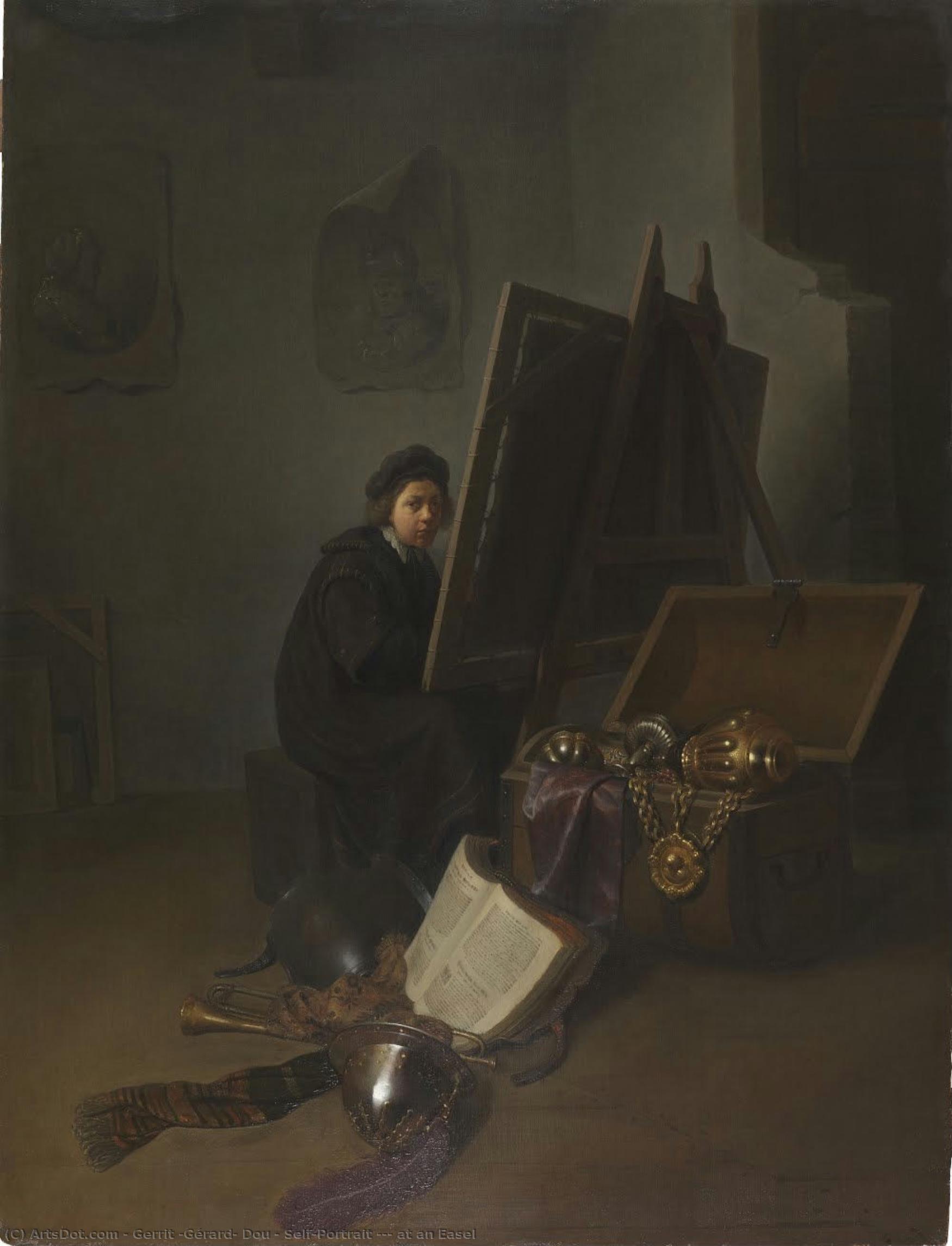
To stand before this depiction of Gerrit Dou at an easel is to step directly into the hushed, intensely focused atmosphere of a 17th-century master’s studio. The scene captures more than just a self-portrait; it is a meticulously staged meditation on the act of creation itself. We see the artist, young and absorbed, positioned amidst the tangible evidence of his craft. His presence anchors the composition, inviting us to consider the very moment inspiration strikes—that delicate balance between contemplation and execution.
The arrangement of objects surrounding him is nothing short of narrative poetry. Books lie open, suggesting deep study; a bowl and vase hold quiet domesticity; and the visible easel stands as the altar upon which his genius is momentarily displayed. These carefully placed artifacts transform the background from mere setting into an active participant in the story, whispering tales of late nights, scholarly pursuits, and the relentless dedication required to achieve mastery.
Mastery in Miniature: Technique and Detail
Gerrit Dou was renowned throughout the Dutch Golden Age for a level of detail that bordered on the microscopic. His technique is not merely painting; it is an act of optical illusion, a triumph of trompe l'oeil. Observe how the light seems to catch on the polished surface of the table or reflect in the unseen gleam of metal—this mastery of rendering texture and luminosity is what elevates this piece beyond simple portraiture. His celebrated handling of chiaroscuro, particularly evident in scenes lit by artificial sources, gives the entire composition a jewel-like depth. Every fold of drapery, every stacked volume, has been rendered with an almost obsessive precision that rewards the closest inspection.
A Study in Domestic Enlightenment
The inclusion of everyday objects—the clocks ticking silently in the background, the simple cup resting near the work surface—grounds this portrait firmly within a specific historical moment. It speaks to the burgeoning bourgeois culture of Leiden, where intellectual life and artistic patronage intertwined so closely. This is not the grand drama of mythology; it is the quiet dignity of skilled labor. The clutter, far from suggesting disarray, suggests fecundity—a workspace overflowing with ideas waiting to be captured by the brush.
Emotional Resonance for the Modern Collector
For the contemporary admirer, this artwork offers a profound connection to the creative spirit. It is an object that speaks directly to anyone who has ever felt the weight and wonder of bringing an idea into tangible form. Owning a reproduction of this piece allows one to curate not just a wall hanging, but a mood—one of focused contemplation, scholarly depth, and quiet artistic achievement. Whether placed in a library, a study, or a sophisticated drawing-room, it serves as a constant, elegant reminder that true beauty often emerges from the careful accumulation of small, meaningful details.