A Window into the Soul: The Quiet Introspection of Gerrit Dou
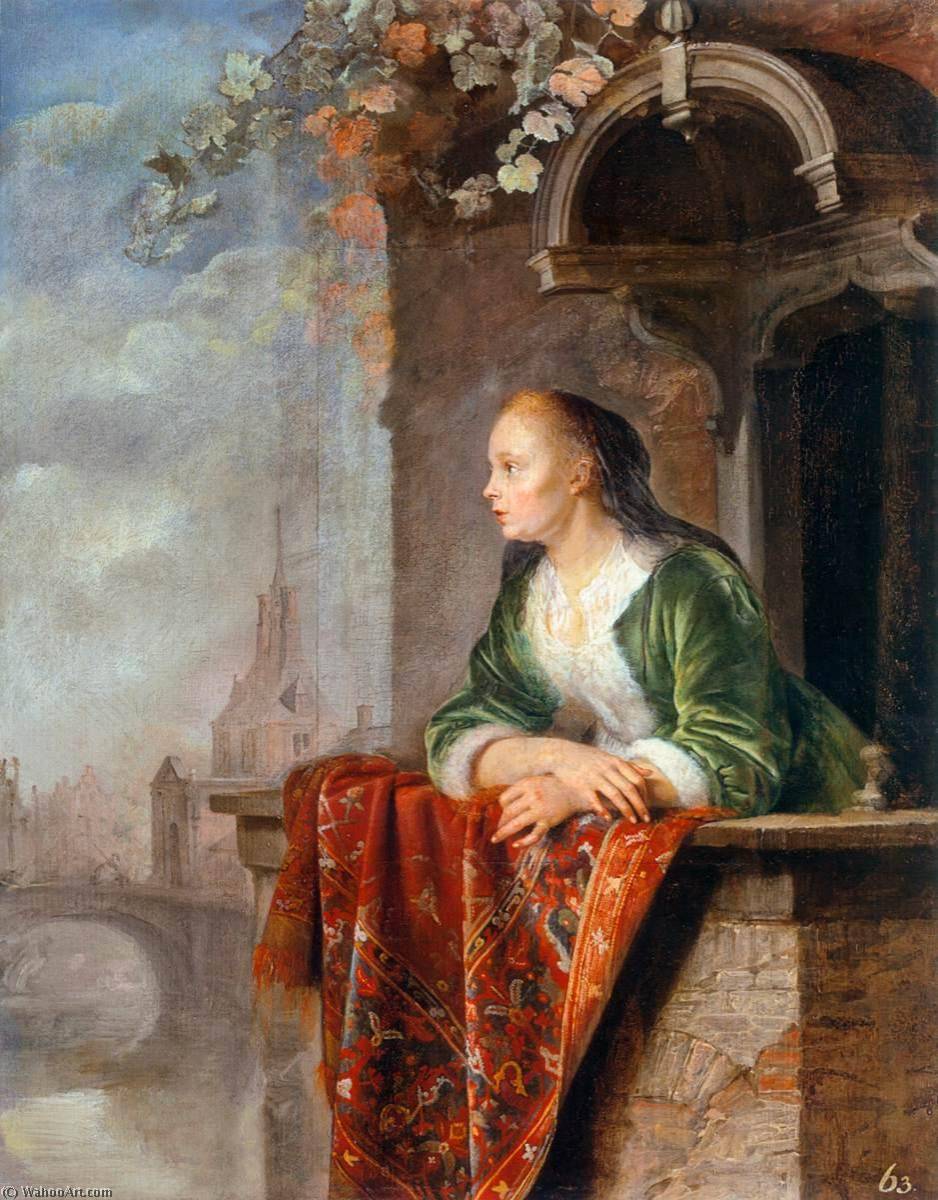
In the soft, diffused light of 1665, a moment of profound stillness was captured on canvas by the master of the Leiden fijnschilders, Gerrit Dou. Young Lady on a Balcony is not merely a portrait; it is an invitation into a private world of contemplation and quiet longing. As we gaze upon this exquisite piece, we find ourselves standing beside a young woman who seems suspended in time, her eyes fixed upon a distant cityscape that whispers of worlds beyond her immediate reach. The painting serves as a masterclass in the Dutch Golden Age tradition, where the boundaries between the viewer's reality and the painted scene become beautifully blurred through meticulous detail and emotional depth.
The composition is a delicate balance of architectural strength and human vulnerability. Framed by the heavy, textured stone of a window ledge, the subject is positioned centrally, creating a sense of stability that contrasts with the ephemeral nature of her thoughts. Dou utilizes perspective with remarkable skill, guiding the eye from the tactile richness of the foreground—where one can almost feel the rough grain of the masonry and the soft weight of the woman's shawl—into the hazy, receding layers of the urban landscape. This technique creates a profound sense of depth, transforming a small-scale work into an expansive window that breathes with the atmosphere of a bygone era.
The Mastery of Light and Texture
To behold a work by Gerrit Dou is to witness the pinnacle of fijnschilder technique, a style defined by its incredibly fine, smooth brushwork that leaves almost no trace of the artist's hand. In this particular work, the use of impasto is subtle yet purposeful, adding a tactile dimension to the fabrics and stone that enhances the realism of the scene. The lighting is masterfully handled; it is not a harsh, dramatic spotlight, but rather a gentle, ambient glow that illuminates the soft folds of the woman's dress and highlights the intricate patterns of the nearby rug. This controlled use of light creates subtle shadows that lend volume to the figure and a sense of mystery to the corners of the room.
For the discerning collector or interior designer, the color palette offers a sophisticated elegance. Dominated by muted, earthy tones, the painting avoids the distraction of garish hues, opting instead for a harmonious range of neutrals that evoke a feeling of nostalgia and tranquility. This subdued chromatic approach allows the textures—the smoothness of skin, the coarseness of stone, and the delicate weave of textile—to take center stage, making the piece an ideal anchor for a room designed for reflection, such as a library, study, or a quiet corner of a grand salon.
Symbolism and the Art of Melancholy
Beyond its technical brilliance, Young Lady on a Balcony is rich with symbolic resonance. The window itself acts as a powerful metaphor: it is both a barrier and a portal, separating the domestic safety of the interior from the vast, unpredictable world outside. The woman's pose, characterized by a gentle leaning and a gaze directed outward, suggests a state of introspection or perhaps a yearning for something lost or yet to be found. This theme of solitude is central to the work, evoking a sense of melancholy that was deeply appreciated in the seventeenth-century Dutch aesthetic.
Every element within the frame contributes to this narrative of quiet reflection. The way the light catches the edge of her sleeve or the stillness of the distant buildings all serve to reinforce the theme of a single, captured moment of thought. For those seeking to bring a piece of history into their contemporary spaces, this reproduction offers more than just decoration; it provides a window into the human condition, offering a sense of peace and a timeless connection to the profound beauty of the Dutch Golden Age.