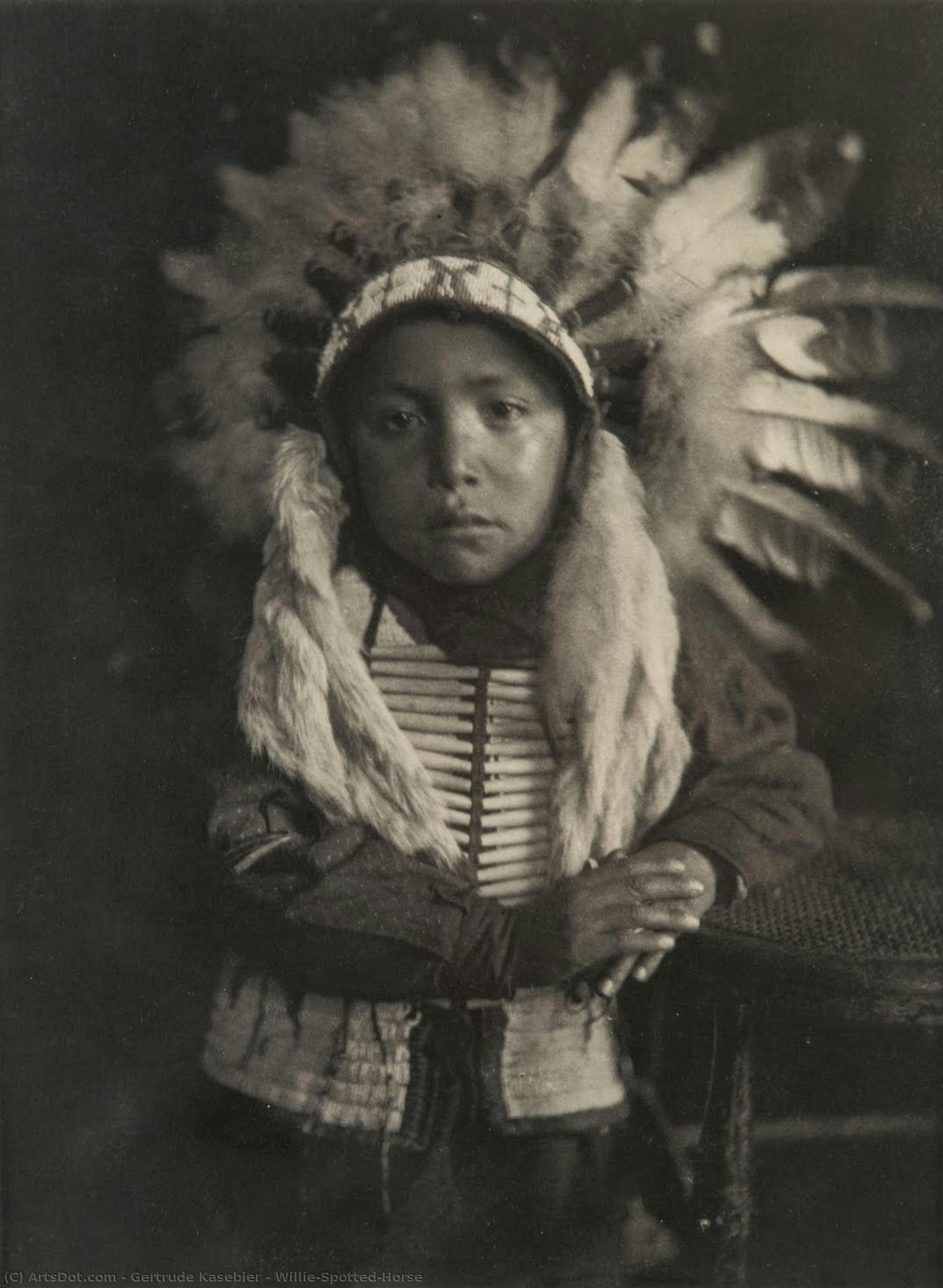
Willie-Spotted Horse, A Pioneer’s Vision of Native American Dignity
Gertrude Käsebier's "Willie Spotted Horse," created in 1901, stands as a testament to the burgeoning Pictorialist movement and its profound engagement with capturing the essence of human experience. More than just a portrait, it embodies Käsebier’s unwavering respect for Native American culture—a sentiment deeply rooted in her own upbringing amidst the entrepreneurial spirit of her father and shaped by witnessing Buffalo Bill's Wild West show.
The photograph depicts a young Sioux Indian boy, Willie Spotted Horse, seated calmly on a stool. Käsebier deliberately eschewed theatrical staging or embellishment, opting for a frontal composition that prioritizes direct eye contact—a technique characteristic of Pictorialism’s desire to elevate photography beyond mere documentation into an art form capable of conveying emotion and psychological depth.
The dramatic lighting – deep shadows punctuated by highlights – skillfully sculpts Willie's face, emphasizing his features and highlighting the textures of his clothing and headdress. This masterful use of chiaroscuro reflects Käsebier’s meticulous attention to detail and her commitment to recreating a sense of realism while simultaneously imbuing the image with artistic intention.
Technical Mastery: Platinum Print Alchemy
Executed in platinum print, Käsebier's method represents a significant advancement over conventional photographic processes. Platinum printing utilizes a chemical process that produces incredibly rich tonal gradations—a velvety smoothness unattainable by gelatin silver prints. This technique demanded considerable skill and patience from the photographer, requiring careful preparation of the emulsion and meticulous control over exposure.
The resulting image possesses an unparalleled luminosity and depth of color, capturing subtle nuances that would otherwise be lost. Furthermore, platinum prints exhibit exceptional archival stability—resistant to fading and discoloration—ensuring that Willie Spotted Horse retains its beauty and emotional resonance for generations to come.
Historical Context: Buffalo Bill’s Influence & Käsebier's Compassion
The photograph was conceived during Käsebier’s visit to Buffalo Bill’s Wild West show in Brooklyn, New York. Captivated by the spectacle and deeply moved by the faces of the Sioux Indians participating in the event—particularly Willie Spotted Horse—Käsebier sought permission to portray him in her studio.
Her fascination with Native American culture stemmed from her childhood memories of Colorado, where her father transported a sawmill during the Gold Rush. Käsebier’s empathy for the plight of indigenous peoples is palpable in her artistic endeavors; she deliberately removed ceremonial articles from Willie Spotted Horse's attire to focus solely on his gaze and posture—a deliberate choice that underscores Pictorialism’s humanist impulse.
Symbolic Resonance: Headdress & Dignity
The headdress worn by Willie Spotted Horse serves as a powerful symbol of Sioux identity and heritage. Käsebier's careful framing captures the boy’s solemn expression, conveying a sense of dignity and quiet contemplation—qualities that resonate deeply within the viewer.
Through her masterful manipulation of light and composition, Gertrude Käsebier transformed a simple portrait into an enduring masterpiece, cementing Willie Spotted Horse’s place as one of Pictorialism's most poignant representations of human emotion and cultural respect. It remains a captivating image for collectors and interior designers alike—a testament to the transformative potential of photographic art.