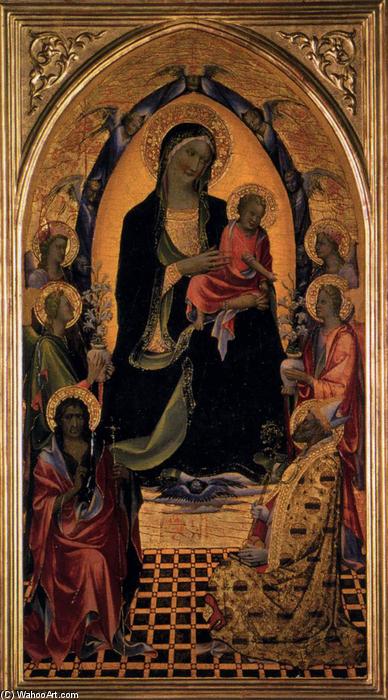
Explore Gherardo di Jacopo Starnina's masterpiece – Virgin with Child and Saints! Admire its intricate detail & Venetian Renaissance style at Museo Bassano & Gallerie Accademia Firenze.
This painting showcases Starnina's masterful technique and attention to detail, reflecting the Venetian Renaissance’s influence on Gothic traditions. It depicts Mary holding Jesus amidst angelic figures and saints
Discover Gherardo di Jacopo Starnina, a 15th-century Venetian Renaissance painter. Explore his religious scenes & Thebaid details at ArtsDot. Masterpieces from Bassano's museum.
Explore Florence's artistic heart at the Galleria dell’Accademia! Witness Michelangelo’s David & masterpieces by Botticelli, Ghirlandaio, and more – a Renaissance treasure.
Gherardo di Jacopo Starnina: A Florentine Master of Detail
Gherardo di Jacopo Starnina (c. 1354 – 1411), affectionately known as “Starnina,” stands as a testament to the quiet brilliance that often characterizes artistic achievement—a figure whose influence on Venetian art history is substantial, yet overshadowed by the flamboyant reputations of his contemporaries like Titian and Tintoretto. He wasn’t merely a painter; he was a craftsman of emotion and precision, elevating devotional imagery with an unparalleled dedication to meticulous detail, particularly evident in his frescoes adorning the Basilica di San Frediano and Museo di Bassano. While Starnina may not dominate museum halls or command headlines, his contribution represents a crucial bridge between Gothic tradition and the burgeoning humanist ideals that defined the Renaissance, securing his place as a cornerstone of Florentine artistic heritage.
Born around 1354 in Florence, Starnina’s early life remains shrouded in relative obscurity—information about his formative years is scarce. However, he received an exceptional education under Agnolo Gaddi, a sculptor and painter who championed Giotto and Simone Martini – artists who prioritized expressive emotion alongside careful observation. This foundational training instilled within him a lifelong commitment to capturing the essence of human experience through meticulous rendering, shaping his artistic vision and technique for decades to come.
The Frescoes of San Frediano: A Symphony of Color and Emotion
Starnina’s magnum opus resides in the Basilica di San Frediano, where he executed a series of frescoes depicting scenes from the Life of Saint Francis of Assisi. These works exemplify Starnina's distinctive style—characterized by luminous color palettes and remarkably realistic depictions of drapery folds and facial expressions. Unlike many artists of his time who favored stylized representations, Starnina sought to convey palpable emotion through subtle nuances of gesture and posture, mirroring the humanist preoccupation with psychological realism that was gaining momentum across Europe. The frescoes are not merely aesthetically pleasing; they serve as powerful meditations on faith and compassion, reflecting Starnina’s profound spiritual convictions.
A Master of Decorative Detail: Beyond Mere Representation
What truly distinguishes Starnina from his peers is his extraordinary skill in decorative embellishment—a characteristic that extends far beyond the confines of his paintings. His frescoes incorporate intricate geometric patterns and stylized floral motifs, demonstrating a mastery of visual language that anticipates later developments in Venetian art. The Museo di Bassano houses several panels featuring scenes from the Bible, showcasing Starnina’s meticulous attention to surface texture and color harmony—a deliberate effort to engage the viewer's senses and elevate the artwork beyond mere visual representation. He achieved this remarkable feat by blending Gothic influences with humanist sensibilities, resulting in a style that is both emotionally resonant and technically sophisticated.
Symbolism Illuminated: Angels, Light, and Divine Grace
The iconography of Starnina’s paintings—particularly his depictions of saints and angels—is imbued with rich symbolic meaning. The use of golden halos signifies holiness and divine grace, while the luminous drapery folds convey spiritual radiance—a technique borrowed from Giotto and Simone Martini that underscores the importance of conveying emotion alongside visual accuracy. Furthermore, Starnina’s masterful manipulation of light creates an atmosphere of solemn contemplation, guiding the viewer's gaze toward the central figures and reinforcing their spiritual significance. These artistic choices reflect a broader humanist concern with understanding the human condition—a desire to capture not only outward appearances but also inner feelings and beliefs.
Legacy: A Quiet Voice Amidst Artistic Giants
Though overshadowed by the flamboyant brilliance of Titian and Tintoretto, Gherardo di Jacopo Starnina’s legacy endures as a symbol of Florentine artistic integrity—a reminder that true artistry lies not merely in grand spectacle but also in profound emotional depth and unwavering technical precision. His frescoes continue to inspire awe and admiration, cementing his place as one of the most important figures in Venetian Renaissance art history.