A Grandiose Allegory: Giandomenico Tiepolo’s “Le Triomphe de la Religion”
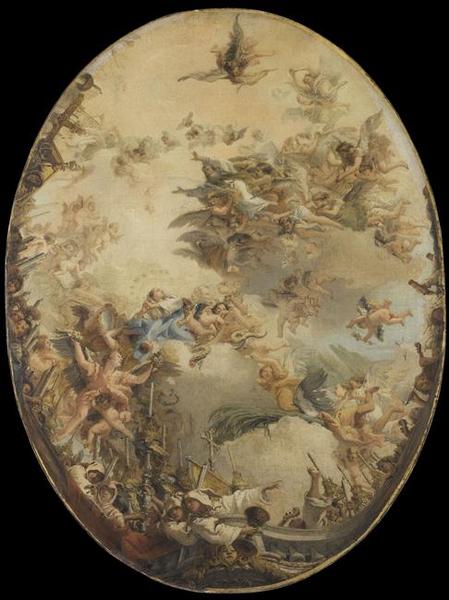
Giandomenico Tiepolo's "Le Triomphe de la Religion" is not merely a painting; it’s an immersive theatrical experience, a swirling vortex of figures and symbolism that transports the viewer to a realm where faith reigns supreme. Completed around 1760 for the Palazzo Labia in Venice, this monumental work embodies the height of Rococo artistry – a dazzling blend of dynamism, opulence, and profound theological contemplation. It’s a testament to Tiepolo's mastery of composition, his ability to capture movement and emotion with breathtaking precision, and his deep understanding of classical and Christian iconography.

Theatrical Composition and Dynamic Movement
The painting’s immediate impact lies in its overwhelming sense of movement. Tiepolo orchestrates a chaotic yet controlled scene, populated by hundreds of figures engaged in a complex dance of triumph. Angels, clad in shimmering gold and flowing robes, ascend amidst swirling clouds – not static forms, but active participants in the divine procession. Below them, a vibrant battle unfolds: soldiers, both human and angelic, clash with what appears to be a force of darkness, perhaps representing heresy or earthly opposition. The composition is deliberately shallow, creating a sense of immediacy and drawing the viewer directly into this tumultuous spectacle. The use of diagonal lines, particularly in the arrangement of figures and drapery, further enhances the feeling of dynamism, as if the entire scene is caught in a perpetual state of motion.
Color, Light, and Symbolism
Tiepolo’s palette is rich and warm, dominated by earthy tones – ochres, siennas, and browns – overlaid with shimmering gold accents. These colors evoke a sense of age and history, suggesting that this is not merely a depiction of a contemporary event but rather an allegory rooted in centuries of Christian tradition. Light plays a crucial role, emanating from multiple sources within the scene itself, bathing figures in a golden glow and highlighting key elements – the radiant halos of angels, the gleaming armor of soldiers. Symbolism abounds throughout the work. The presence of trumpets signifies divine proclamation; the banners bear emblems of faith and victory; and the very act of battle represents the ongoing struggle between good and evil. The composition itself can be interpreted as a visual representation of the Christian narrative – the triumph of Christ over sin and death.
A Masterpiece of Rococo Technique
Technically, “Le Triomphe de la Religion” is a remarkable achievement. Tiepolo employed oil paints on canvas with meticulous detail, layering colors to create depth and luminosity. His brushwork is generally smooth and blended, contributing to the painting’s overall sense of grandeur and refinement. The artist skillfully utilized techniques such as glazing – applying thin layers of translucent paint over dried underlayers – to achieve subtle color variations and atmospheric effects. The illusionistic quality of the scene—the depth, the movement, the sheer number of figures—is a testament to Tiepolo’s mastery of perspective and his ability to create a convincing sense of space. The painting's scale (approximately 360 cm x 480 cm) further enhances its impact, enveloping the viewer in its dramatic world.
A Legacy of Baroque Grandeur
“Le Triomphe de la Religion” stands as a pinnacle of Tiepolo’s career and a quintessential example of Rococo art. It reflects the era's fascination with mythology, allegory, and theatrical spectacle, while also drawing upon classical artistic traditions. The painting’s influence can be seen in subsequent generations of artists, and it continues to captivate viewers today with its sheer scale, dramatic composition, and profound symbolic meaning. Reproductions offer a remarkable opportunity to experience the beauty and power of this monumental work, bringing its vibrant world into any space.