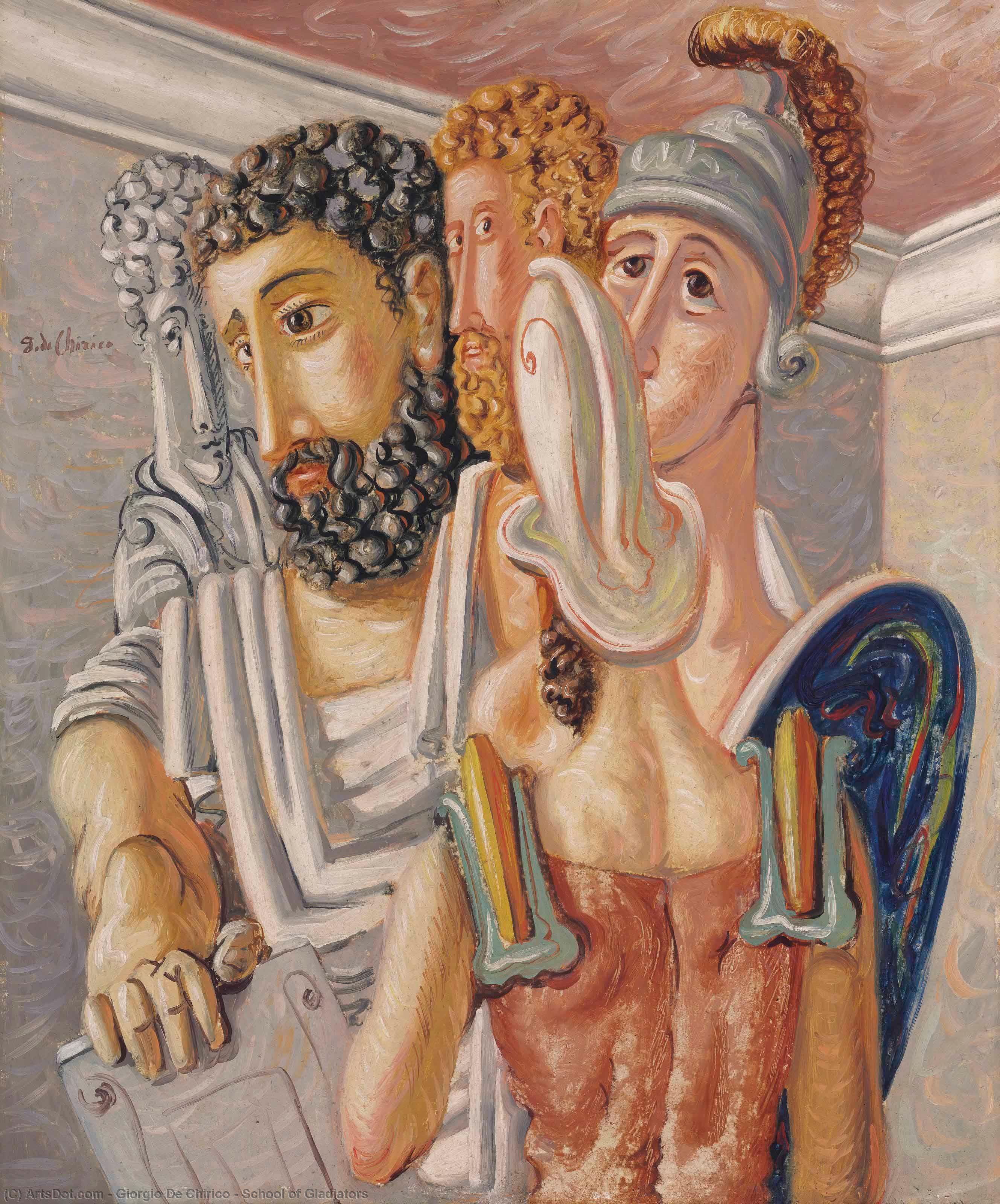
A Surreal Echo of Antiquity: The Enigma of School of Gladiators
To step into Giorgio de Chirico’s 1953 masterpiece, "School of Gladiators," is to enter a realm where the boundaries between reality and dream dissolve into a profound, unsettling stillness. This work serves as a haunting meditation on the intersection of classical ideals and modern psychological unease, a hallmark of De Chirico’s unique vision. The painting does not merely depict figures; it constructs an atmospheric stage set for disquiet, inviting the viewer to wander through a meticulously crafted space that feels simultaneously familiar and profoundly disconcerting. It is a piece that captures the lingering anxieties of mid-20th century Europe, filtering the weight of history through a lens of Surrealist mystery.
The composition is a masterclass in the use of perspective, employing an illusionistic room bathed in a diffused, ghostly light—a technique reminiscent of Renaissance masters but imbued here with a chilling, frozen quality. De Chiriente’s figures are rendered with a stylized, almost sculptural physicality, yet they remain emotionally distant, as if caught in a moment of eternal suspension. The stark contrast between the nude male bodies and the surrounding objects creates a rhythmic tension: vases overflowing with flowers, a solitary clock hanging precariously on the wall, and the presence of horses—one prominent on the left and another subtly tucked into the right—all contribute to a sense of deliberate imbalance and ambiguity.
Neo-Baroque Grandeur and the Architecture of Silence
Stylistically, "School of Gladiators" finds its soul within the neo-baroque tradition. However, De Chirico eschews the typical opulence associated with the Baroque era in favor of a muted, psychological palette dominated by ochre, gray, and earthy tones. This restraint heightens the painting’s impact, turning every texture—from the cold stone of the walls to the heavy folds of drapery—into a vessel for meaning. The meticulous attention to detail speaks to a fascination with theatrical presentation, where every element is placed with surgical precision to evoke a sense of metaphysical depth.
For the discerning collector or interior designer, this artwork offers more than mere decoration; it provides a focal point of intellectual and emotional gravity. The presence of everyday objects—a bowl near the center, a book resting on a surface, and the ticking suggestion of the wall clock—interacts with the classical subject matter to create a narrative that is both timeless and deeply personal. It is an ideal piece for spaces that demand a sense of contemplative luxury and sophisticated mystery, offering a window into a world where the shadows stretch long and the silence speaks volumes.