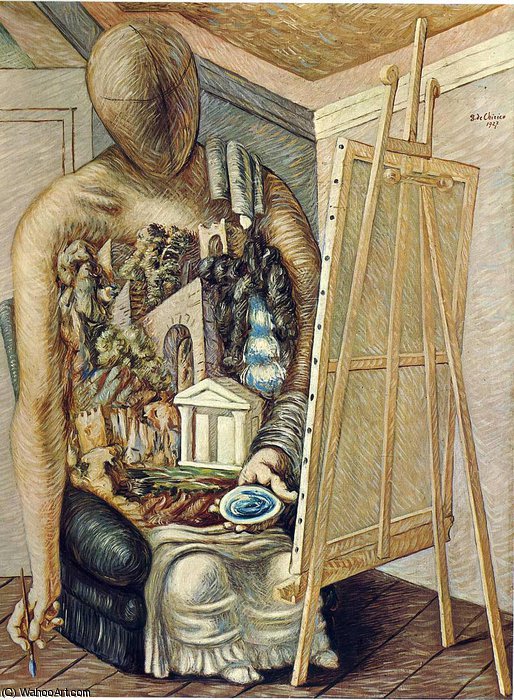
The painting depicts Giorgio de Chirico's signature surrealist style – a solitary artist seated on a bench with an easel, framed by a window and adorned with a mask, creating an atmosphere of mystery and contemplation amidst muted blues and greens.
A Dreamscape of the Subconscious
In the hauntingly quiet realm of Giorgio de Chirico's "untitled (484)", the boundaries between reality and the dream world dissolve into a singular, unsettling vision. Completed in 1967, this enigmatic masterpiece serves as a profound invitation into the depths of the human psyche. The canvas presents a landscape painted in muted, melancholic tones of blue and green, creating an atmosphere that feels both ancient and profoundly modern. At the heart of this composition sits a solitary figure—a man seated upon a bench, his face obscured by a mask, clutching an easel as if guarding a secret truth. This choice of anonymity immediately pulls the viewer into a state of contemplation, forcing us to confront the mystery of identity and the shadows that linger within our own minds.
The painting is far more than a mere visual arrangement; it is a carefully constructed stage for metaphysical inquiry. De Chirico utilizes a technique of meticulous layering and blending, where the oil paints coalesce to create a remarkable tonal subtlety. This softness in color stands in stark contrast to the rigid, geometric forms that define the space. The sharp lines of the wall and the bench impose a sense of spatial stillness, a heavy silence that is only interrupted by the presence of a distant doorway on the left and a small, bird-like figure on the right. These elements act as psychological anchors, guiding the eye through a labyrinth of uncertainty and prompting the viewer to wonder what lies beyond the threshold of the seen.
The Echoes of Philosophy and Tradition
To understand the profound depth of "untitled (484)," one must look toward the intellectual currents that shaped De Chirico’s vision. The artist’s work is a sophisticated dialogue between classical heritage and the existential dread of the twentieth century. Drawing inspiration from the symbolic landscapes of Arnold Böcklen and Max Klinger, De Chirico imbues his scenes with a sense of tragic beauty. His fascination with the works of Friedrich Nietzsche and Arthur Schopenhauer is palpable here; the painting embodies the tension between rationality—represented by the structured architecture—and the irrationality of the subconscious, represented by the masked figure and the dreamlike palette.
For the discerning collector or interior designer, this piece offers an unparalleled emotional resonance. It does not merely decorate a space; it transforms it, providing a focal point for deep thought and quiet reflection. The muted greens and blues are exceptionally versatile, offering a sophisticated, calming presence that complements both contemporary minimalist settings and more classical, opulent interiors. Owning a high-quality reproduction of this work means bringing a piece of art history into the home—a piece that captures the very essence of Surrealism and the enduring mystery of the human soul.