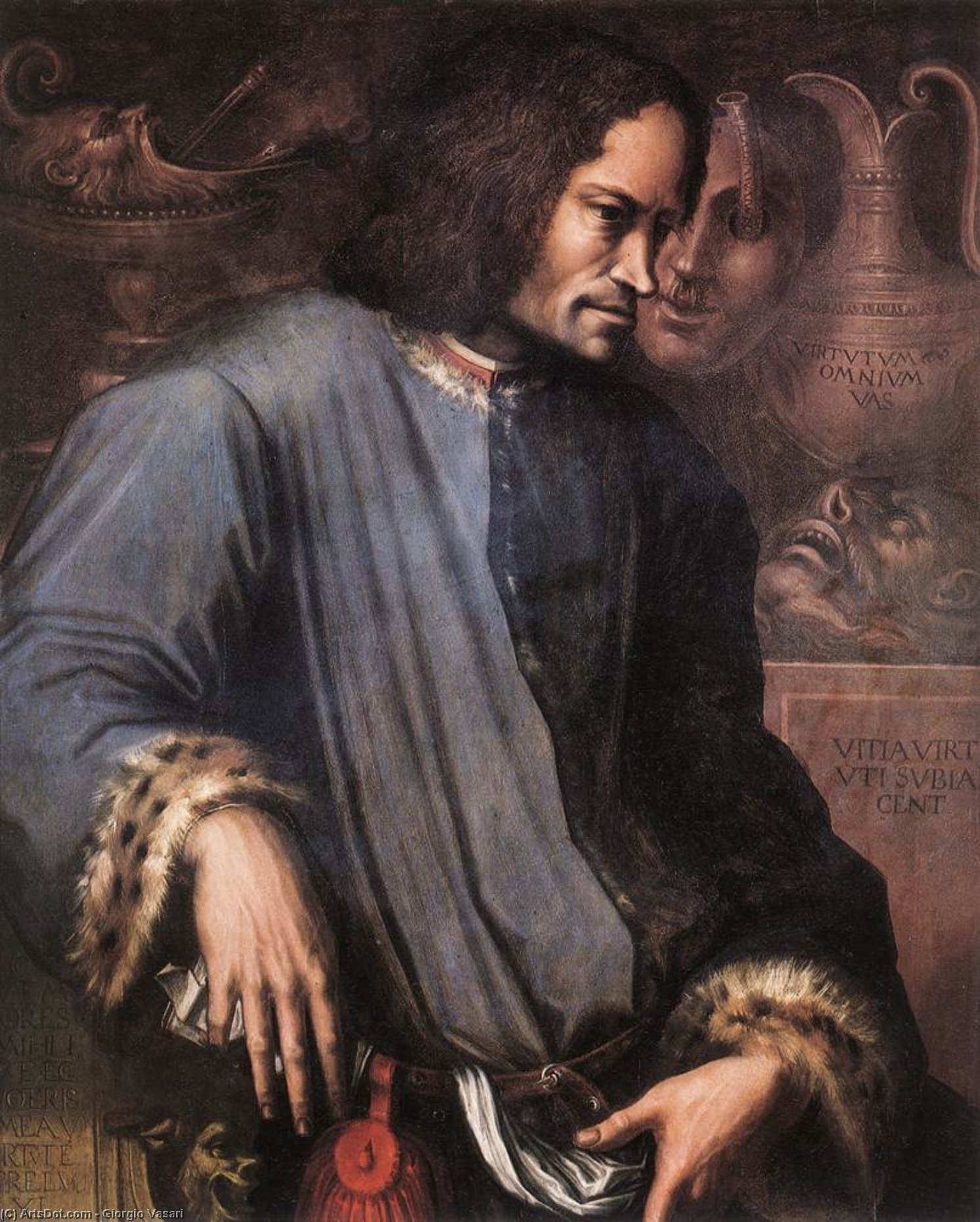
A Window into Renaissance Florence: Giorgio Vasari’s Portrait of Lorenzo de' Medici
Giorgio Vasari’s “Portrait of Lorenzo the Magnificent” isn’t merely a depiction of a man; it’s a meticulously crafted emblem of Florentine grandeur and humanist ideals during the High Renaissance. Commissioned by Alessandro de’ Medici, grandson of Lorenzo, this oil-on-wood painting transcends simple representation, serving as both a commemoration of Lorenzo’s illustrious lineage and an assertion of Medici power after a turbulent republican period.
Vasari, himself a prolific architect and historian, approached the task with characteristic precision. He captured Lorenzo's face with solemn dignity, directing his gaze slightly to his left – a subtle gesture that speaks volumes about composure and thoughtfulness. The artist’s masterful use of chiaroscuro illuminates Lorenzo’s features, emphasizing the contours of his brow and highlighting the seriousness etched upon his countenance.
Style & Technique: Vasari's Mannerist Influence
Vasari’s style firmly anchors itself within the Mannerist movement, a reaction against the idealized beauty championed by Raphael and Michelangelo. Unlike those artists who sought harmony and balance, Vasari embraced complexity and dramatic contrasts—a hallmark of Mannerism—creating an image imbued with palpable tension. The artist skillfully employs layering techniques to achieve depth and texture, particularly evident in Lorenzo’s robe and fur trim.
Symbolism & Context: Echoes of Classical Antiquity
The painting's background is a deliberate invocation of classical motifs—a vase and a mask—reflecting the humanist fascination with Greco-Roman culture prevalent during Vasari’s time. These symbols represent wisdom, beauty, and theatrical performance, respectively, aligning perfectly with Lorenzo’s role as patron of the arts and intellectual pursuits. The Latin inscriptions “VITA VIRTVS” (“Life Virtue”) and “VIITAE VIRTVS” (“Life Virtue”), positioned prominently at the top and bottom of the canvas, underscore this thematic preoccupation.
A Legacy Preserved: Galleria degli Uffizi & Artistic Significance
Currently housed in the Galleria degli Uffizi in Florence—one of Italy’s most revered art museums—this portrait stands as a testament to Vasari's artistic genius and the enduring allure of Renaissance portraiture. It exemplifies the meticulous attention to detail, psychological insight, and symbolic richness that defined the era, securing its place as an iconic masterpiece within the canon of Western art history.
- Artist: Giorgio Vasari (1511-1574)
- Medium: Oil on Wood
- Size: 90 x 72 cm
- Location: Galleria degli Uffizi, Florence