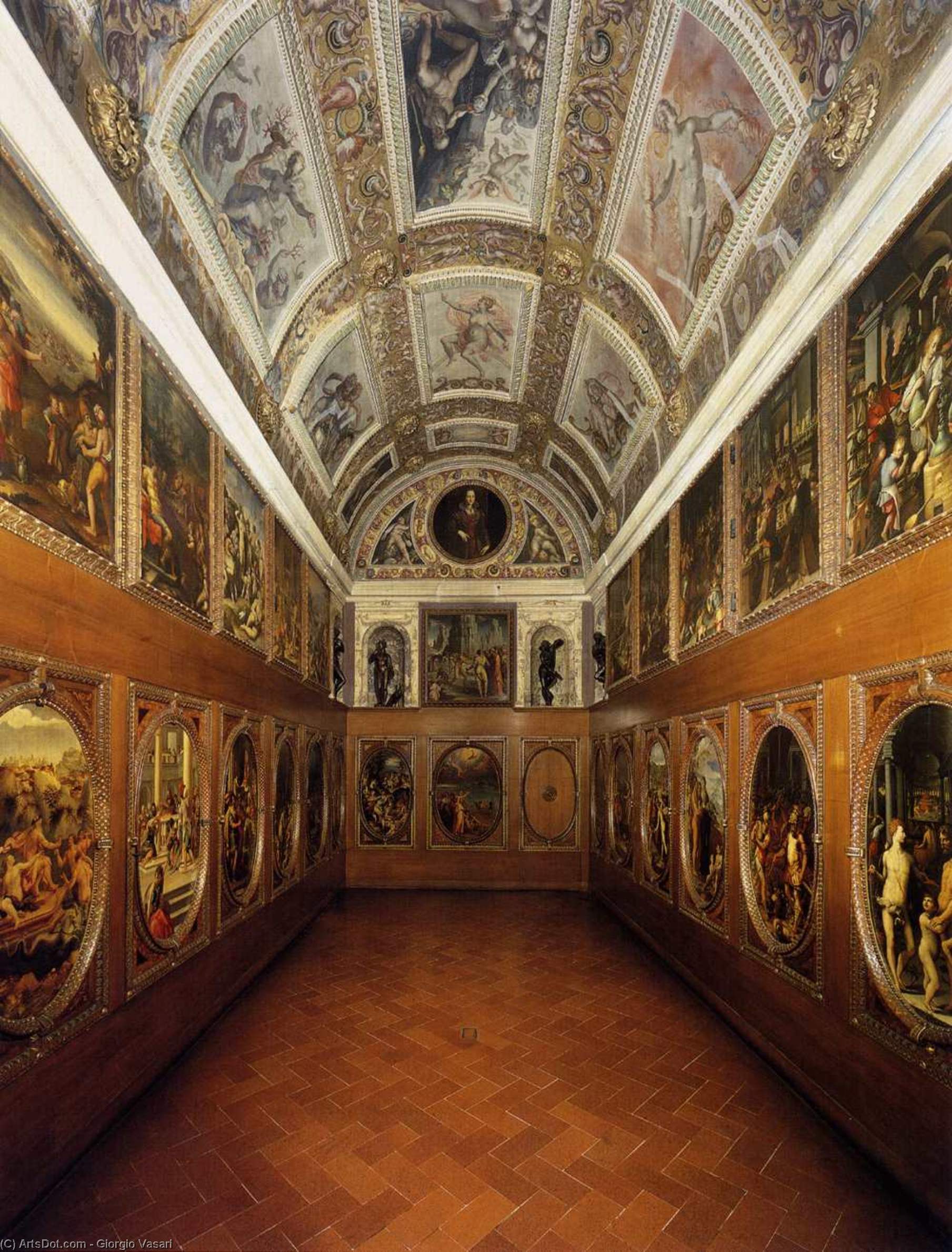
Giorgio Vasari’s ‘View of the Studiolo,’ a breathtaking 1570 fresco depicting Prometheus stealing fire, showcases Renaissance artistry and humanist ideals within Palazzo Vecchio. Admire this masterful tempera on slate artwork and discover its profound symbolism – a timeless piece to own.
Giorgio Vasari (1511-1574): Italian Renaissance painter, architect & art historian. Author of 'Lives of Artists,' a cornerstone of art history, and designer of the Uffizi Gallery.
Explore Palazzo Vecchio, Florence’s historic town hall! Discover its stunning art, political history & Renaissance secrets within the Uffizi Museum. A must-see landmark!
View of the Studiolo by VASARI, Giorgio
Giorgio Vasari’s “View of the Studiolo” stands as an emblem of Renaissance intellectual curiosity and artistic patronage—a testament to Francesco I de' Medici’s ambition to embody the ideals of humanist learning within a meticulously crafted microcosm. Painted in 1570, this monumental fresco dominates the interior space of Palazzo Vecchio, Florence, offering viewers a glimpse into a world where art served as both reflection and catalyst for scientific inquiry.
The Studiolo itself was conceived by Vincenzo Borghini, Vasari’s collaborator, reflecting the prevailing fascination with the cosmos and its underlying order. Borghini envisioned the room as mirroring the celestial sphere—a deliberate symbolic gesture intended to elevate Francesco’s intellectual pursuits and solidify his position as a champion of humanist ideals. The fresco embodies this concept perfectly.
Vasari skillfully employed tempera on slate, a technique favored by Florentine artists during the Renaissance for its luminosity and durability. He meticulously rendered Prometheus stealing fire from Zeus—a mythological allusion to humankind’s capacity for innovation and transformation—against a backdrop of swirling celestial bodies. The composition is balanced and harmonious, reflecting Borghini's desire to create an aesthetically pleasing space that simultaneously conveyed intellectual grandeur.
The fresco’s symbolism extends beyond its immediate narrative. Each element—the Prometheus figure, the radiant fire, the constellations—represents a facet of humanist thought: observation, experimentation, and the pursuit of knowledge. Vasari's masterful execution captures not only the visual beauty of the Studiolo but also its profound philosophical significance.
“View of the Studiolo” continues to inspire admiration for its artistic merit and intellectual depth. Its enduring appeal lies in its ability to transport viewers back to a pivotal moment in European history—a time when art and science converged to illuminate the human condition. It serves as an unforgettable reminder of the Renaissance spirit’s unwavering belief in the power of reason and imagination.