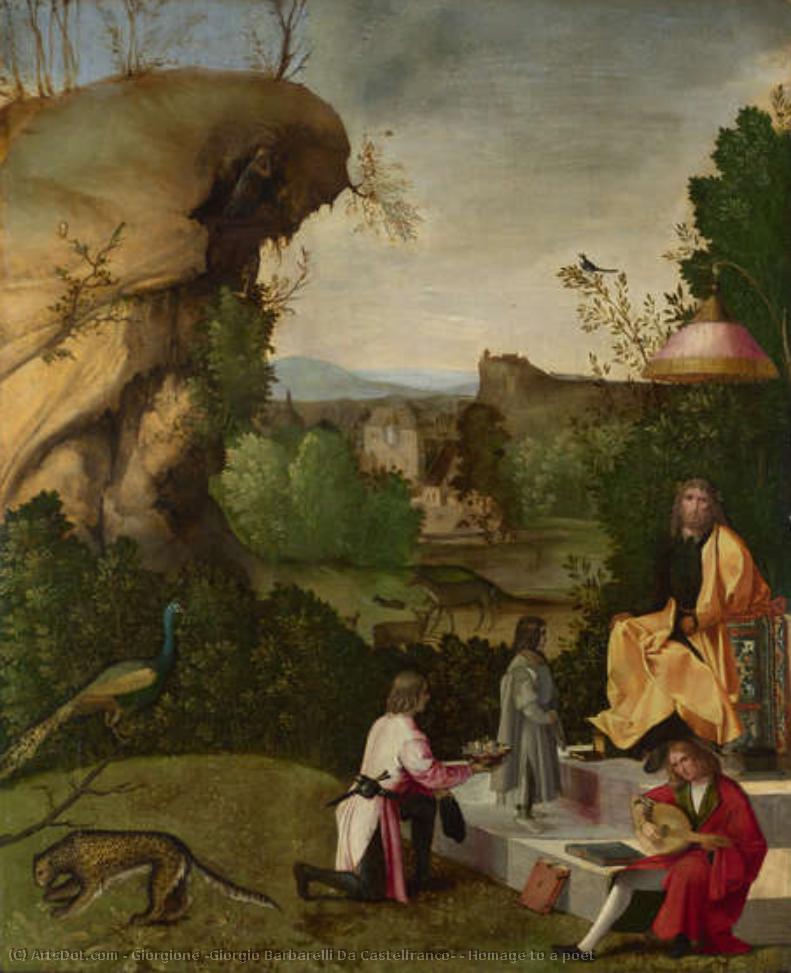
Admire Giorgione's 'Homage to a Poet,' a Venetian masterpiece exploring themes of contemplation and artistic inspiration. Discover its symbolism, influences & legacy through this detailed reproduction.
A Venetian Reverie: Decoding Giorgione’s Enigmatic Masterpiece
Giorgione's "Homage to a Poet," painted sometime around 1500, remains one of the most debated and cherished works within the Venetian Renaissance. More than just a beautiful depiction of a tranquil landscape—a verdant expanse dotted with flowering meadows and rocky outcrops—it’s an invitation into a complex tapestry of philosophical contemplation and artistic allusion. The painting's allure stems from its deliberate ambiguity, prompting scholars to wrestle with interpretations ranging from Aristotle’s musings on virtue to the biblical tale of Joseph and Pharaoh’s dream. This captivating puzzle is further deepened by Giorgione’s masterful technique: he employs a luminous palette—dominated by muted greens and golds—and utilizes sfumato, a blurring effect that softens contours and creates an ethereal atmosphere characteristic of Venetian painting during this period.
- Composition & Setting: The scene unfolds on a stone bench beneath the shade of a parasol, establishing a sense of stillness and seclusion. A young man plays the lute while another sits beside him, engaged in conversation—figures rendered with remarkable realism despite their stylized poses. The inclusion of animals – a leopard licking its paw and a peacock perched atop a barren branch – adds layers of symbolic significance, representing strength and immortality respectively.
- Symbolism & Allegory: Beyond the immediate visual elements, “Homage to a Poet” is rife with references to classical philosophy and mythology. The presence of Saturn—often depicted devouring his children—suggests themes of exile and regret, mirroring the artist’s own uncertain fate. Furthermore, the meticulous arrangement of books symbolizes knowledge and intellectual pursuit, aligning perfectly with the painting's title.
- Technique & Style: Giorgione’s mastery is evident in his subtle blending of colors—a hallmark of sfumato—which imbues the landscape with an otherworldly glow. The artist meticulously captures the textures of stone, foliage, and fabric, demonstrating a profound understanding of artistic craftmanship. Notably, he drew inspiration from Albrecht Dürer's engraving "The Prodigal Son," incorporating elements of composition and perspective into his work.
- Historical Context: Created during Venice’s Golden Age—a period marked by flourishing art patronage and intellectual ferment—the painting reflects the humanist ideals prevalent at the time. It speaks to a broader conversation about morality, wisdom, and the pursuit of beauty – themes that resonated deeply with Venetian society.
Provenance & Recognition: The artwork’s journey began in Cardinal Pietro Aldobrandini's collection in Rome around 1603, where it was meticulously documented as “a picture on panel with a poet crowned with laurel with three other figures, a tiger, and a peacock.” Its arrival at the National Gallery solidified its place among Venice’s artistic treasures.
Conclusion: Giorgione's "Homage to a Poet" transcends mere visual representation; it embodies an enduring spirit of contemplation and artistic innovation. Reproductions offer a chance to experience this captivating vision, allowing viewers to appreciate the brilliance of Venetian Renaissance art and its continuing relevance in our own time.