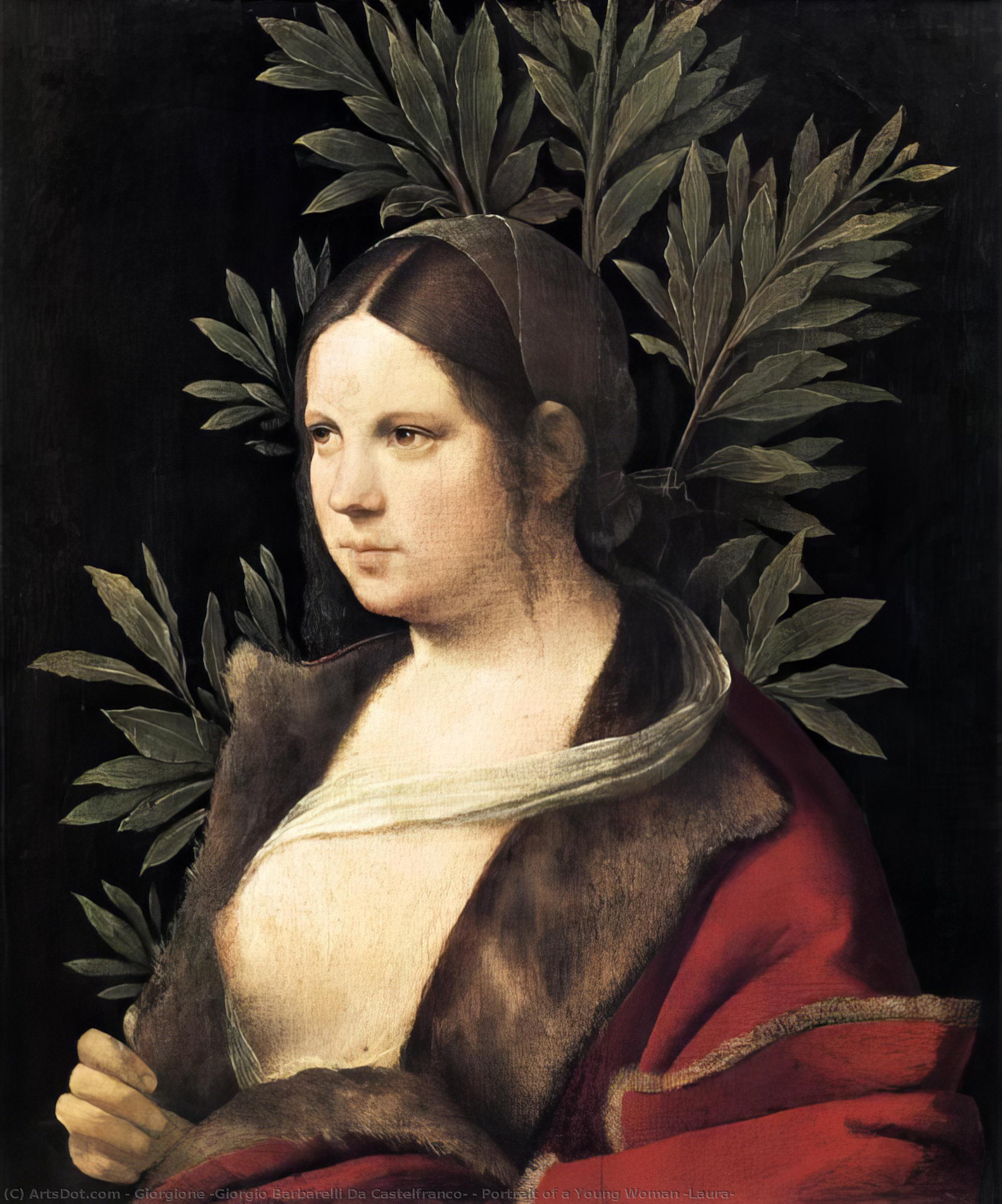
Portrait of a Young Woman (Laura): A Venetian Renaissance Enigma
- Artist: Giorgione (Giorgio Barbarelli Da Castelfranco)
- Date: c. 1505
- Medium: Oil on canvas
- Dimensions: Unknown
- Location: Musée du Louvre, Paris
A Glimpse into High Renaissance Venice
The "Portrait of a Young Woman (Laura)" stands as a captivating example of Venetian painting during the High Renaissance. Attributed to Giorgione, this oil painting embodies the era's shift towards lyrical beauty and atmospheric depth. Unlike the linear precision favored in Florence, Venetian art prioritized color, light, and emotional resonance. This work exemplifies that style, showcasing a young woman rendered with soft contours and an almost dreamlike quality. The portrait’s enigmatic nature has captivated viewers for centuries, fueling speculation about the sitter's identity and the artist's intentions. While often referred to as "Laura," the true name of the subject remains uncertain, adding to the painting's mystique. Initially, the artwork was altered into an oval shape before being restored to its original rectangular format, revealing a composition that originally extended below the waist, creating a sense of distance characteristic of Giorgione’s style.
Visual Elements and Artistic Technique
The portrait depicts a young woman adorned in a luxurious red dress with a fur collar, her long hair flowing gracefully around her shoulders. A leafy plant, possibly a laurel branch, adorns her head, while she holds a similar branch in her hand. The artist masterfully uses color to create depth and visual interest. The rich red of the dress contrasts beautifully with the muted background, drawing attention to the figure. The laurel branches, meticulously rendered, are silhouetted against a neutral gray-green halo of leaves, isolating the subject and creating a sense of ethereal beauty. This technique echoes Leonardo da Vinci's approach in "Ginevra de' Benci," demonstrating Giorgione’s awareness of and adaptation from Florentine innovations. The softening of contours, influenced by Leonardo, contributes to the painting's overall softness and dreamlike quality. Giorgione’s use of oil paint allowed for subtle gradations of tone and a luminous effect that was revolutionary at the time.
Symbolism and Interpretation
The laurel branch held by the young woman carries significant symbolic weight. In classical antiquity, laurel represented victory, honor, and immortality. Its presence in the portrait suggests a possible connection to virtue or achievement, though its precise meaning remains open to interpretation. The unspecific nature of the subject’s expression further enhances the painting's enigmatic quality. Is she contemplating something profound? Or simply presenting herself with quiet dignity? The lack of overt narrative allows viewers to project their own interpretations onto the image, contributing to its enduring appeal. The red dress itself could symbolize passion or status, while the overall composition—a pyramidal structure with the woman’s body forming the base—creates a sense of stability and balance.
Giorgione's Legacy and Venetian Painting
"Portrait of a Young Woman (Laura)" is a quintessential example of *colorito*, the hallmark style of Venetian painting during the Renaissance. Giorgione, along with Titian, pioneered this approach, emphasizing color harmony and atmospheric effects over strict adherence to linear perspective. His work profoundly influenced subsequent generations of Venetian artists, shaping the course of Western art history. The portrait’s enduring appeal lies not only in its technical brilliance but also in its ability to evoke a sense of mystery and timeless beauty. For those interested in exploring more works by Giorgione, visit ArtsDot.com. To delve deeper into the world of Western painting and its evolution, refer to Wikipedia's article on Western Painting. Discover the Venetian Painting Art Movement on ArtsDot.com for a detailed look at this influential school.