Explore Giorgione’s ‘Tempest,’ a haunting Renaissance masterpiece of Venetian mystery & atmosphere. Discover its sfumato technique & profound emotional resonance.
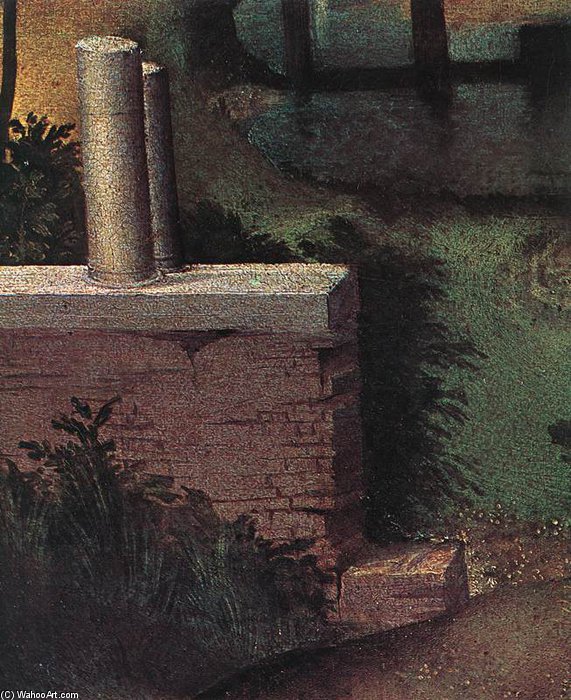
A serene forest scene unfolds before you, illuminated by dappled sunlight and dominated by a weathered stone wall adorned with two majestic pillars. A simple bench invites contemplation amidst the tranquil beauty.
The Enigma of Giorgione’s Tempest
Giorgio Barbarelli da Castelfranco – Giorgione – remains one of the most captivating and frustrating figures in Renaissance art, an artist whose legacy is as profound as his biography is elusive. Born around 1470 or 1478 in Castelfranco Veneto, near Venice, Giorgione’s tragically brief life ended in 1510 at just thirty-two or thirty-three, leaving behind a handful of paintings that continue to inspire debate and speculation about their meaning. Giorgio Vasari's Lives of the Most Excellent Painters offers scant detail on his personal life, portraying him as a man of remarkable charm and intellect – a lover of music, poetry, and humanist philosophy – whose artistic vision captured the sensual beauty and melancholic spirit of Venetian culture during its golden age.
- Early Apprenticeship: Evidence suggests Giorgione began his artistic training under Giovanni Bellini in Venice, absorbing the established traditions of Venetian painting before forging his own distinctive style.
- Venetian Patronage: He quickly gained recognition for his talent and was commissioned to paint portraits of prominent figures – including the Doge Agostino Barbarigo and Matteo Costanzo – securing lucrative commissions that propelled him to prominence within Venice’s artistic elite.
A Revolutionary Palette: The Style of Giorgione
Giorgione's stylistic innovations stand apart from those of his contemporaries, particularly Florentine painters like Leonardo da Vinci. Unlike the linear disegno-led approach favored by Leonardo, Giorgione embraced sfumato – a technique pioneered by Bellini and perfected by Titian – characterized by subtle gradations of tone and color that create an atmospheric haze and imbue the painting with an ethereal quality. This masterful manipulation of light and shadow contributes to the profound emotional resonance of his works, conveying moods of contemplation and mystery rather than depicting explicit narratives. His canvases are imbued with a sense of poetic melancholy, reflecting the humanist sensibilities prevalent in Venice during the High Renaissance.
The Tempest: Symbolism and Atmosphere
Perhaps Giorgione’s most celebrated painting, “The Tempest,” exemplifies his artistic genius. Executed sometime between 1505 and 1508, this monumental altarpiece depicts a serene forest scene dominated by a weathered stone wall adorned with two pillars. A solitary bench sits beneath the trees, inviting viewers to contemplate the stillness of the landscape. The painting’s muted palette – predominantly greens, browns, and ochres – reinforces its atmospheric mood, creating an illusion of depth and suggesting the passage of time. Critics have interpreted the image as a meditation on mortality and regeneration, reflecting the Renaissance preoccupation with classical ideas about cyclical renewal. The stormy sky looming in the background serves as a powerful symbol of inner turmoil juxtaposed against outward tranquility—a visual representation of the complexities of human experience.
Legacy and Influence
Giorgione’s impact on Venetian painting – and indeed, on European art history – is undeniable. He established alongside Titian the Venetian school of Italian Renaissance painting, shaping its distinctive aesthetic qualities for decades to come. His innovative use of color and sfumato profoundly influenced subsequent generations of artists, fostering a tradition of painterly exploration that prioritized mood and atmosphere over precise representation. Despite the scarcity of surviving paintings and the ongoing debate surrounding their interpretation, Giorgione’s “Tempest” – and his other works – continue to captivate audiences worldwide, cementing his place as one of the most enduring symbols of Venetian artistic brilliance and Renaissance poetic imagination.