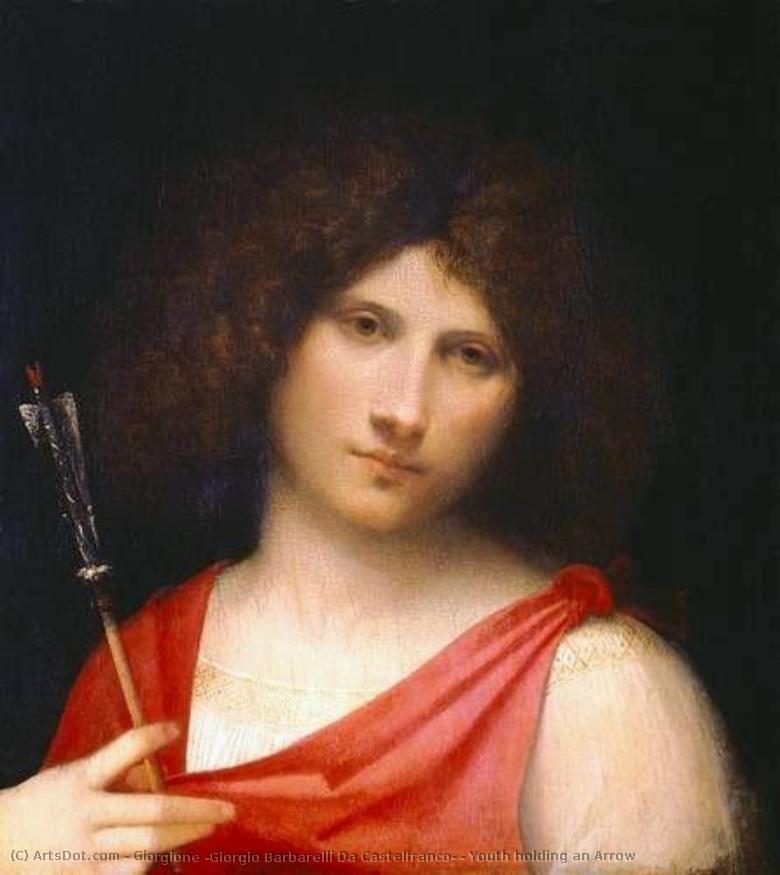
A Portrait of Contemplation: Giorgione’s ‘Youth Holding an Arrow’
Giorgio Barbarelli da Castelfranco, known universally as Giorgione, remains a figure shrouded in artistic enigma—a master whose brief but brilliant career defied easy categorization and cemented his place among the titans of Renaissance painting. Born around 1477 or 1478 in Castel Franco Veneto, near Venice, his life tragically curtailed by illness at just thirty-two or thirty-three, yielded an oeuvre remarkably sparse yet profoundly influential. Unlike many artists of his era whose biographies are painstakingly documented, Giorgione’s story unfolds from fragments—the astute observations of Giorgio Vasari, coupled with scholarly speculation—suggesting a man deeply rooted in the vibrant intellectual and artistic currents of Venetian society. He honed his craft under Giovanni Bellini, Venice's foremost painter, absorbing the established traditions before embarking on an independent trajectory marked by innovation and a singular sensitivity to beauty. This formative apprenticeship instilled within him a profound understanding of perspective and color theory—elements that would become hallmarks of his distinctive style.
- Subject Matter: The painting depicts a young man—likely idealized—holding an arrow in his right hand, gazing intently at the viewer with a solemn expression. Two additional figures stand behind him, adding depth to the composition and hinting at a narrative beyond mere portraiture.
- Style: Giorgione’s work embodies the High Renaissance aesthetic, prioritizing harmony, balance, and psychological realism. It eschews dramatic gestures or overtly emotive poses, favoring instead a quiet contemplation that invites viewers into the inner life of the subject.
Technique and Artistic Innovation – The Power of Sfumato
Giorgione’s mastery lay not merely in capturing likeness but in achieving an ethereal quality—a technique he termed “sfumato,” derived from the Italian word for smoke. This revolutionary approach involved layering translucent glazes over pigment, creating subtle gradations of tone and color that blurred outlines and softened contours. Unlike earlier artists who sought to render forms with sharp precision, Giorgione prioritized atmospheric perspective, conveying a sense of depth and luminosity that surpassed anything seen before. The meticulous brushwork—almost invisible to the naked eye—allowed him to capture not just what was visible but also what *felt* like it—a feat achieved through painstaking observation and artistic intuition. This technique is particularly evident in the rendering of the drapery, which appears to shimmer with an inner radiance, contributing significantly to the painting’s overall mood.
- Material: The artwork was executed on wood panel using oil paint – a medium favored by Venetian artists during this period for its ability to produce rich colors and durable surfaces.
- Color Palette: Giorgione employed a restrained palette dominated by muted reds, browns, and greens—colors that evoke the Tuscan landscape and imbue the scene with an air of serenity and melancholy.
Historical Context and Symbolic Resonance
Painted around 1505 during the zenith of Venetian artistic achievement, ‘Youth Holding an Arrow’ reflects the humanist ideals prevalent at the time—a fascination with human psychology and a belief in the power of beauty to elevate the soul. The arrow itself is laden with symbolic significance; it represents courage, precision, and aspiration – qualities attributed to young men embarking on their journey toward maturity. Simultaneously, the darkened background serves as a foil to the luminous figure, emphasizing his presence and inviting contemplation about inner reflection and moral fortitude. Giorgione’s work aligns seamlessly with the broader artistic movement of its time, demonstrating an unwavering commitment to capturing not just visual reality but also emotional truth—a legacy that continues to inspire artists and collectors alike.
Emotional Impact – A Moment Frozen in Time
Ultimately, ‘Youth Holding an Arrow’ transcends mere representation; it communicates a profound sense of stillness and introspection. The young man's gaze directs the viewer inward, prompting reflection on themes of vulnerability, resolve, and the pursuit of wisdom. Giorgione’s masterful use of sfumato creates an atmosphere of quiet contemplation—a testament to his ability to convey complex emotions through subtle visual cues. It is a painting that lingers in the memory long after viewing, reminding us of the enduring power of art to illuminate the human condition and capture fleeting moments of beauty and grace.