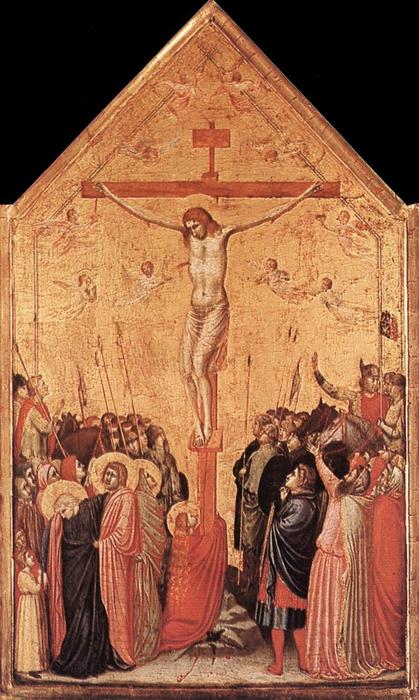
Giotto Di Bondone: Crucifixion – A Pioneering Vision of Grief
The Crucifixion by Giotto Di Bondone stands as a cornerstone of Proto-Renaissance art, marking a decisive break from Byzantine conventions and establishing a new standard for emotional realism. Created around 1335 in Padua, Italy, this monumental fresco resides within the Cappella degli Scrovegni—a testament to Giotto’s enduring influence on Western artistic tradition. Its profound depiction of Christ's suffering continues to resonate with viewers centuries later, captivating audiences with its masterful composition and emotive portrayal of human experience.
Composition and Spatial Depth
Giotto revolutionized painting by introducing a groundbreaking concept: spatial depth—a technique previously absent in Byzantine art. Unlike the flattened surfaces characteristic of earlier religious iconography, Giotto’s Crucifixion achieves an astonishing sense of perspective, drawing viewers into the scene with remarkable accuracy. The central crucifix dominates the composition, positioned prominently within a shallow architectural space that mimics the contours of the chapel itself. This innovative approach dramatically enhances the impact of the artwork, conveying not merely what is seen but how it feels to be present in this moment of profound sorrow.
Symbolism and Emotional Expression
The painting’s symbolism is layered and deeply evocative. The crucifix itself serves as a focal point for contemplation, representing Christ's sacrifice and embodying Christian faith. Surrounding him are figures conveying a spectrum of emotions—despair, compassion, grief—captured with breathtaking sensitivity. Giotto skillfully utilizes facial expressions and body language to communicate these sentiments, demonstrating an unprecedented level of psychological insight. Notably, the inclusion of two birds – one perched on Christ’s shoulder and another hovering above – adds a subtle yet significant element of symbolism. Traditionally interpreted as representing the Holy Spirit and divine compassion, they underscore the spiritual significance of the scene.
Technique: Tempera on Wood
Giotto's masterful execution is achieved through tempera paint applied to wooden panels—a technique that distinguishes him from his Byzantine predecessors. Tempera involves mixing pigment with egg yolk, resulting in durable, luminous colors and remarkable detail. Giotto’s meticulous attention to texture and shading imbues the figures with palpable physicality, conveying a sense of immediacy and realism unparalleled at the time. The subtle gradations of color—particularly evident in the drapery—create an illusion of three-dimensionality that contributes significantly to the painting's emotional impact.
Historical Context and Legacy
The Crucifixion exemplifies Giotto’s role as a pivotal figure in transitioning art from Byzantine formalism towards Renaissance humanism. Prior to Giotto, religious art largely adhered to stylized conventions prioritizing spiritual contemplation over naturalistic representation. Giotto’s daring innovation—his embrace of spatial depth and emotional realism—challenged established artistic norms and paved the way for subsequent generations of artists. Its influence extends far beyond Padua, shaping the visual language of European painting for centuries to come. The Crucifixion remains a powerful reminder of Giotto's genius and his enduring contribution to Western art history.
Reproductions Available at ArtsDot.com
For those who wish to experience the beauty and depth of this masterpiece firsthand, ArtsDot.com offers exceptional high-quality oil painting reproductions. Visit
Giotto Di Bondone: Crucifixion to explore the intricate details and acquire a stunning replica of Giotto’s iconic artwork.
Other Works by Giotto Di Bondone
These works demonstrate Giotto’s consistent ability to evoke profound emotions through his art—a testament to his enduring legacy as one of the most influential painters in European history.
Discover More About Giotto Di Bondone
Discover the Staatliche Museen zu Berlin, Germany