A Beacon of Hope in a Time of Turmoil
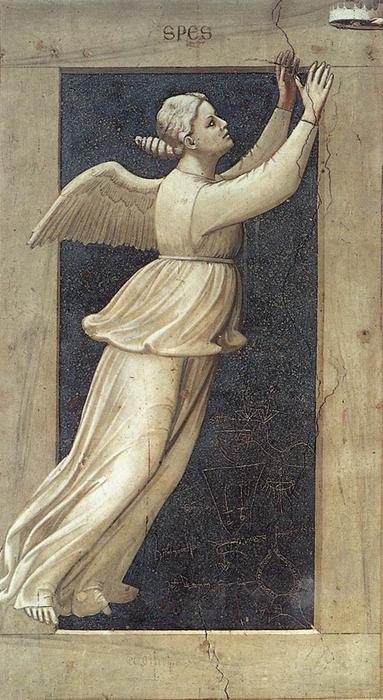
Giotto di Bondone’s “No. 46 The Seven Virtues: Hope,” created in 1306 as part of the breathtaking fresco cycle within the
Cappella Scrovegni (Arena Chapel) in Padua, Italy, is far more than a religious depiction; it's a poignant exploration of the human spirit’s resilience. This artwork stands as a pivotal moment in art history, marking a departure from the stylized Byzantine tradition and ushering in the dawn of the Renaissance.
Decoding the Image: A Woman Ascending
The painting presents a solitary female figure, wings unfurled, reaching upwards towards a dimly lit sky. Her posture is not one of serene ascension but rather conveys struggle – a sense of striving against an unseen force. This isn’t a triumphant angel; it's a representation of *Hope* as an active virtue, requiring effort and perseverance in the face of adversity. The muted color palette—dominated by blues, grays, and earthy tones—enhances the somber mood, while subtle modeling gives form to her body and drapery. The simplicity of the background focuses all attention on the figure and her emotional state.
Giotto’s Revolutionary Technique
Executed in fresco – a technique involving painting directly onto wet plaster – “Hope” demonstrates Giotto's mastery of this demanding medium. He moved away from the flat, gilded representations common in Byzantine art, instead employing
chiaroscuro (the use of light and shadow) to create a sense of volume and depth. While perspective is still developing at this stage, Giotto’s figures possess a newfound naturalism and emotional weight that was revolutionary for his time. His ability to convey psychological realism through gesture and expression set him apart from his contemporaries.
Historical & Religious Context
The Cappella Scrovegni itself is steeped in history. Commissioned by Enrico Scrovegni, a wealthy Paduan merchant, the chapel was intended as an act of atonement for his family’s usury practices – a sin heavily condemned by the Church. Giotto's frescoes depict scenes from the lives of Mary and Christ, alongside allegorical representations of virtues and vices. “Hope” is part of a series representing the seven cardinal virtues, serving as moral exemplars for viewers. The placement within the chapel was deliberate, intended to inspire piety and offer solace.
Symbolism & Interpretation
The symbolism in "Hope" is layered. Wings traditionally represent angelic beings and spiritual aspiration. However, the figure’s strained pose suggests that hope isn't passively received but actively pursued. The upward gaze signifies a yearning for divine intervention or a better future. Some interpretations suggest she may be reaching towards a symbolic flame – representing faith or enlightenment. The overall message is one of enduring strength in the face of hardship, a theme resonant across centuries.
Emotional Resonance & Lasting Legacy
“No. 46 The Seven Virtues: Hope” evokes a powerful emotional response. It’s not a saccharine depiction of optimism but rather a realistic portrayal of the struggle to maintain faith and courage during difficult times. This honesty is what makes Giotto's work so enduringly relevant. He laid the groundwork for future Renaissance masters like Masaccio, Michelangelo, and Raphael, influencing generations of artists with his commitment to naturalism, emotional depth, and innovative technique. This piece continues to inspire viewers today, offering a timeless message of resilience and the power of hope.
Collecting & Interior Design
A high-quality reproduction of “Hope” can serve as a powerful focal point in any space. Its muted tones lend themselves well to both traditional and contemporary interiors. Consider pairing it with neutral color palettes to allow the artwork’s emotional weight to take center stage. Its themes of perseverance and faith make it particularly suitable for contemplative spaces like libraries, studies, or meditation rooms. The painting's historical significance also adds a layer of intellectual depth to any collection.
- Style: Proto-Renaissance, Early Italian
- Technique: Fresco
- Dimensions: 120 x 60 cm
- Location: Cappella Scrovegni (Arena Chapel), Padua, Italy