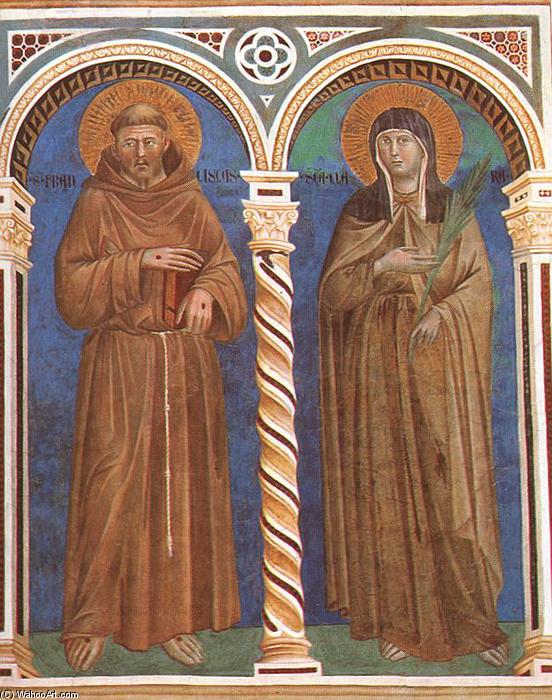
Saint Francis and Saint Clare: A Window into Early Renaissance Faith
Giotto di Bondone’s “Saint Francis and Saint Clare,” painted in 1279, isn't merely a depiction of two revered figures; it’s a profound meditation on faith, humility, and the burgeoning spirit of the early Italian Renaissance. Housed within the Cappella Scrovegni in Padua—a chapel commissioned by Enrico Scrovegni as an act of penance—this fresco transcends its physical setting to offer a glimpse into the evolving artistic and spiritual landscape of 13th-century Europe. Giotto, already recognized for his revolutionary approach to portraying human emotion and spatial depth, masterfully utilizes light, shadow, and composition to create a scene brimming with both serenity and quiet intensity.
The painting immediately draws the eye to the central figures: Saint Francis, radiating an almost childlike innocence, and Saint Clare, embodying a dignified composure. Giotto’s genius lies in his ability to imbue these religious icons with palpable humanity. They aren't idealized representations of saints; instead, they are presented as individuals experiencing a shared moment of contemplation. Notice how Giotto subtly shifts the weight of the scene – Francis leans slightly forward, engaging directly with Clare, while Clare maintains a more formal stance, suggesting a quiet reverence. The figures’ gestures—a gentle hand extended by Francis, a receptive posture from Clare—speak volumes about their connection and mutual respect.
Beyond the central pair, Giotto skillfully employs a series of smaller figures to enrich the narrative context. These aren't mere decorative elements; they represent the diverse community surrounding the saints – monks, laypeople, and even animals, reflecting Francis’s deep commitment to all living creatures. The architectural backdrop—a building with imposing columns—provides a sense of grounding and stability, anchoring the scene within a recognizable earthly realm while simultaneously hinting at the spiritual significance of the event. The use of perspective, though nascent in Giotto's style, is remarkably effective in creating an illusion of depth, drawing the viewer into the heart of the fresco.
The Cappella Scrovegni: A Chapel of Redemption
To fully appreciate “Saint Francis and Saint Clare,” it’s crucial to understand the context within which it was created – the Cappella Scrovegni. Commissioned by Enrico Scrovegni, a wealthy cloth merchant, the chapel served as a powerful symbol of atonement for his family's sins. Scrovegni, burdened by guilt and a troubled past, sought to cleanse his conscience through an act of profound generosity: he funded a magnificent artistic project dedicated to the Virgin Mary and Christ. Giotto’s frescoes, including this pivotal scene with Francis and Clare, transformed the chapel into a sacred space—a testament to faith, repentance, and the transformative power of art.
The chapel itself is a remarkable architectural achievement, built between 1303 and 1305. Its austere exterior contrasts sharply with the vibrant, emotionally charged frescoes that adorn its walls. The Scrovegni Chapel represents a pivotal moment in artistic history—a bridge between the Gothic style of Giotto’s predecessors and the burgeoning realism of the Renaissance. Giotto's work here is considered a foundational element in the development of Western art, paving the way for generations of artists to come.
Key Elements & Artistic Techniques
Several key elements contribute to the painting’s enduring power. The figures are rendered with an unprecedented level of naturalism—their faces expressive, their bodies realistically proportioned. Giotto abandons the stylized, flattened forms characteristic of Byzantine art in favor of a more three-dimensional approach, capturing the essence of human emotion and movement. Notice how he uses subtle shifts in color and shading to create volume and depth, particularly in the drapery of the saints’ robes.
Furthermore, Giotto's masterful use of light is central to the painting's impact. The fresco employs a technique known as *buon umbra*, utilizing dark pigments to create deep shadows that enhance the sense of volume and drama. Light streams in from an unseen source, illuminating the figures and casting long shadows across the scene, creating a dynamic interplay of light and darkness. This careful manipulation of light not only adds visual interest but also serves to emphasize the spiritual significance of the event.
A Legacy of Emotional Realism
“Saint Francis and Saint Clare” stands as a testament to Giotto’s revolutionary approach to painting—a shift towards emotional realism that profoundly influenced the course of Western art. It's more than just a religious depiction; it’s a deeply human portrayal of faith, compassion, and mutual respect. The fresco invites viewers to contemplate the lives of these two extraordinary figures and to reflect on their enduring message of humility, service, and devotion. ArtsDot offers meticulously crafted hand-painted reproductions that faithfully capture the beauty and emotional depth of this iconic masterpiece, allowing you to bring its timeless spirit into your home or studio.