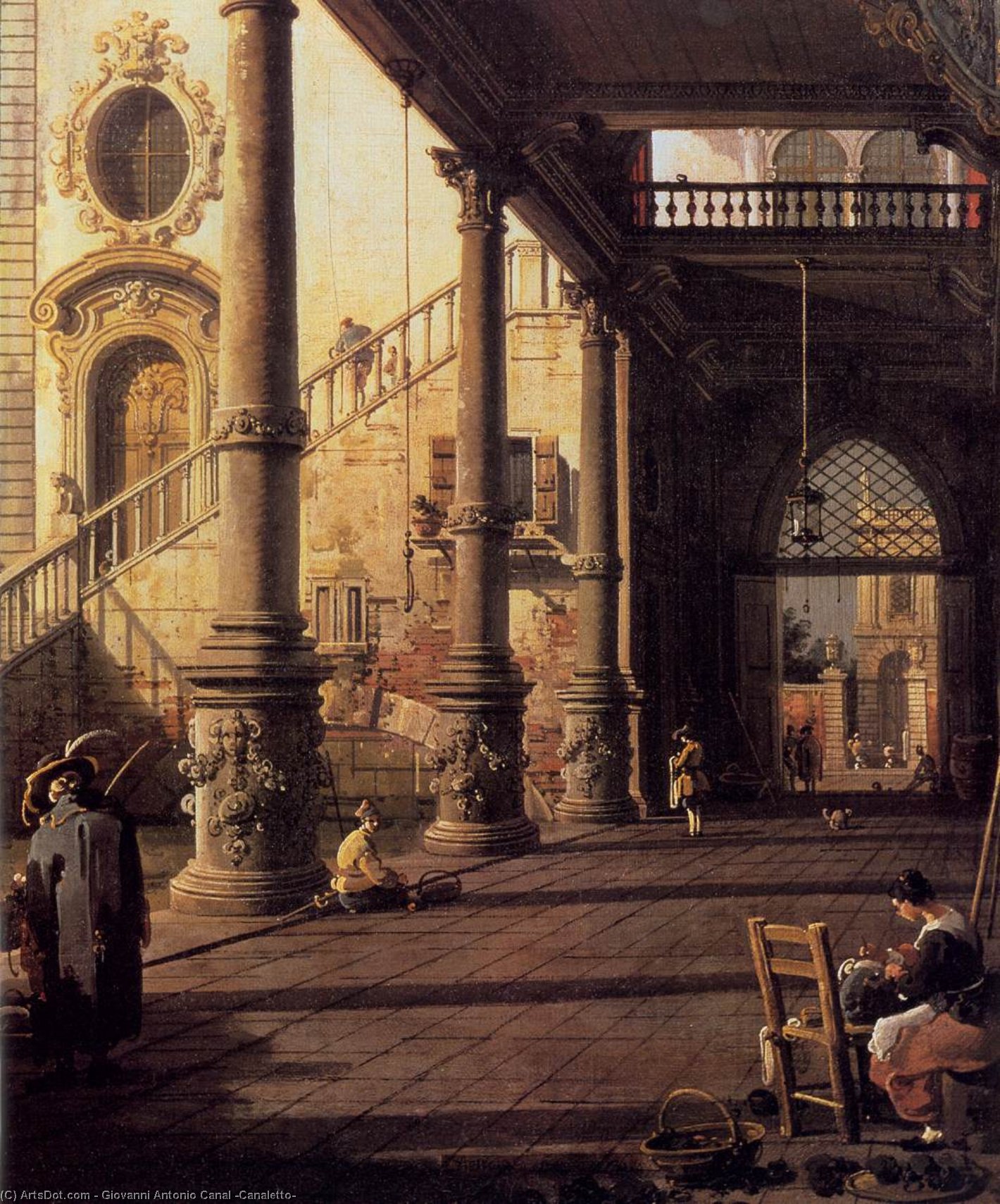
A Window Into Venetian Life: Canaletto’s Perspective View with Portico
Giovanni Antonio Canaletto, known universally as Canaletto, emerged from the vibrant artistic milieu of Venice in the mid-18th century, establishing himself as one of the foremost topographical painters of his era. Born in 1697 to Bernardo Canal and Artemisia Barbieri – a lineage steeped in artistic tradition – Canaletto’s formative years instilled within him an unwavering dedication to capturing the essence of urban landscapes with remarkable precision and evocative beauty. His journey began with apprenticeship under his father, honing foundational skills in theatrical scenery painting before venturing into Rome where he collaborated on opera productions, solidifying his understanding of composition and dramatic presentation.
Returning to Venice, Canaletto embarked upon a prolific artistic career characterized by his distinctive topographical style – a technique that would propel him to international acclaim. Unlike many artists of his time who prioritized idealized representations, Canaletto meticulously documented the realities of Venetian life, focusing on architectural grandeur alongside everyday scenes of commerce and social interaction. This commitment to realism was underpinned by masterful brushwork and a profound grasp of perspective, creating images that transported viewers directly into the heart of the city.
Notable amongst his achievements were monumental canvases depicting iconic locations such as The Stonemason’s Yard (circa 1725), which showcased Canaletto's early talent and demonstrated his ability to convey atmosphere with subtle tonal variations. Equally captivating was Regatta on the Grand Canal, a vibrant portrayal of Venetian ceremonial processions—a testament to Canaletto’s skill in capturing movement and conveying the dynamism of public life. His commissions extended beyond Venice, notably including Eton College (1746-1756), where he meticulously rendered the collegiate campus with painstaking detail, cementing his reputation as an artist capable of transporting viewers across geographical boundaries.
The influence of Canaletto’s work resonated deeply within the artistic circles of Europe, particularly England, where his paintings served as inspiration for architectural designs and interior decoration. His canvases weren't merely visual records; they functioned as conduits of cultural understanding, presenting Venice as a beacon of sophistication and artistic excellence. The artist’s meticulous attention to detail—the precise rendering of stonework, the subtle interplay of light and shadow—served not only to document the physical environment but also to convey an emotional resonance that captured the spirit of its time. Canaletto's legacy continues to inspire artists and collectors alike, reminding us of the power of art to illuminate history and elevate our perception of beauty.
- Style: Topographical
- Technique: Oil on canvas; meticulous brushwork; masterful perspective projection.
- Historical Context: Venetian Baroque; Enlightenment Era; Commissions from aristocratic patrons and educational institutions.
Source Image: WikiArt.org