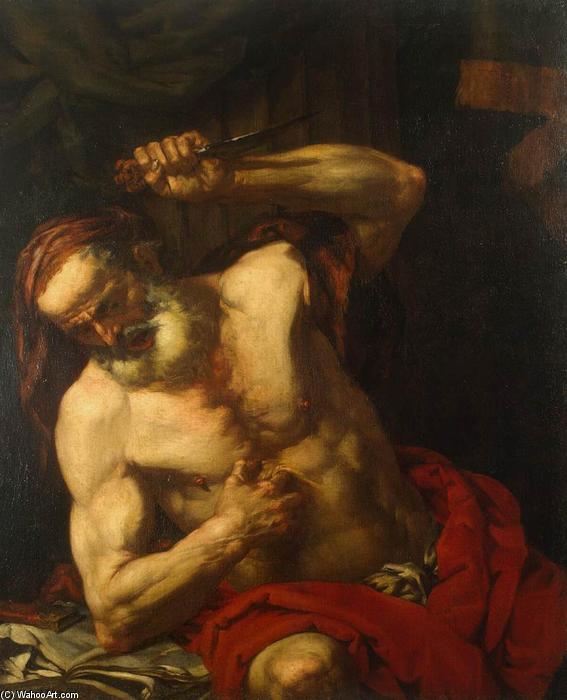
Giovanni Battista Langetti’s ‘Cato’ (1660) is a dramatic oil painting capturing Christ’s suffering. Intense realism, rich colors & masterful technique – a captivating Baroque artwork reflecting Venetian Caravaggismo.
Giovanni Battista Langetti (1625-1676) was a Venetian Baroque painter known for his Caravaggesque style & historical busts. Explore his works like 'Diogenes & Alexander' & 'Apollo & Marsyas'.
Explore the Hermitage Museum in St. Petersburg! Discover masterpieces from Renaissance to modern times within stunning historic palaces – a cultural journey awaits.
Giovanni Battista Langetti’s Dramatic Vision: An Exploration of ‘Cato’
Giovanni Battista Langetti (1635 – 22 October 1676) stands as a cornerstone of Venetian Baroque, embodying the visceral energy and theatrical grandeur championed by Caravaggesque painting while simultaneously cultivating his own distinctive artistic voice. Born in Genoa, Italy, Langetti’s formative years were steeped in the influence of masters like Assereto and Pietro da Cortona, absorbing stylistic precepts that would subsequently permeate his oeuvre—a testament to unwavering dedication to conveying profound emotion and executing masterful technique. His relocation to Venice marked a pivotal moment, establishing him as an integral participant within a burgeoning artistic landscape characterized by innovation and expressive fervor.
The Subject Matter: A Moment of Intense Suffering
‘Cato,’ painted in 1660, depicts Christ’s agonizing torment during his crucifixion—a scene meticulously rendered with unflinching realism that aligns squarely with Langetti's commitment to Caravaggesque principles. The central figure dominates the composition, portraying Jesus with a posture conveying profound distress and pain. His arms are raised aloft, clutching a knife – a potent symbol of sacrificial suffering and defiance against Roman authority. The artist’s masterful use of chiaroscuro—the dramatic interplay between light and shadow—amplifies the emotional impact of the image, highlighting Christ's flesh and emphasizing the contours of his body with luminous illumination.
Stylistic Influences & Technique: Caravaggesque Realism Elevated
Langetti’s artistic approach draws heavily from Caravaggio’s revolutionary technique, prioritizing direct observation and capturing fleeting expressions of emotion. However, unlike Caravaggio’s austere palette, Langetti employs a richer color scheme—particularly reds and golds—to imbue the painting with vibrancy and grandeur. The artist skillfully blends oil paints to achieve textural nuances that heighten the sense of physicality and immediacy. Furthermore, Langetti's meticulous attention to detail extends beyond mere representation; he strives to convey psychological depth, capturing the palpable agony etched upon Christ’s face.
Historical Context & Symbolism: Resistance Against Tyranny
‘Cato’ emerged during a period marked by religious fervor and political upheaval—the Counter-Reformation in Rome profoundly impacted artistic sensibilities. The depiction of Christ's suffering served as a powerful visual reminder of Christian martyrdom and underscored the importance of unwavering faith amidst oppression. The knife held aloft symbolizes not only physical pain but also spiritual resistance against Roman tyranny, mirroring the broader anxieties surrounding papal authority during Langetti’s time.
Emotional Impact & Artistic Legacy: A Masterpiece of Baroque Expression
Ultimately, ‘Cato’ transcends mere visual representation; it resonates with profound emotional depth—a testament to Langetti's artistic genius and his ability to capture the essence of human experience. The painting continues to captivate viewers centuries later, inspiring admiration for its dramatic composition, masterful technique, and enduring symbolic significance. Giovanni Battista Langetti cemented his place as a pivotal voice in Venetian Baroque, leaving behind an indelible mark on art history—a legacy characterized by unwavering conviction in conveying emotion and elevating realism to unparalleled heights.