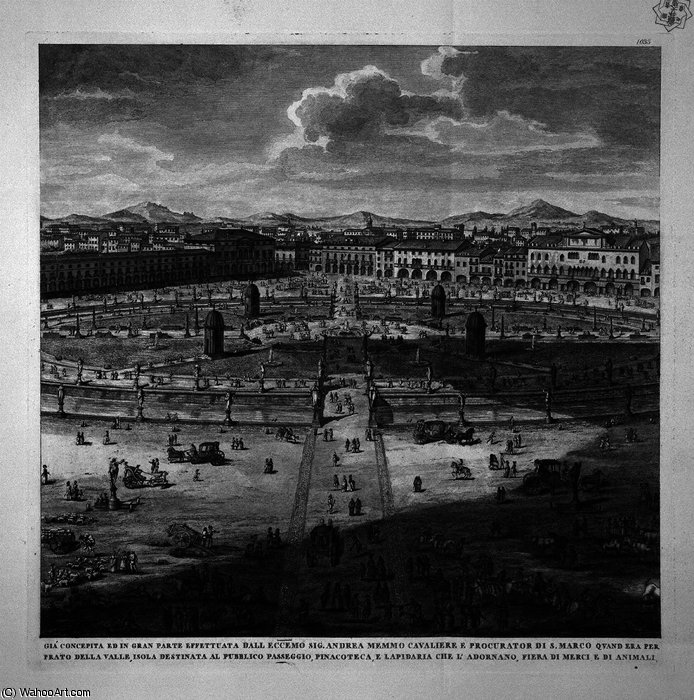
Explore Giovanni Battista Piranesi's masterful etching of Padua’s New Square—a breathtaking panorama rendered with intricate line work and perspective, capturing the grandeur of classical architecture.
Giovanni Battista Piranesi (1720-1778): Italian master of etching famed for dramatic Roman architecture, fantastical 'Carceri' prisons & detailed cityscapes. A Neoclassical visionary.
Perspective of New Square in Padua
Giovanni Battista Piranesi’s etching “Perspective of New Square in Padua” stands as a testament to the Romantic fascination with ruins and the power of imagination—a captivating glimpse into a meticulously crafted architectural vision that transcends mere representation. Created sometime around 1760, this monochrome masterpiece captures the essence of Venetian urban planning and embodies Piranesi's singular approach to artistic expression.
Subject Matter & Composition
The artwork’s subject is deceptively simple: a panoramic view of New Square in Padua, Italy—a space that would have been familiar to visitors during Piranesi’s era. However, it’s not merely a topographical depiction; rather, it's an ambitious attempt to convey the grandeur and solemn beauty of the square itself. The composition prioritizes perspective, utilizing linear convergence to draw the viewer’s gaze towards a central vanishing point—a technique that Piranesi perfected during his explorations of Roman ruins. Buildings frame the scene on all sides, creating a sense of enclosure and emphasizing the scale of the space. Scattered figures add dynamism to the tableau, hinting at human activity within this monumental setting.
Style & Technique: Piranesi’s Architectural Etching
Piranesi's distinctive style is firmly rooted in architectural etching—a technique he championed as a means of capturing the sublime qualities of ancient sites. He achieved this remarkable effect through painstaking line work, employing hatching and cross-hatching to build up tonal values with astonishing precision. The artist meticulously rendered every detail, from the facades of buildings to the paving stones of the square, demonstrating an unwavering commitment to accuracy and realism within a stylized framework. Copper plates were incised with intricate lines—a laborious process that demanded considerable skill and patience—before being inked and pressed onto paper, resulting in impressions that retain the textural richness of the original plate.
Historical Context & Symbolism
Piranesi’s work emerged during a period of intense scholarly interest in classical antiquity, fueled by discoveries at Pompeii and Herculaneum. He wasn't simply documenting these sites; he sought to evoke their spirit—the feeling of awe and wonder that accompanies encountering the vestiges of vanished civilizations. The etching reflects this intellectual climate, embodying the Romantic preoccupation with ruins as symbols of time’s passage and humanity’s mortality. Furthermore, Piranesi’s meticulous rendering speaks to a broader humanist concern for understanding and appreciating the beauty inherent in natural and architectural forms—a legacy that continues to inspire artists and designers today.
Emotional Impact & Artistic Legacy
“Perspective of New Square in Padua” possesses an undeniable emotional resonance. The stark monochrome palette amplifies the sense of drama and grandeur, transporting viewers back to a bygone era. More than just a visual record, it’s an invitation to contemplate the sublime—to experience the profound beauty found within carefully constructed spaces and the enduring power of artistic vision. Piranesi's etching remains a cornerstone of architectural etching and continues to captivate audiences with its masterful execution and evocative atmosphere—a timeless reminder that art can transcend time itself.