A Glimpse into the Heart of Ancient Rome
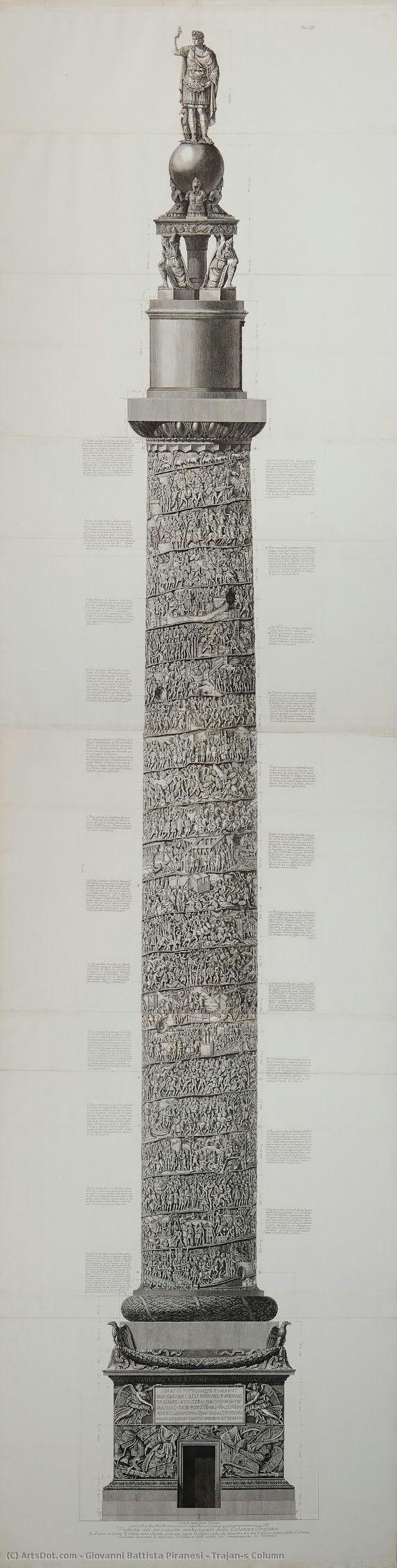
Giovanni Battista Piranesi's “Trajan’s Column” isn’t merely a depiction of an architectural marvel; it’s a portal. A meticulously crafted engraving, born from the meticulous observations and artistic genius of the 18th-century Italian artist, it transports us back to the heart of ancient Rome – specifically, to the reign of Emperor Trajan and his triumphant campaigns in Dacia (modern Romania). The column itself, a colossal monument erected nearly two millennia ago, stands as a testament to Roman military prowess, imperial ambition, and the enduring power of visual storytelling. Piranesi’s engraving doesn't simply record the column; it breathes life into its intricate details, capturing not just its physical form but also the spirit of an era.

The Spiral Narrative: A Chronicle of Conquest
What immediately captivates the viewer is the column’s mesmerizing spiral. This isn’t a static image; it’s a continuous narrative unfolding in exquisite detail. Piranesi masterfully employed the technique of relief carving, creating miniature scenes that depict Trajan's military expeditions – the initial crossings of the Danube, the subjugation of Dacian cities, and ultimately, the defeat of King Decebalus. Each scene is rendered with remarkable precision, showcasing a vast array of figures engaged in battle, construction, sacrifice, and diplomatic exchanges. The sheer scale of the frieze, stretching over 23 complete turns, demands attention and invites prolonged contemplation. Notice how Piranesi deliberately avoids depicting large-scale battles; instead, he focuses on smaller, more intimate moments – a Roman engineer overseeing bridge building, a Dacian offering tribute, or a soldier tending to his wounded. This subtle shift in focus subtly shifts the narrative away from brutal violence towards a carefully constructed image of imperial order and control.
Piranesi’s Technique: A Dance of Light and Shadow
The engraving's power lies not only in its subject matter but also in Piranesi’s masterful technique. He skillfully manipulated the etching process to create a remarkable range of tonal values, mimicking the textures of stone and the play of light and shadow on the column’s surface. The deep blacks accentuate the folds of drapery, the contours of armor, and the weathered surfaces of ancient buildings. The lighter areas highlight the polished marble, creating an illusion of depth and volume. Piranesi's use of fine lines to build up these tonal variations is particularly striking – a testament to his patience and artistic control. The meticulous detail, achieved through countless hours of labor, elevates the engraving beyond a simple representation; it becomes a tangible embodiment of Piranesi’s vision.
Symbolism and Emotional Resonance
Beyond its historical documentation, “Trajan’s Column” is rich in symbolism. The column itself represents imperial authority, military triumph, and the enduring legacy of Rome. The spiral design, reminiscent of a coiled serpent, symbolizes both conquest and renewal – the subjugation of foreign lands and the integration of their resources into the Roman Empire. Piranesi's choice to depict scenes of construction alongside those of warfare suggests a broader vision: not just military dominance but also the creation of a lasting civilization. The engraving evokes a sense of awe and reverence for the power and artistry of ancient Rome, while simultaneously hinting at the complexities and contradictions inherent in imperial ambition. It’s a powerful reminder of humanity's capacity for both great achievement and profound destruction.