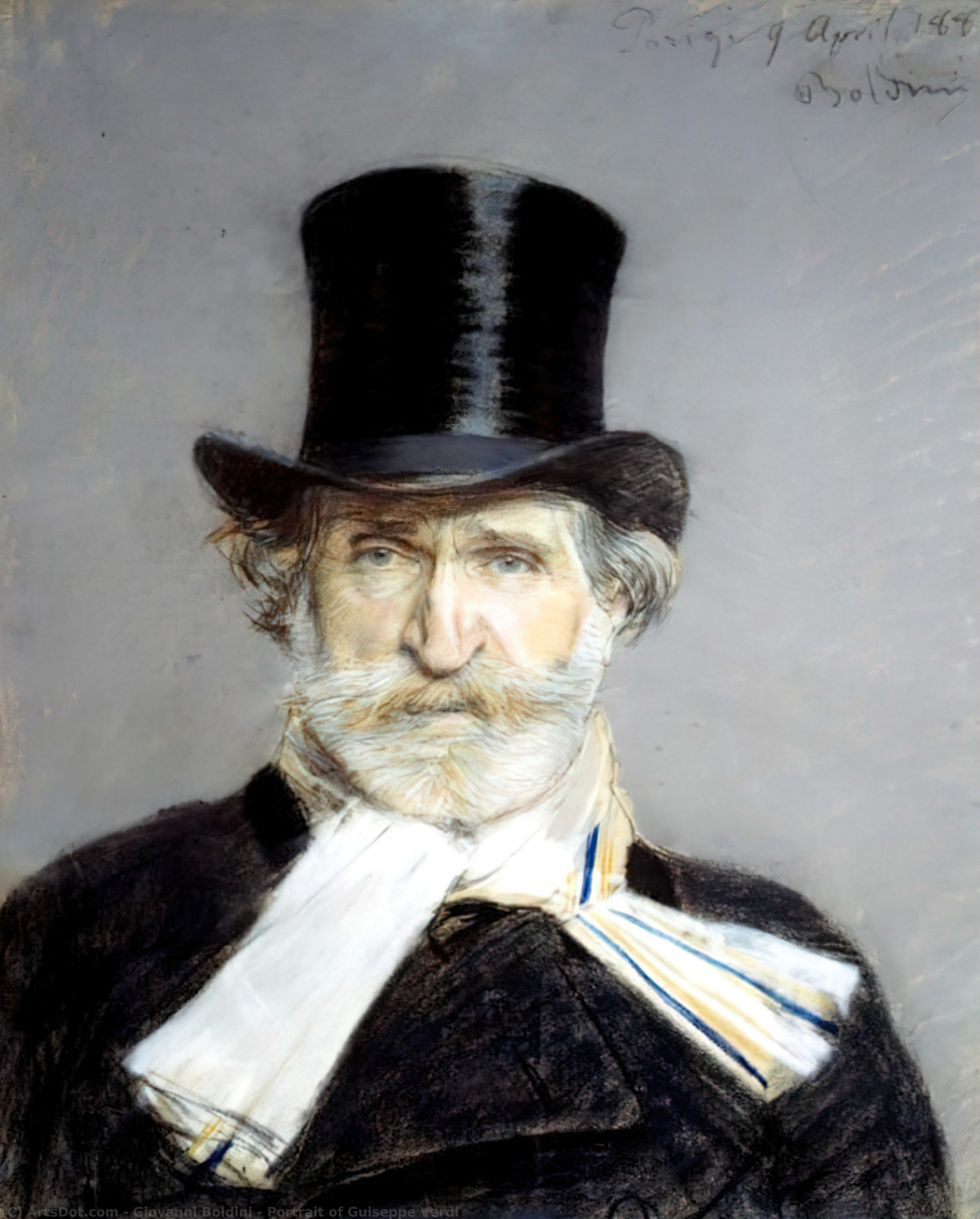
A Vision of Dignity: Boldini’s Encounter with Verdi
In the golden twilight of the Belle Époque, few images capture the intersection of musical genius and painterly elegance as profoundly as Giovanni Boldini’s Portrait of Giuseppe Verdi. This is not merely a likeness of a man; it is an encounter with an era. As the world transitioned from the rigid structures of the Victorian age toward the fluid dynamism of the modern century, Boldini—the celebrated "Master of Swish"—captured the legendary Italian composer in a moment of quiet, monumental introspection. The portrait serves as a bridge between the historical weight of Verdi’s operatic legacy and the shimmering, sophisticated atmosphere of late 19th-century Parisian high society.
The composition draws the viewer into an intimate space, focusing our gaze upon the weathered yet resolute features of the maestro. Positioned with a subtle, dynamic balance, Verdi emerges from a soft, indistinct background that allows his presence to command the frame entirely. There is a profound sense of gravity in his expression; his eyes, rendered with meticulous care, seem to hold the echoes of his most dramatic arias, reflecting a lifetime of creative struggle and triumph. The verticality of his formal attire—the sharp lines of his collar and the imposing silhouette of his top hat—luminous against the darker tones, lends the subject an architectural strength, as if he were a pillar of Italian culture itself.
The Artistry of Light and Motion
Technically, the painting is a masterclass in the controlled use of texture and light. Boldini, influenced by his early encounters with the Macchiaioli realists, employs a technique that balances precision with a certain painterly spontaneity. Through the careful layering of oils on canvas, he achieves a subtle gradation of tones that breathes life into Verdi’s complexion. One can almost feel the contrast between the smooth, refined fabric of his formal clothing and the textured, organic detail of his silvered beard and mustache.
The color palette is intentionally restrained, dominated by a sophisticated arrangement of blacks, grays, and whites. This monochromatic depth does not diminish the work; rather, it elevates it, imbuing the portrait with a timeless, somber elegance. The light appears diffused, as if filtered through the heavy velvet curtains of a grand opera house, casting soft shadows that sculpt the contours of Verdi’s face without harshness. It is this delicate interplay of light and shadow that creates the psychological depth characteristic of Boldini’s finest works, inviting the observer to contemplate the man behind the myth.
An Eternal Legacy for the Discerning Collector
For the art lover or the interior designer, a reproduction of this masterpiece offers more than just visual beauty; it provides a focal point of historical prestige. The portrait possesses a unique ability to anchor a room, bringing an air of intellectual sophistication and classical grandeur to any setting. Whether placed in a library lined with leather-bound volumes or as a striking statement piece in a contemporary salon, the work radiates a sense of permanence and respect.
To possess such a piece is to celebrate the enduring power of human character and the sublime beauty of the Italian spirit. It is an investment in an atmosphere of dignity, a tribute to one of history's greatest composers, and a testament to the unparalleled skill of Giovanni Boldini. This artwork remains a captivating window into a lost world of grandeur, making it an essential acquisition for those who seek to surround themselves with art that speaks of both history and soul.