A Renaissance Riddle: Unveiling Arcimboldo's "Costume Drawing"
Giuseppe Arcimboldo, a name synonymous with audacious creativity and intellectual depth, remains one of the most singular figures in the history of Renaissance art. Born in Milan in 1527, his career unfolded during an era defined by profound transformation – religious upheaval, burgeoning scientific inquiry, and a relentless fascination with the interplay between nature and humanity. While initially recognized for his masterful frescoes adorning grand cathedrals and meticulously rendered court portraits, Arcimboldo’s enduring legacy rests upon a revolutionary approach: constructing elaborate composite heads entirely from seemingly disparate objects—fruits, vegetables, flowers, books, musical instruments, and even animal parts. These weren't mere whimsical diversions; they were complex allegories, imbued with layers of symbolism that resonated deeply within the Renaissance worldview and continue to captivate audiences centuries later.
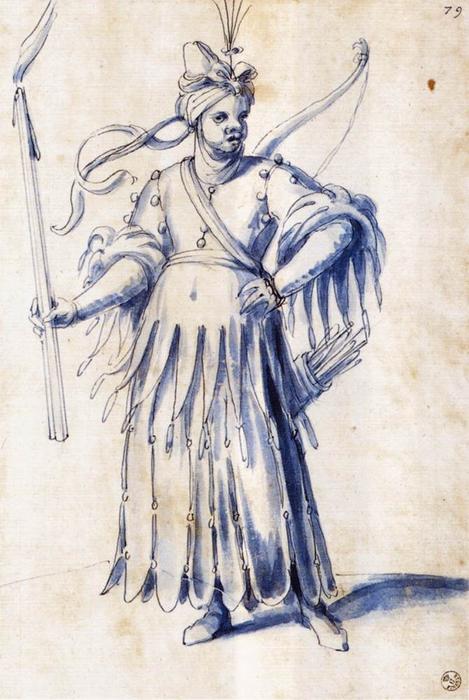
Arcimboldo’s “Costume Drawing for a Female Figure with Torch,” created in 1585, exemplifies this unique artistic vision. This captivating work, now housed at the Galleria degli Uffizi in Florence (as documented through extensive online research – see links below), depicts a woman radiating an ethereal glow, holding aloft a dramatic torch. The image is far more than a simple portrait; it’s a meticulously constructed puzzle, a visual riddle that invites contemplation and rewards close observation. The composition immediately draws the eye to the central figure, whose serene expression contrasts sharply with the vibrant, almost chaotic arrangement of elements surrounding her.
Deconstructing the Composition: A Symphony of Objects
Upon closer inspection, the woman’s attire—a flowing blue gown—is subtly integrated into the artwork itself. The background is a rich tapestry of carefully chosen objects, each contributing to the overall narrative. The prominent torch, rendered with exquisite detail, isn't merely a decorative element; it symbolizes illumination, guidance, and perhaps even sacrifice – a potent metaphor within the context of Arcimboldo’s work. Scattered around her are elements suggestive of both earthly abundance and intellectual pursuits: books, representing knowledge and learning; fruits and vegetables, symbolizing fertility and the cycles of nature; and fragments of musical instruments hinting at harmony and artistic expression.
- The Blue Gown: A deliberate choice, suggesting nobility and perhaps a connection to the Virgin Mary.
- The Torch: Represents enlightenment, guidance, and potentially sacrifice or protection.
- Fruits & Vegetables: Symbolize abundance, fertility, and the seasons – key themes in Renaissance art.
- Books: Represent knowledge, learning, and intellectual pursuits.
A Portrait of a Time: Historical Context and Arcimboldo’s Patronage
Arcimboldo's work was commissioned by the powerful Habsburg court in Vienna and Prague, serving as court painter to three Holy Roman Emperors – Ferdinand I, Maximilian II, and Rudolf II. This patronage afforded him unparalleled access to luxury goods and exotic materials, fueling his inventive compositions. Rudolf II, a renowned collector of art, natural history specimens, and esoteric objects, was particularly fascinated by Arcimboldo’s ability to transform the mundane into the extraordinary. The Emperor's interest in alchemy, astrology, and the occult undoubtedly influenced Arcimboldo’s symbolic approach.
The year 1585, when this particular drawing was created, coincided with a period of intense intellectual ferment within Europe. Neo-Platonism—a philosophical movement emphasizing the harmony between the physical world and the realm of ideas—was gaining traction among artists and intellectuals. Arcimboldo’s composite portraits can be interpreted as visual allegories reflecting these complex philosophical concepts, suggesting that the human form is merely a temporary manifestation of an underlying unity.
Beyond the Surface: Symbolism and Emotional Resonance
While often described as playful or eccentric, Arcimboldo's work possesses a profound emotional depth. The woman in “Costume Drawing for a Female Figure with Torch” embodies a sense of quiet strength and serenity amidst the vibrant chaos of her surroundings. The torch she holds casts an ethereal glow, suggesting hope, guidance, and perhaps even a touch of melancholy. Arcimboldo’s genius lies not only in his technical skill but also in his ability to evoke complex emotions through seemingly simple arrangements of objects. The piece invites us to contemplate the relationship between appearance and reality, beauty and decay, life and death – timeless themes that continue to resonate with viewers today.
Further Research: For a deeper understanding of this remarkable artwork, we encourage you to explore the following resources: