A Portrait Unlike Any Other: Exploring Giuseppe Arcimboldo's Masterpiece
Giuseppe Arcimboldo, born in Milan in 1527, stands apart from his contemporaries as a true visionary of the Renaissance. While artists of his era diligently pursued realism and anatomical accuracy – striving to capture the human form with meticulous detail – Arcimboldo dared to challenge convention, presenting portraits not as representations of individuals but as elaborate constructions of natural elements.
- The Innovation: Arcimboldo’s technique—the creation of composite heads from fruits, vegetables, flowers, and books—was revolutionary. It signaled a departure from traditional portraiture and embraced the burgeoning interest in alchemy and symbolism prevalent during the period.
- A Symbolic Language: Each meticulously arranged element carried profound meaning. Fruits symbolized fertility and abundance, flowers represented beauty and purity, while books alluded to knowledge and erudition. Arcimboldo’s portraits weren't merely aesthetically pleasing; they functioned as visual metaphors conveying complex ideas about power, intellect, and the interconnectedness of nature and humanity.
Considered a herald of Mannerism—a stylistic movement characterized by exaggerated forms and stylized poses—Arcimboldo’s work reflects the anxieties and aspirations of his time. The Reformation was reshaping religious beliefs across Europe, fostering a renewed appreciation for humanist values and prompting artists to explore themes beyond mere physical likeness.
- Technique: Arcimboldo employed oil paint on canvas with remarkable precision. He painstakingly sculpted the fruits and vegetables into shapes that resembled facial features, utilizing subtle shading and highlighting to create an illusion of depth and volume.
- Historical Context: His portraits were commissioned by influential patrons—including Maximilian I Holy Roman Emperor—demonstrating Arcimboldo’s ability to navigate the political landscape of Renaissance Italy and secure prestigious commissions.
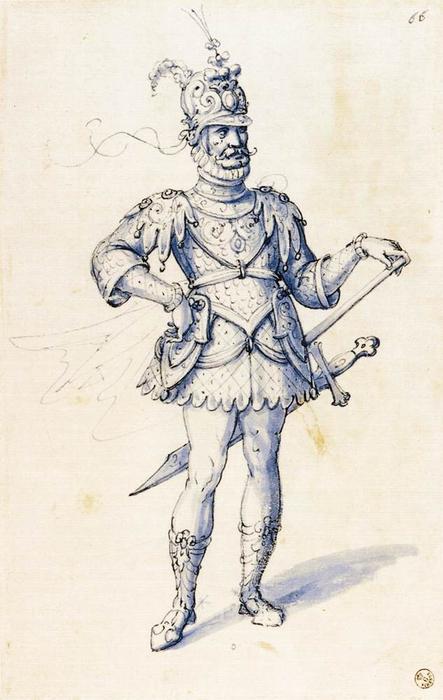
The resulting images are undeniably arresting, demanding contemplation and inviting interpretation. They capture not just a likeness but an essence – a spirit distilled into tangible forms. Arcimboldo's Costume Drawing for a Knight exemplifies this artistic triumph, cementing his place as one of the most inventive and intellectually stimulating artists of his era.
More than simply decorative objects, Arcimboldo’s creations are invitations to engage in dialogue with history and symbolism. They remind us that art can transcend mere representation, communicating ideas and emotions in ways that resonate across centuries.