Giuseppe Arcimboldo’s Geometric Vision: A Renaissance Masterpiece
Giuseppe Arcimboldo (1527 – 1593), Milanese artist of the High Renaissance, stands apart from his contemporaries not merely for his technical prowess but for an audacious conceptual leap—a refusal to depict human likeness in conventional portraiture. Instead, Arcimboldo embarked on a daring experiment that would solidify his place as one of the most influential figures in Mannerist art: he created composite heads composed entirely of meticulously arranged objects – fruits, vegetables, flowers, books, musical instruments – transforming recognizable forms into elaborate visual riddles.
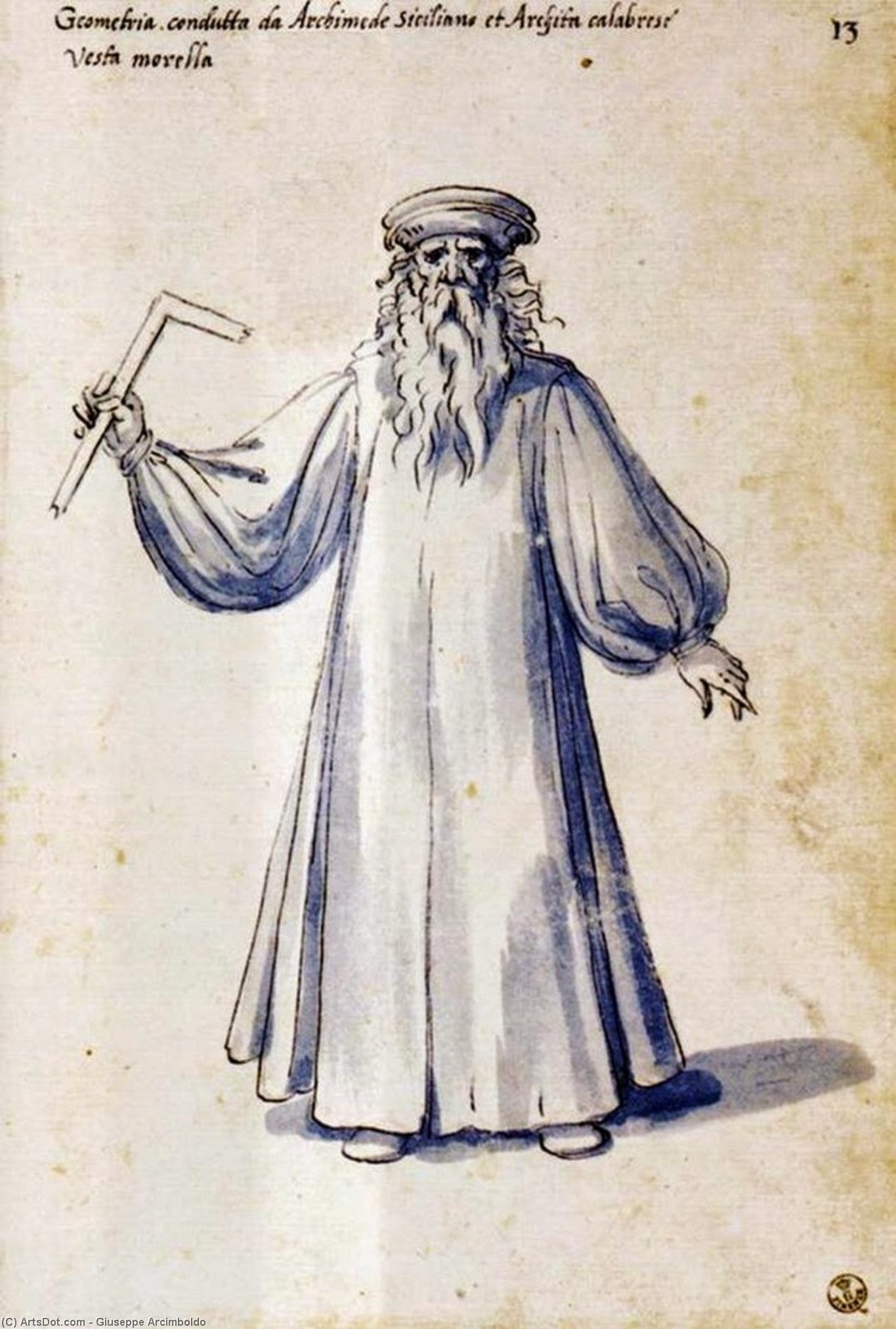
The artwork under scrutiny, “Costume of the allegorical figure ‘Geometry’” (1585), housed in the Galleria degli Uffizi in Florence, exemplifies Arcimboldo’s signature style. This monumental painting depicts an elderly man rendered as a complex assemblage of geometric shapes and natural elements. The artist skillfully employs pen and ink on canvas to achieve remarkable detail and textural nuance, capturing the subtle interplay of light and shadow within each carefully positioned component.
More than just a visual spectacle, “Geometry” operates on multiple levels of symbolic interpretation. Arcimboldo’s choice of materials—representing instruments of musical harmony alongside fruits symbolizing fertility and knowledge—directly references the title itself. Geometry, as understood during the Renaissance, encompassed not only mathematical precision but also philosophical contemplation concerning order, proportion, and divine intellect. The figure's serene expression reinforces this intellectual theme, inviting viewers to engage in a dialogue about the pursuit of wisdom and understanding.
The background is deliberately muted—a stark white expanse—allowing Arcimboldo’s meticulously crafted composition to dominate the visual field. This minimalist approach underscores the artist’s focus on conveying abstract concepts rather than realistic representation, aligning perfectly with the prevailing artistic sensibilities of his time. The painting's enduring appeal lies in its ability to provoke wonder and contemplation, prompting viewers to consider the profound connections between art, science, and spirituality.
A testament to Arcimboldo’s genius is the signature “Arcimboldo” inscribed in the lower right corner, alongside a watermark identifying the Galleria degli Uffizi as its origin. The slight yellowish tint of the canvas hints at the passage of centuries, preserving the artwork's original vibrancy and ensuring that Arcimboldo’s groundbreaking vision continues to inspire admiration and scholarly debate.
- Artist: Giuseppe Arcimboldo
- Year Created: 1585
- Location: Galleria degli Uffizi, Florence
- Medium: Pen and Ink on Canvas
- Style: Mannerist
“Costume of the allegorical figure ‘Geometry’” offers a captivating glimpse into Arcimboldo’s artistic imagination—a masterful fusion of observation, intellect, and symbolic artistry that secures its place as an unforgettable emblem of Renaissance creativity.