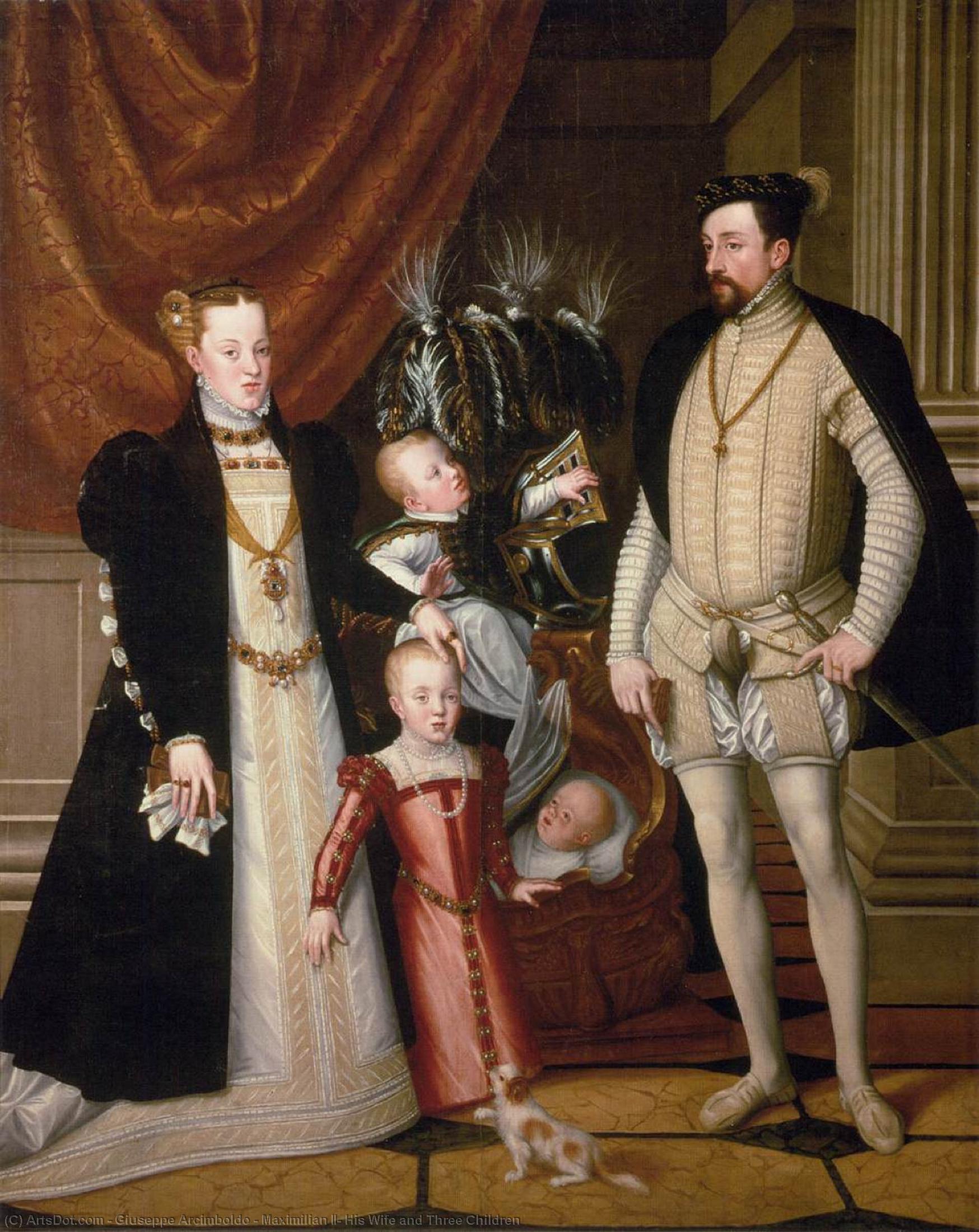
A Royal Tableau Reimagined
In the grand tapestry of the Renaissance, few works capture the intersection of imperial power and surrealist imagination quite like Giuseppe Arcimboldo’s “Maximilian II, His Wife and Three Children.” Completed in 1563, this masterpiece is far more than a mere family portrait; it is a profound exploration of lineage, nature, and the very essence of identity. At first glance, the viewer is presented with a formal, intimate gathering of the Holy Roman Emperor Maximilian II, his wife Anna Johanne Mansfeld-Harzhausen, and their children. Yet, as the eye lingers, the familiar boundaries of portraiture begin to dissolve, revealing the artist's revolutionary approach to the human form.
The painting serves as a breathtaking testament to the era's intellectual curiosity. While it honors the dignity of the Habsburg dynasty, Arcimboldo infuses the scene with a sense of wonder that transcends the rigid protocols of courtly art. For collectors and enthusiasts of fine art, this work offers a rare glimpse into a moment where the political stability of an empire meets the whimsical, almost dreamlike creativity of the Mannerist period.
The Alchemy of Nature and Form
What truly distinguishes this work is Arcimboldo’s signature, groundbreaking technique. Moving beyond traditional brushwork, he employs a method of composite portraiture that feels centuries ahead of its time. The artist painstakingly assembles disparate elements—vibrant fruits, crisp vegetables, delicate flowers, and even intricate books or musical instruments—to construct the features of the imperial family. This meticulous arrangement transforms the mundane bounty of the earth into a magnificent, living mosaic.
The technique demands an extraordinary level of precision, where every grape, leaf, and petal is placed with surgical intent to capture the interplay of light and shadow. This creates a textured, almost three-dimensional surface that breathes life into the canvas. For those looking to adorn a space with art, the visual complexity of this piece provides a captivating focal point, offering a tactile richness that invites endless re-examination. It is an alchemical process where nature is not merely depicted but is used as the very building block of human majesty.
Symbolism and the Legacy of the Habsburgs
Beyond its visual trickery lies a deep well of symbolism intended to resonate with the Renaissance mind. The use of organic matter to form the faces of the ruling class suggests a powerful allegory: the idea that the strength and prosperity of the empire are inextricably linked to the fertility and abundance of the natural world. By weaving together the botanical and the biological, Arcimboldo celebrates the interconnectedness of human intellect and the earth's bounty.
The portrait also functions as a vital document of succession. In depicting Maximilian II alongside his wife and children, the painting underscores the continuity of the bloodline—a crucial element in the political landscape of 16th-century Europe. The presence of the children, including figures who would go on to shape European history, adds a layer of historical gravity to the whimsical execution. To possess a reproduction of such a work is to hold a piece of a larger narrative regarding power, growth, and the enduring legacy of one of history's most influential families.
An Inspiration for the Modern Interior
For interior designers and connoisseurs of high-quality reproductions, “Maximilian II, His Wife and Three Children” offers an unparalleled opportunity to introduce conversation and character into a room. Its unique aesthetic—blending the formal elegance of a royal portrait with the surrealist charm of a botanical study—allows it to integrate seamlessly into both classical and contemporary settings. Whether placed in a sunlit library or a sophisticated dining hall, the painting acts as a window into a world where reality and imagination are beautifully entwined.
Choosing a hand-painted reproduction of this masterpiece means bringing home more than just decor; it is an invitation to experience the wit, the intellect, and the profound beauty of the Renaissance spirit every single day.