A Symphony of Figures: Unveiling Arcimboldo’s “Scenes from the Life of St John the Baptist”
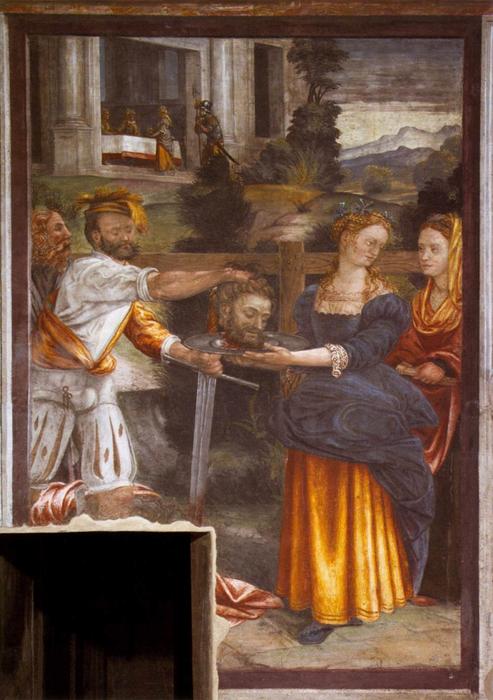
Giuseppe Arcimboldo's "Scenes from the Life of St John the Baptist," completed in 1545 and now residing within the serene walls of San Maurizio al Monastero Maggiore in Milan, isn’t merely a painting; it’s an immersive theatrical tableau. Arcimboldo, a master of visual illusion and allegorical complexity, doesn't depict a traditional narrative but rather constructs a vibrant, layered story through meticulously arranged objects – fruits, vegetables, books, musical instruments, all coalescing to form the head of St John the Baptist. This isn’t simple portraiture; it’s a deliberate challenge to our perception, inviting us to look beyond the surface and decipher the intricate symbolism woven into every carefully placed element.
The painting immediately captivates with its sheer density and richness. A central figure, likely representing an older religious figure or perhaps even John himself, is framed by a cascade of autumnal bounty: pomegranates bursting with ruby seeds, plump grapes hinting at the Eucharist, and delicate artichokes suggesting humility. To his left, a woman in blue – her status subtly indicated by her headdress – engages in what appears to be a gesture of care or perhaps even a moment of contemplation. A figure on the right extends a hand towards the central figure, creating a dynamic interplay of gestures and visual connections. The background landscape, rendered with a delicate precision that contrasts sharply with the exuberant foreground, grounds the scene within a recognizable, yet subtly stylized, Italian countryside.
The Renaissance World Reimagined: Arcimboldo’s Artistic Vision
Arcimboldo's work emerged during a period of profound intellectual and artistic transformation in 16th-century Europe. The Renaissance witnessed a renewed interest in classical antiquity, alongside burgeoning scientific inquiry and a fascination with the natural world. This context profoundly shaped Arcimboldo’s approach to art. He wasn’t simply depicting a biblical scene; he was engaging with the prevailing humanist ideals of the era – celebrating the interconnectedness of all things, exploring the relationship between humanity and nature, and utilizing visual metaphors to convey complex theological concepts.
His technique—fresco painting—further enhances the work's impact. Fresco, a method involving applying pigments directly onto wet plaster, creates an unparalleled level of permanence and luminosity. The colors retain their vibrancy over centuries, offering a tangible connection to the artist’s workshop and the time in which the piece was created. Arcimboldo’s mastery of this medium is evident in the sharp detail of each element, from the individual seeds on the pomegranates to the folds of the figures' garments.
Symbolism and Allegory: Decoding Arcimboldo’s Language
“Scenes from the Life of St John the Baptist” is a veritable treasure trove of symbolism. The fruits themselves carry significant weight, representing not just sustenance but also spiritual nourishment and divine grace. The pomegranate, for instance, often symbolizes fertility, abundance, and the blood of Christ. The artichoke, with its thorny exterior concealing a tender heart, speaks to themes of humility and inner strength. The inclusion of books suggests knowledge, wisdom, and the importance of scripture in John’s life.
The figures themselves are open to interpretation. The woman's attire and gesture invite speculation about her role within the narrative – perhaps a disciple, a confidante, or even a representation of Mary Magdalene. The extended hand suggests an act of compassion, guidance, or perhaps a moment of shared understanding. Arcimboldo deliberately avoids providing explicit answers, encouraging viewers to engage in their own contemplation and draw their own conclusions.
A Timeless Masterpiece: Reproduction and Beyond
ArtsDot offers meticulously crafted reproductions of “Scenes from the Life of St John the Baptist,” allowing you to bring this extraordinary artwork into your home or office. Our high-quality prints capture the painting’s vibrant colors, intricate details, and profound symbolism with exceptional fidelity. Whether you are an art enthusiast, a collector seeking a unique addition to your collection, or simply someone drawn to the beauty and complexity of Renaissance art, our reproduction provides a stunning tribute to Arcimboldo's genius.