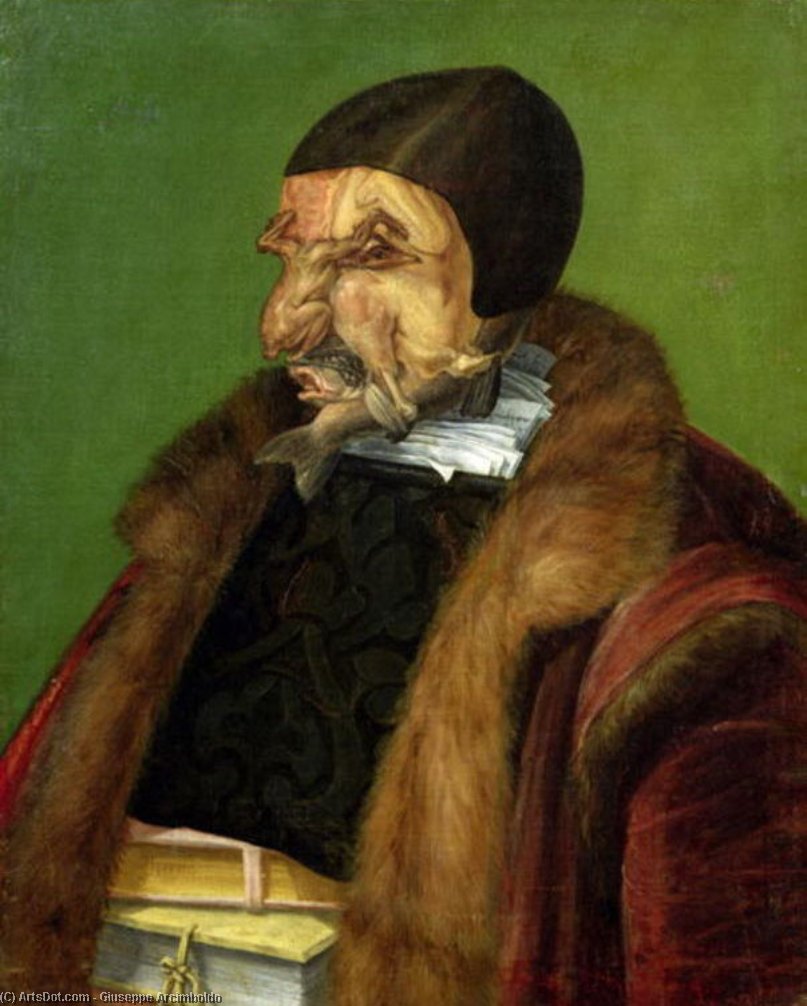
Giuseppe Arcimboldo’s “The Jurist”: A Portrait of Paradox
Giuseppe Arcimboldo’s “The Jurist,” completed in 1566, stands as an astonishing testament to Renaissance artistic ingenuity and a masterful exploration of visual symbolism. More than just a portrait—albeit an extraordinarily unconventional one—it embodies the intellectual currents of its time, reflecting a fascination with humanist ideals intertwined with anxieties about religious dogma.
At first glance, the painting presents itself as a familiar genre piece: a depiction of an elderly man in profile. However, Arcimboldo swiftly dismantles conventions by constructing his subject’s visage from meticulously arranged fruits, vegetables, flowers, books, and musical instruments—a technique that would solidify his reputation as one of the most inventive artists of the era.
The stylistic influence of Leonardo da Vinci is palpable. Like Da Vinci's sfumato, Arcimboldo employs subtle shading to create an illusion of depth and volume, lending a remarkable realism to what appears initially to be an assemblage of disparate objects. The artist’s meticulous attention to detail—evident in the individual textures of each element—further enhances the impression of authenticity.
- Technique: Arcimboldo utilized oil paint on canvas, applying thin layers of pigment to achieve a luminous surface and capturing the nuances of light and shadow. The brushstrokes are visible, contributing to the painting’s textural richness and conveying a sense of artistic process.
- Historical Context: Commissioned by Rudolf II, Holy Roman Emperor, Arcimboldo's portrait reflects the humanist spirit prevalent in Prague during Rudolf’s reign—a period marked by intellectual curiosity and a renewed interest in classical learning. It also speaks to the anxieties surrounding papal authority and the burgeoning Protestant Reformation.
- Symbolism: The arrangement of objects is laden with symbolic meaning. Fruits represent fertility and abundance, symbolizing wisdom and virtue – qualities associated with justice and law. Flowers convey beauty and purity, mirroring moral integrity. Books symbolize erudition and knowledge, representing legal scholarship and intellectual discernment. Musical instruments signify harmony and balance, reflecting the importance of reason and contemplation in achieving spiritual enlightenment.
“The Jurist” transcends mere visual representation; it invites contemplation on themes of intellectuality, morality, and the pursuit of truth. Arcimboldo’s audacious approach challenges viewers to reconsider their perceptions of portraiture and celebrates the transformative power of artistic imagination. The painting's enduring appeal lies in its ability to provoke thought and inspire wonder—a remarkable achievement considering its unconventional composition.
Its muted green background serves not only as a neutral backdrop but also subtly reinforces the overarching theme of jurisprudence, suggesting stability and impartiality. Arcimboldo’s masterful manipulation of light and shadow further emphasizes the contours of the face, creating an arresting visual experience that captures both the solemn dignity of the subject and the artist's profound understanding of humanist ideals.
Today, reproductions of “The Jurist” adorn homes and galleries worldwide, serving as a reminder of Arcimboldo’s unparalleled artistic vision—a vision that continues to captivate audiences centuries after its creation.