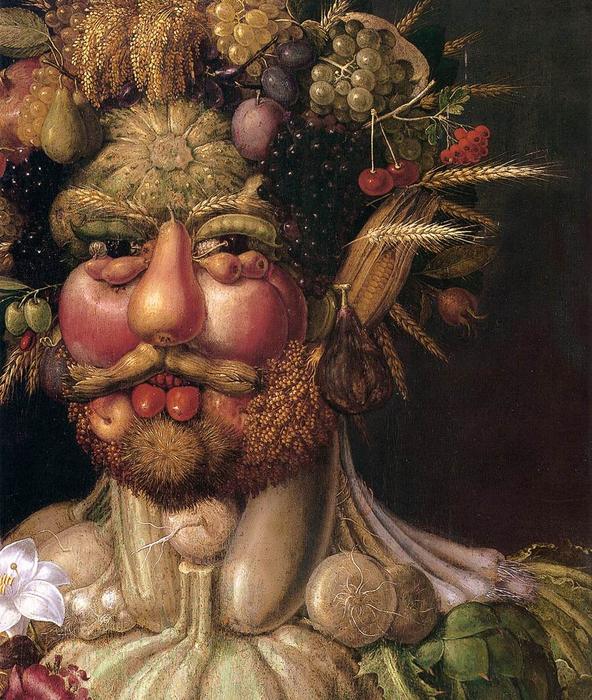
A masterful Mannerist portrait by Giuseppe Arcimboldo reimagines human form as an astonishing assemblage of fruits and vegetables—a vibrant testament to nature's artistry and a captivating glimpse into Renaissance imagination. Explore Vertumnus reproductions at ArtsDot.
Discover Giuseppe Arcimboldo (1527-1593), the Italian Mannerist master renowned for his surreal portraits composed of fruits, vegetables & objects. Explore his whimsical yet insightful art!
Delve into Swedish history & art at Skokloster Castle! Admire Baroque architecture, explore military collections & discover masterpieces by Nils Schillmarch – a captivating journey awaits!
A Symphony of Flora and Form: Exploring Giuseppe Arcimboldo’s Vertumnus
Giuseppe Arcimboldo's *Vertumnus*, completed in 1590, stands as an astonishing testament to the Mannerist artistic movement—a period characterized by intellectual experimentation and a deliberate rejection of Renaissance ideals. More than just a portrait, it’s a conceptual masterpiece housed within Skoklosters Slott museum in Sweden, inviting viewers into a world where nature transcends mere representation and becomes the very embodiment of human intellect and transformation.
The Genesis of Illusion: Composition and Technique
At first glance, *Vertumnus* presents itself as an unsettling spectacle: a human head sculpted from meticulously arranged fruits, vegetables, flowers, and leaves. Arcimboldo’s genius lies not in achieving photographic realism—a feat impossible given the medium—but rather in crafting an illusion of depth and dimensionality through masterful trompe l'oeil techniques. Each element is painstakingly positioned to create overlapping planes and textures that mimic the contours of facial features. The artist employed oil paint on panel, applying thin glazes over a preparatory underpainting to build up color intensity and luminosity. This meticulous layering ensures that every detail contributes to the overall effect—a captivating visual paradox.
Renaissance Symbolism Revisited: Allegory and Interpretation
The painting’s symbolism is rich with references to Renaissance humanist thought and astrological beliefs. Arcimboldo deliberately chose these organic materials – apples representing knowledge, pears symbolizing beauty and fertility, plums signifying prudence – to convey a complex message about the cyclical nature of life and the interconnectedness of human and natural realms. The inclusion of musical instruments subtly underscores the idea that intellect and creativity are equally vital components of human flourishing. Furthermore, *Vertumnus* embodies Arcimboldo’s fascination with the concept of metamorphosis—a central theme in Renaissance cosmology—suggesting that humanity must adapt to changing circumstances and embrace new perspectives.
A Legacy of Imagination: Arcimboldo's Influence
Arcimboldo’s innovative approach profoundly impacted subsequent generations of artists, establishing him as a pioneer of visual illusionism and inspiring countless imitators. His work challenged conventional artistic conventions and demonstrated the transformative potential of blending disparate elements into a unified whole. *Vertumnus* continues to resonate with audiences today because it speaks to our innate desire for beauty, wonder, and intellectual stimulation—a timeless reminder that art can transcend boundaries of time and culture. Its enduring appeal lies in its ability to provoke contemplation about the relationship between humanity and nature, prompting us to consider how we might embody the virtues represented within this extraordinary botanical portrait.