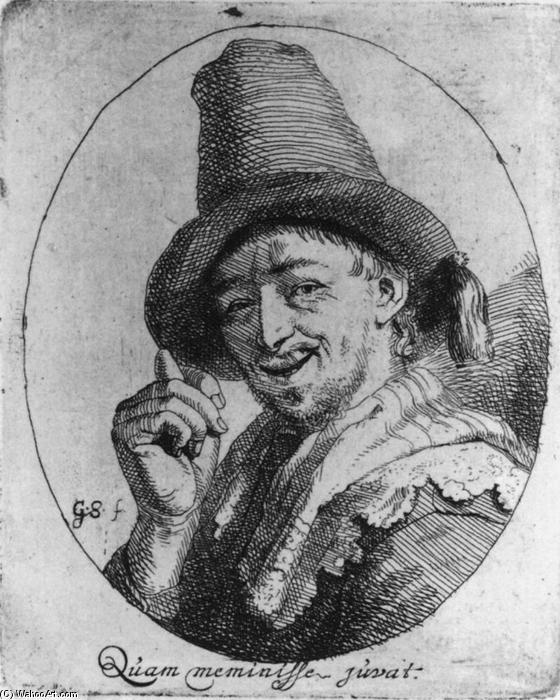
A Glimpse of Dutch Refinement: Godfried Schalcken’s “Man Making an Obscene Gesture”
Godfried Schalcken's "Man Making an Obscene Gesture," a captivating etching or engraving executed around 1670, offers a rare and arresting intersection of formal portraiture and subversive expression. More than just a depiction of a single moment, the work embodies the complex social dynamics and burgeoning individualism that characterized the late Dutch Golden Age. It’s a piece that invites contemplation on power, defiance, and the subtle tensions simmering beneath the veneer of societal decorum – a testament to Schalcken's mastery in capturing both the outward appearance and the unspoken emotions of his subjects.
The scene unfolds within an oval frame, a deliberate choice reminiscent of 17th-century portraiture, lending the image a dignified formality. Yet, the man’s posture – head tilted slightly, gaze direct and mischievous – immediately disrupts this composure. He is positioned not as a subject to be admired, but as an active participant in his own narrative, boldly gesturing with a hand that clearly defies convention. The details of his attire—a ruffled collar and waistcoat—further emphasize the contrast between outward appearance and inner turmoil. This deliberate juxtaposition is key to understanding the work’s enduring power; it's not merely about a single act of impropriety, but about challenging established norms.
The Language of Light: Technique and Style
Schalcken’s skill as an engraver is immediately apparent in the meticulous rendering of form and texture. The image is dominated by fine lines, expertly crafted to build up tonal values and create a remarkable illusion of depth. Hatching and cross-hatching techniques are employed with precision, suggesting the weight of fabric, the contours of flesh, and the subtle play of light and shadow. Notice how the artist uses these linear elements not just to define shapes, but also to evoke a sense of tactile reality – you can almost feel the roughness of the man’s clothing or the smoothness of his skin.
The monochromatic palette—a carefully orchestrated range of grays from near black to white—further enhances the dramatic effect. The lighting, originating from the upper left, casts strong shadows on the right side of the man's face and body, creating a sense of volume and drawing attention to his defiant gesture. This strategic use of light is characteristic of Schalcken’s style, mirroring the techniques employed by Rembrandt and other masters of chiaroscuro – a deliberate manipulation of light and shadow to heighten emotional impact.
A Portrait of an Era: Context and Symbolism
“Man Making an Obscene Gesture” must be understood within the context of 17th-century Dutch society, a period marked by both immense wealth and rigid social hierarchies. While outward appearances were carefully cultivated, beneath the surface lay currents of dissent and questioning. The act of making an obscene gesture—a direct challenge to societal expectations—became a potent symbol of rebellion and individual expression. It’s a subtle but significant commentary on the constraints placed upon individuals by established norms.
The man's expression is particularly revealing. His mischievous gaze suggests a playful defiance, almost as if he relishes in his transgression. This isn’t simply an act of rudeness; it’s a deliberate assertion of agency—a refusal to be defined solely by societal expectations. The portrait becomes a visual representation of the internal struggle between conformity and individuality, a theme that resonated deeply within the intellectual circles of the time.
Echoes of Schalcken: A Master of Candlelight
Godfried Schalcken’s legacy rests largely on his ability to capture the evocative quality of candlelight. His works are renowned for their atmospheric realism and the way he rendered the subtle nuances of light and shadow, creating a sense of intimacy and drama. This skill is particularly evident in “Man Making an Obscene Gesture,” where the carefully placed shadows not only define form but also contribute to the overall mood of intrigue and defiance. Schalcken’s work stands as a testament to his artistic vision and technical mastery, securing his place as one of the most polished artists of the Dutch Golden Age.