A Vision of Intimacy: Exploring Gustav Klimt’s Adam and Eva (Unfinished)
Gustav Klimt, born July 14, 1862, in Baumgarten near Vienna, emerged from a family touched by both artistic inclination and financial hardship. His father, Ernst Klimt, was a gold engraver, a profession that would subtly yet profoundly influence the young Gustav’s aesthetic sensibilities—the allure of gold leaf, the meticulous detail, the sheer opulence. The family's struggles meant frequent moves within Vienna, a transient upbringing that perhaps fostered in Klimt a keen observation of his surroundings and a sensitivity to human experience. Even as a child, his drawing skills were remarkable, nurtured by his father’s profession and an innate talent that quickly became apparent. In 1876, he entered the Vienna Kunstgewerbeschule (School of Applied Arts), embarking on formal training in architectural painting under Ferdinand Laufberger. This provided him with a solid technical foundation, but also exposed him to the prevailing academic styles—styles Klimt instinctively rejected, seeking instead a path toward artistic expression that resonated with his own inner vision.
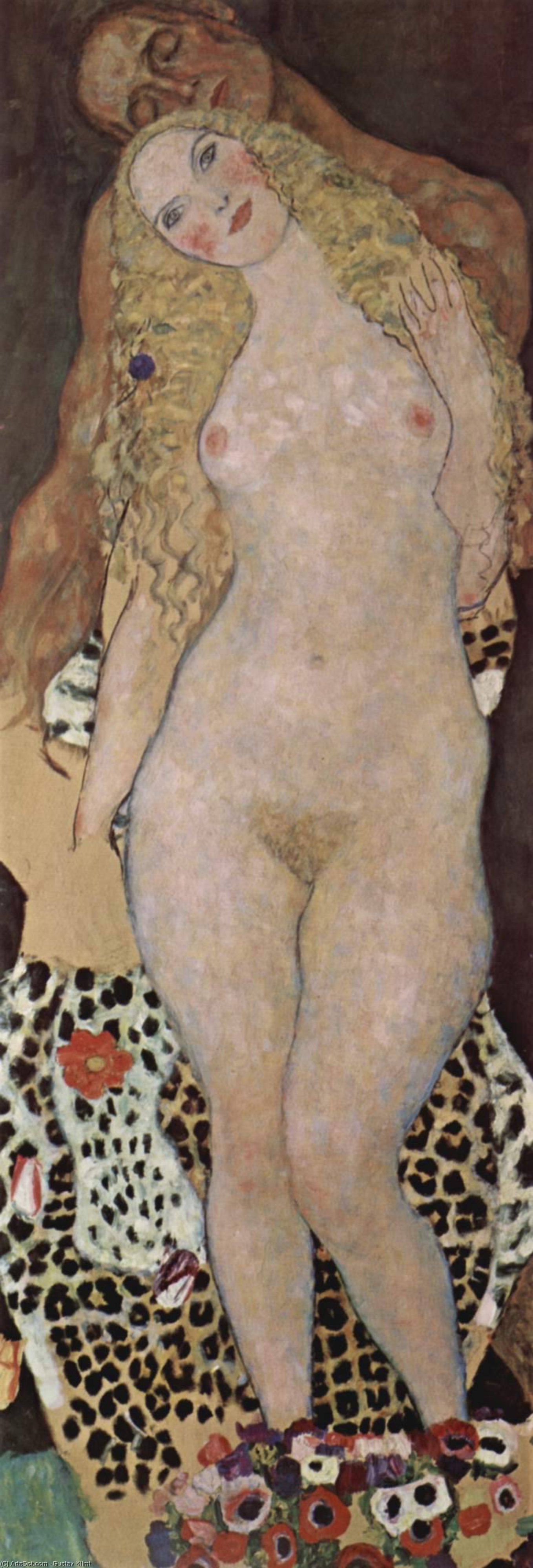
- Subject Matter: The painting depicts Adam and Eve, figures central to Judeo-Christian mythology representing innocence and transgression. Klimt’s depiction isn't merely literal; it aims to convey the profound emotional connection between humanity and divinity.
- Style: Klimt firmly established himself within the Art Nouveau movement, a stylistic rebellion against Victorian formalism. Characterized by flowing lines, organic forms inspired by Celtic and Byzantine art, and an overwhelming preoccupation with decorative elements, Art Nouveau sought to elevate craftsmanship alongside artistic innovation.
Technique and Material Considerations
Klimt’s masterful execution involved a groundbreaking technique—the incorporation of gold leaf onto canvas. This wasn't simply ornamentation; it was integral to the artwork’s expressive power. The shimmering gold symbolizes divine grace, fertility, and spiritual enlightenment – concepts deeply rooted in Klimt’s symbolic worldview. He meticulously applied thin layers of gold leaf, painstakingly burnished to achieve a radiant sheen that captivated viewers upon its unveiling. Alongside gold leaf, Klimt utilized oil paints blended with resin, creating a durable surface capable of capturing the subtle nuances of color and texture. The meticulous layering process ensured that every brushstroke contributed to the overall visual impact.
Historical Context: A Reaction Against Academic Tradition
The early 20th century witnessed an artistic ferment fueled by movements like Expressionism and Fauvism, which prioritized emotional intensity over objective representation. Klimt deliberately distanced himself from these trends, reaffirming his allegiance to Art Nouveau’s aesthetic principles. This decision reflected a broader cultural shift—a yearning for beauty and spirituality amidst the anxieties of industrialization and societal change. Klimt's refusal to conform solidified his position as a visionary artist who championed artistic freedom and challenged established conventions.
Symbolism and Emotional Resonance
Beyond its formal stylistic elements, Adam and Eva (unfinished) is laden with symbolic significance. The embrace of the figures represents not only physical intimacy but also spiritual unity—a yearning for wholeness and transcendence. The floral motifs surrounding them symbolize rebirth, fertility, and the cyclical nature of life. Klimt’s deliberate use of color – predominantly warm hues – evokes feelings of passion, tenderness, and vulnerability. The painting invites contemplation on themes of creation, loss, and redemption, resonating deeply with viewers across generations.
A Legacy Enduring Through Reproduction
Today, Adam and Eva (unfinished) continues to inspire artists and collectors alike. Reproductions crafted by ArtsDot offer a remarkable opportunity to experience Klimt’s artistic brilliance firsthand—to appreciate the luminous gold leaf, the intricate detailing, and the profound emotional depth of this iconic masterpiece. Bringing Klimt's vision into your home transforms it into a space imbued with beauty, contemplation, and an enduring connection to art history.