A Fragment of Creation: Exploring Klimt’s *Adam and Eve (unfinished)*
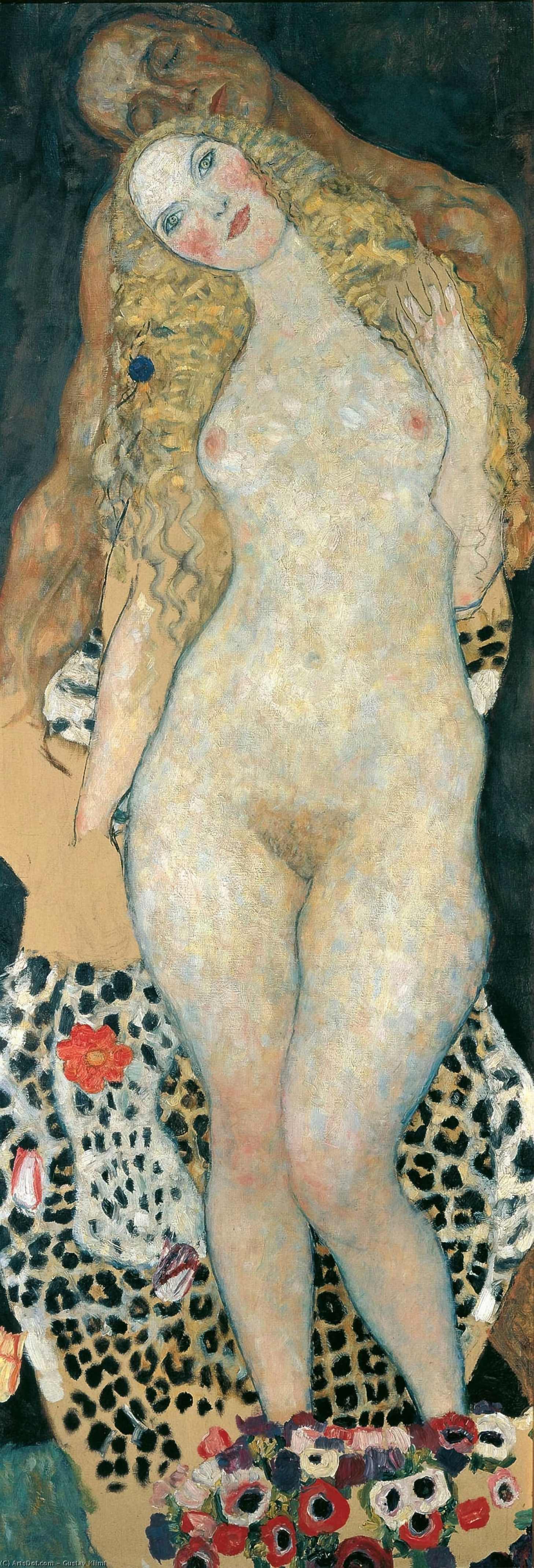
Gustav Klimt's *Adam and Eve (unfinished)* is more than just a fragment; it’s a potent distillation of the artist’s lifelong fascination with life, love, and the complexities of human existence. Begun in 1917-18, during a period of personal and societal upheaval as World War I raged on, this painting offers a glimpse into Klimt's evolving style and his continued exploration of themes central to the Symbolist movement. Though incomplete at the time of his death in 1918, it remains a powerfully evocative work.
The Artist & His Moment
Gustav Klimt (1862-1918) was a pivotal figure in Austrian art, and a leading member of the Vienna Secession – an artistic movement that rebelled against the conservative academic traditions of the time. He embraced ornamentation, symbolism, and a sensuous aesthetic heavily influenced by Byzantine mosaics and Japanese prints. Klimt’s work often blurred the lines between decorative arts and fine painting, creating a unique visual language characterized by lavish gold leaf, intricate patterns, and emotionally charged subject matter. The late period of his career, including *Adam and Eve*, saw him move away from the fully ornamental style of his “Golden Phase” towards a more expressive and psychologically probing approach.
Decoding the Composition
The painting depicts Adam and Eve, not as idealized figures of innocence, but as intertwined forms within a swirling vortex of smaller nude figures. The composition is deliberately fragmented and unfinished, with areas of exposed canvas adding to its raw emotional intensity. Klimt’s characteristic use of gold leaf remains present, though less dominant than in his earlier works, suggesting a shift in focus from purely decorative splendor towards deeper psychological exploration. The central pair are enveloped by a dense network of bodies, hinting at the burgeoning complexity and potential for both creation and destruction inherent in humanity.
Symbolism & Interpretation
*Adam and Eve (unfinished)* is rich with symbolic meaning. The biblical figures represent not just the origin of humankind but also the duality of human nature – innocence versus knowledge, temptation versus purity.
The surrounding smaller figures can be interpreted as representing humanity itself, born from Adam and Eve, and already entangled in a web of desire and consequence.
The unfinished state of the painting may symbolize the incompleteness of human understanding or the ongoing process of creation and evolution. The use of swirling patterns evokes both fertility and chaos, reflecting the turbulent times in which it was created.
Technique & Artistic Style
Klimt’s technique in *Adam and Eve (unfinished)* is characterized by loose brushwork, expressive lines, and a masterful manipulation of color and texture. He employed an impasto technique – applying paint thickly to the canvas – creating a tactile surface that adds depth and dimension to the work. The painting's palette is dominated by earthy tones, punctuated by flashes of gold and vibrant reds and greens. This combination creates a sense of both warmth and unease, reflecting the complex emotions at play within the composition. The flattened perspective and decorative elements are hallmarks of Klimt’s style, drawing inspiration from both Art Nouveau and Symbolism.
Emotional Resonance & Legacy
*Adam and Eve (unfinished)* is a deeply moving work that invites contemplation on fundamental questions about human existence. It evokes feelings of longing, vulnerability, and the inherent contradictions within us all. The painting’s unfinished state adds to its power, suggesting that the story of creation – and the story of humanity – is never truly complete. Klimt's influence continues to resonate with artists today, and his work remains highly sought after by collectors and museums worldwide. This piece, even in its incomplete form, stands as a testament to Klimt’s genius and his enduring contribution to modern art.
- Ideal for: Collectors of Symbolist art, enthusiasts of Gustav Klimt's work, those seeking emotionally resonant artwork.
- Interior Design Notes: This piece would serve as a striking focal point in a living room, study, or bedroom. Its rich colors and intricate details complement both modern and traditional interiors. Consider pairing it with neutral tones to allow the painting's vibrancy to shine.
- Reproduction Quality: High-quality reproductions capture the nuances of Klimt’s brushwork and the luminosity of his gold leaf, making this artwork accessible for a wider audience.