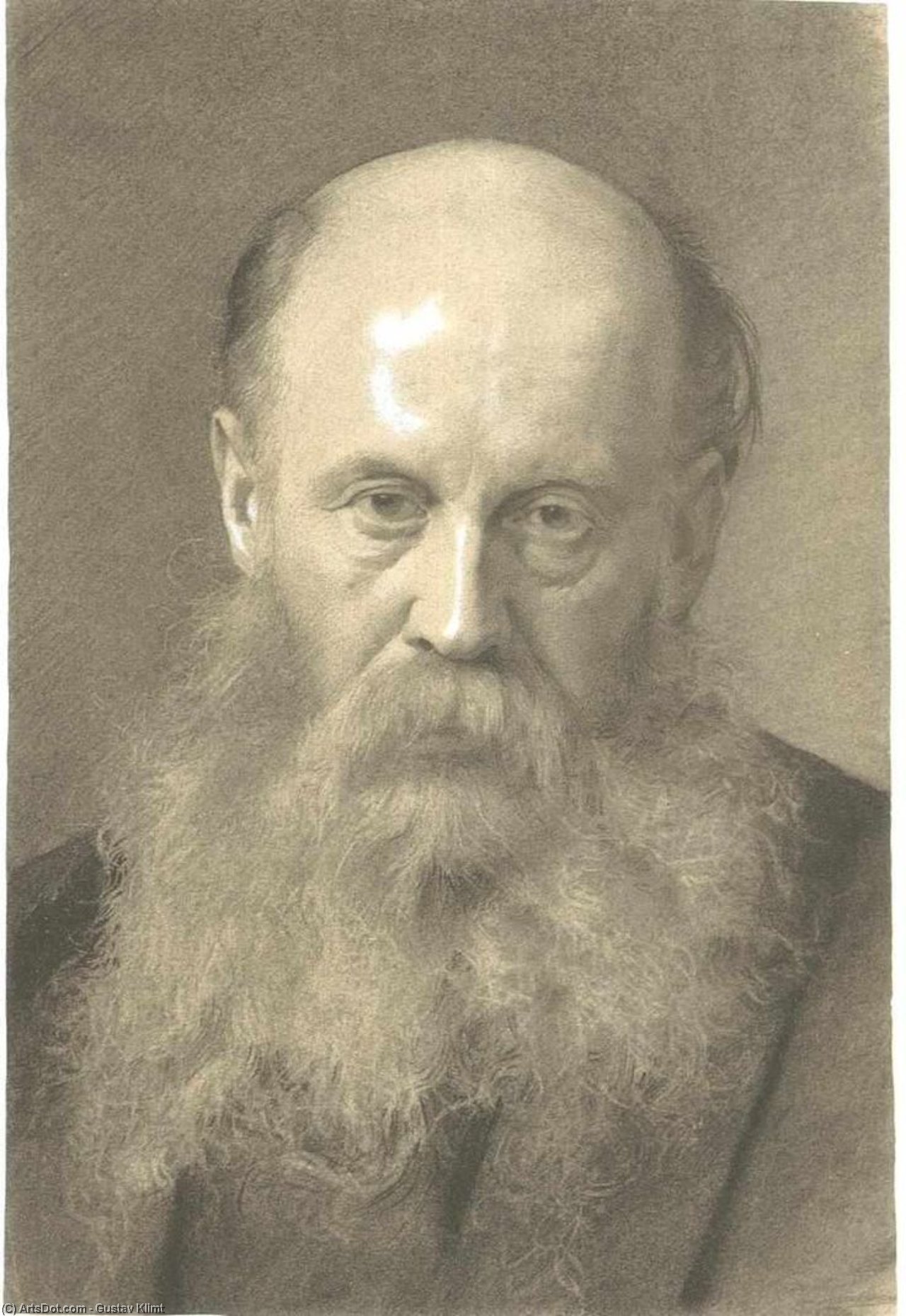
Gustav Klimt's 'Brustbild eines bärtigen Mannes von vorne': A Study of the Artist and His Work
Austrian symbolist painter Gustav Klimt (1862-1918) stands as a monumental figure in the artistic landscape of the late 19th century, celebrated for his distinctive visual language—a fusion of opulent ornamentation, sensual imagery, and profound psychological exploration. As a pivotal member of the Vienna Secession movement, Klimt irrevocably altered perceptions of portraiture and decorative art, establishing himself as an icon of Art Nouveau and profoundly influencing subsequent generations of artists.
Early Life and Artistic Foundations
- Born on July 14, 1862, in Baumgarten near Vienna, Austria, Klimt’s upbringing was marked by financial hardship and familial instability. His father, Ernst Klimt, a gold engraver, pursued employment opportunities across Bohemia, shaping young Gustav's awareness of economic realities.
- Despite these challenges, Klimt demonstrated exceptional artistic talent from an early age, nurtured by his father’s profession and instilled with a passion for visual expression. He honed his skills at the Vienna Kunstgewerbeschule (School of Applied Arts), studying architectural painting under Ferdinand Laufberger—a formative experience that exposed him to both traditional academic styles and burgeoning avant-garde ideas.
The Secession Movement and Artistic Innovation
- In 1897, Klimt co-founded the Wiener Sezession (Vienna Secession), a revolutionary artistic collective that vehemently rejected the conservative conventions of Viennese art circles. Unlike many movements of its time, the Secession eschewed formal manifesto declarations, fostering an environment where diverse stylistic approaches flourished—allowing Klimt to push boundaries and refine his singular vision.
- The Secession’s ethos championed experimentation and challenged established artistic hierarchies, providing Klimt with a platform to explore themes of sexuality, mythology, and psychological complexity. His rejection of academic dogma solidified his commitment to creating art that resonated emotionally and intellectually.
‘Brustbild eines bärtigen Mannes von vorne’: A Portrait Beyond Representation
‘Brustbild eines bärtigen Mannes von vorne’ (Portrait of a Bearded Man from the Front), completed around 1895, exemplifies Klimt's groundbreaking approach to portraiture. Unlike conventional depictions prioritizing anatomical accuracy, Klimt prioritized conveying inner emotion and psychological state through intricate patterns and shimmering gold leaf—a technique characteristic of his “Golden Phase.” The subject’s face is rendered with meticulous detail, capturing subtle expressions of contemplation and resilience.
However, the true brilliance of the piece lies in its juxtaposition against a backdrop of stylized geometric shapes and swirling arabesques. These decorative elements serve not merely as ornamentation but as conduits for symbolic meaning—representing concepts of masculinity, spirituality, and the interplay between masculine and feminine energies. Klimt’s masterful use of gold leaf elevates the portrait beyond mere likeness, transforming it into an emblem of artistic grandeur and spiritual contemplation.
Legacy and Enduring Influence
Gustav Klimt's oeuvre continues to captivate audiences worldwide, securing his place as one of the most influential artists of the 20th century. His distinctive style—characterized by opulent ornamentation, sensual imagery, and psychological depth—inspired countless subsequent artists and designers. ‘Brustbild eines bärtigen Mannes von vorne’ stands as a testament to Klimt's unwavering commitment to artistic innovation and his ability to imbue visual art with profound emotional resonance. To explore the beauty and complexity of Klimt’s masterpieces, visit ArtsDot.com for exceptional hand-painted reproductions.