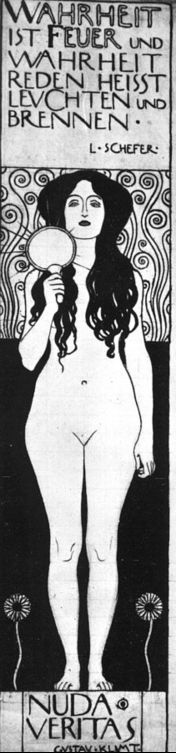
Gustav Klimt’s mesmerizing 'Drawing for Two Emblems for Ver Sacrum' captures Art Nouveau elegance with a nude woman gazing into a mirror—a poignant exploration of truth and beauty rendered in flowing lines and shimmering gold leaf. Admire this iconic masterpiece and bring timeless artistry home.
Discover Gustav Klimt (1862-1918), the Austrian Symbolist master of Art Nouveau! Explore his iconic 'Golden Phase,' sensual portraits, and masterpieces like *The Kiss*. Learn about his life, influences & legacy.
A Portrait of Reflection: Gustav Klimt’s “Drawing for Two Emblems for Ver Sacrum (Nuda Veritas)”
The photograph captures a striking image—Gustav Klimt's preparatory sketch for "Ver Sacrum" ("Sacred Grove"), a monumental mural commissioned for the Österreichisches Kunstgebäude in Vienna. More than just a depiction of a woman, this drawing embodies the spirit of Art Nouveau and delves into profound themes of introspection and idealized beauty. Klimt’s meticulous attention to detail reveals not only his mastery of technique but also his deep engagement with artistic symbolism prevalent during his era.
Style and Technique: The Fluid Embrace of Art Nouveau
Klimt's approach is unmistakably rooted in the Art Nouveau movement, which flourished between 1890 and 1910. Characterized by organic forms, flowing lines, and opulent ornamentation—particularly gold leaf—Art Nouveau sought to reject industrial aesthetics and embrace a celebration of nature’s rhythms and feminine grace. This sketch exemplifies these principles perfectly; the woman's pose is deliberately languid, mirroring the undulating curves of the decorative borders surrounding her figure. The artist skillfully employs charcoal or pencil on paper, achieving remarkable tonal contrasts through careful shading—a technique honed during his formative years at the Kunstgewerbeschule. Lines are not merely delineating shapes but actively contributing to the overall visual harmony, creating a sense of movement and dynamism that is characteristic of the style.
Historical Context: Vienna’s Artistic Renaissance
Vienna in Klimt's time was experiencing an artistic renaissance fueled by intellectual ferment and patronage from wealthy industrialists and aristocrats. The Viennese Secession, founded in 1897 by Klimt alongside artists like Josef Maria Olbrich and Emil Körner, challenged the conservative academic tradition and championed a new vision of art—one that prioritized expressive freedom and psychological depth. “Ver Sacrum,” intended as a centerpiece for this revolutionary movement, aimed to depict the Virgin Mary surrounded by symbolic flora and fauna, reflecting the spiritual aspirations of the period. Klimt’s preparatory sketch serves as an invaluable glimpse into his creative process and underscores the importance of symbolism in conveying artistic ideas.
Symbolism: Mirroring Truth and Embracing Feminine Ideal
The central element—the mirror—is laden with symbolic significance. It represents introspection, self-awareness, and the quest for inner truth – mirroring the title itself, “Nuda Veritas” ("Bare Truth"). Klimt’s depiction of the woman is deliberately idealized, reflecting Art Nouveau's fascination with feminine beauty as a symbol of purity and spiritual harmony. The flowing hair and graceful posture convey an aura of serenity and contemplation. Furthermore, the circular decorative motifs—likely inspired by Celtic spirals—suggest connections to ancient mythology and represent wholeness and cyclical renewal.
Emotional Impact: A Moment Frozen in Time
Ultimately, “Drawing for Two Emblems for Ver Sacrum (Nuda Veritas)” transcends mere visual representation; it evokes a feeling of quiet contemplation and reverence. Klimt’s masterful use of tonal shading creates an atmosphere of subdued luminosity, inviting the viewer to immerse themselves in the scene's serene beauty. The drawing captures not just a portrait but also a psychological state—a yearning for spiritual understanding and an appreciation for the sublime elegance of the female form. It remains a testament to Klimt’s artistic genius and his enduring contribution to Art Nouveau’s legacy.