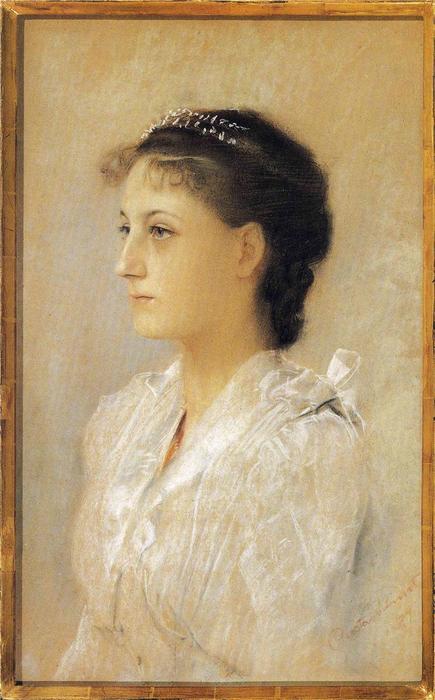
Emilie Floge, Aged 17: A Portrait of Youthful Grace in Klimt’s Vienna
Gustav Klimt's “Emilie Flöge, Aged 17,” painted in 1891, is more than just a portrait; it’s a shimmering window into the heart of late 19th-century Vienna – a city pulsating with artistic innovation and social change. The painting depicts Emilie Louise Flöge, a pioneering fashion designer and Klimt's lifelong companion, at seventeen, capturing her poised beauty and hinting at the vibrant personality that would shape her remarkable career. The image immediately draws the eye to the young woman’s profile, framed by a delicate white dress and crowned with an ornate headpiece – a subtle nod to both aristocratic tradition and the burgeoning artistic sensibilities of the era.
Klimt's masterful use of black and white creates an immediate sense of timelessness and formality, reminiscent of classical portraiture while simultaneously retaining a distinctly modern aesthetic. The stark contrast emphasizes the delicate textures of her gown – the subtle folds, the sheen of the fabric – and highlights the luminous quality of her skin. The composition is carefully balanced; Emilie occupies a significant portion of the frame, yet she’s placed within a softly receding background, creating a sense of depth that invites the viewer to contemplate her presence.
Art Nouveau and the Vienna Secession: A Blossoming Aesthetic
“Emilie Flöge, Aged 17” is firmly rooted in the Art Nouveau movement, also known as Jugendstil in Germany. This style, which flourished throughout Europe at the turn of the century, rejected academic art traditions in favor of organic forms, flowing lines, and a celebration of nature. Klimt was a key figure in the Vienna Secession, an artistic group that broke away from the conservative Academy of Fine Arts to establish their own independent salon and exhibition space. The Secession championed innovation and challenged established norms, embracing themes of beauty, sensuality, and symbolism – all powerfully evident in this portrait.
The influence of Japanese prints is also discernible; Klimt was deeply fascinated by the aesthetics of the East, particularly its use of flat planes, bold outlines, and decorative patterns. This can be seen in the simplified forms of Emilie’s dress and the overall sense of stylized elegance. Furthermore, the painting reflects the broader social currents of the time – a growing interest in female emancipation and a desire to redefine traditional notions of beauty.
Symbolism and the Portrait as Window
Beyond its aesthetic qualities, “Emilie Flöge, Aged 17” is rich in symbolic meaning. The crown on her head represents not just social status but also a connection to tradition and perhaps even a hint of artistic aspiration. Her direct gaze towards the viewer establishes an immediate intimacy, inviting us into her world and suggesting a shared understanding. Klimt frequently used portraiture as a means of exploring complex psychological themes, and this painting is no exception.
The choice of black and white further amplifies the symbolic weight of the image. It evokes notions of purity, innocence, and timelessness – qualities that are particularly relevant when considering Emilie’s youth and her potential for future development. The subtle details—the delicate lace at the neckline, the carefully arranged hair—speak volumes about the values and aspirations of the era.
A Timeless Masterpiece: Reproductions and Artistic Legacy
ArtsDot offers meticulously crafted hand-painted reproductions of “Emilie Flöge, Aged 17,” allowing you to bring this iconic artwork into your home or office. Our skilled artists faithfully recreate Klimt’s delicate brushwork, nuanced color palette, and evocative composition, ensuring that the essence of the original painting is preserved with stunning accuracy. Whether you're an art collector, a design enthusiast, or simply someone who appreciates beauty, a ArtsDot reproduction offers a unique opportunity to own a piece of Viennese artistic history.
Consider how this portrait’s themes – youth, beauty, and the burgeoning spirit of modernism – resonate with contemporary sensibilities. “Emilie Flöge, Aged 17” remains a powerful testament to Klimt's genius and a captivating glimpse into a transformative era in art history.