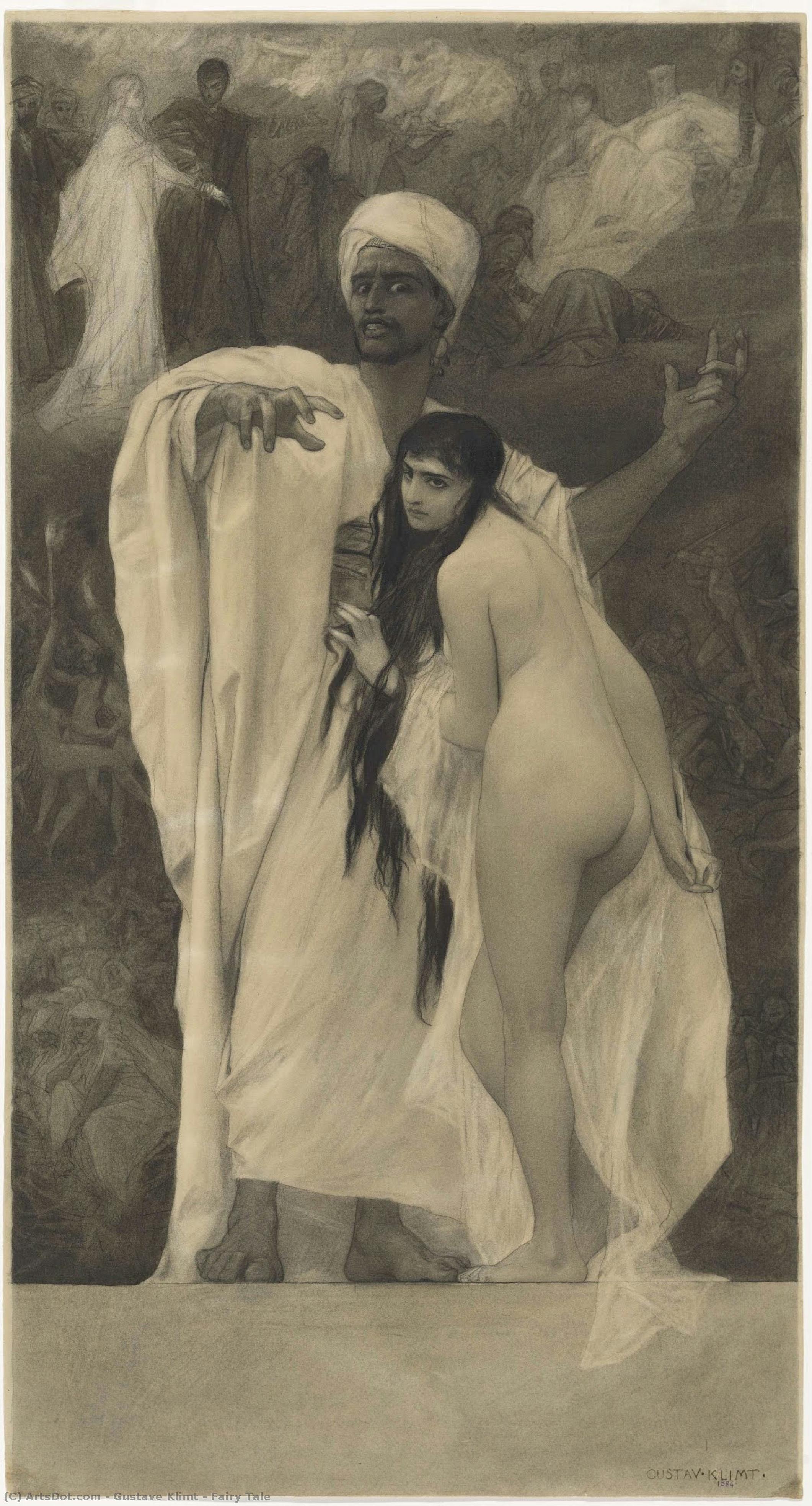
Gustave Klimt’s "Fairy Tale" etching: A dramatic, monochromatic scene of an Arab man & nude woman. Romantic Symbolism, intricate detail, & rich texture – a captivating masterpiece.
Discover Gustav Klimt (1862-1918), the Austrian Symbolist master of Art Nouveau! Explore his iconic 'Golden Phase,' sensual portraits, and masterpieces like *The Kiss*. Learn about his life, influences & legacy.
Explore Vienna's artistic soul at the Wien Museum! Discover Klimt masterpieces & delve into centuries of history through stunning art collections, archaeological finds & architectural grandeur.
A Dramatic Encounter: Unveiling Klimt’s ‘Fairy Tale’ (1884)
This striking monochromatic etching by Gustav Klimt, created in 1884, presents a scene of intense drama and unsettling intimacy. Far removed from the opulent gold leaf that would later define his signature style, *Fairy Tale* reveals Klimt's early mastery of line and shadow, showcasing a raw emotional power characteristic of Symbolist art.
Subject & Composition
The artwork depicts an Arab man and a nude woman locked in a charged encounter. The composition is deliberately complex; the central figures dominate the foreground, yet are surrounded by a swirling mass of indistinct onlookers. This creates a sense of both exposure and isolation – the couple seemingly set apart from, or perhaps oblivious to, the world around them. Klimt’s meticulous attention to detail is evident in the rendering of the man's elaborate cloak and the delicate contours of the woman’s form. The flattened perspective adds to the theatricality, drawing the viewer directly into this ambiguous moment.
Technique & Style
Klimt employs etching with exceptional skill, utilizing a dense network of fine lines – achieved through cross-hatching and stippling – to build up tonal variations and create rich textures. This technique lends a tactile quality to the image, almost as if one could feel the weight of the drapery or the smoothness of skin. While foreshadowing elements of his later Art Nouveau style, *Fairy Tale* firmly resides within the realm of Symbolism and Romanticism. The emphasis is on evoking emotion and exploring subjective experience rather than adhering to strict realism.
Historical Context & Early Klimt
Created during a formative period in Klimt’s career – before his involvement with the Vienna Secession and his iconic “golden phase” – *Fairy Tale* offers valuable insight into his artistic development. In the 1880s, Klimt was establishing himself as a sought-after artist through commissions for decorative murals alongside his brother Ernst and Franz von Matsch within their collaborative "Company of Artists." However, works like this demonstrate his growing desire to explore more personal and challenging themes beyond purely decorative purposes. This period saw him experimenting with different styles and techniques, laying the groundwork for the revolutionary art he would become known for.
Symbolism & Interpretation
The symbolism within *Fairy Tale* is deliberately ambiguous, inviting multiple interpretations. The scene hints at themes of seduction, power dynamics, and perhaps even alienation. The contrast between the clothed man and the nude woman immediately suggests an imbalance of control. The anonymous crowd could represent societal judgment or simply the indifferent gaze of the world. Is this a moment of liberation, exploitation, or something more complex? Klimt leaves these questions unanswered, allowing the viewer to project their own emotions and experiences onto the scene.
Emotional Impact & Aesthetic Appeal
*Fairy Tale* is not merely a visually striking artwork; it’s an emotionally resonant one. The dramatic lighting, intricate detail, and ambiguous narrative create a sense of mystery and heightened tension. The work's monochromatic palette further intensifies the emotional impact, focusing attention on form and texture rather than color. For collectors and interior designers, this etching offers a unique opportunity to acquire a rare example of Klimt’s early work – a piece that showcases his technical brilliance and foreshadows the artistic revolution he would soon ignite. It's a captivating artwork capable of adding depth and intrigue to any collection or space.