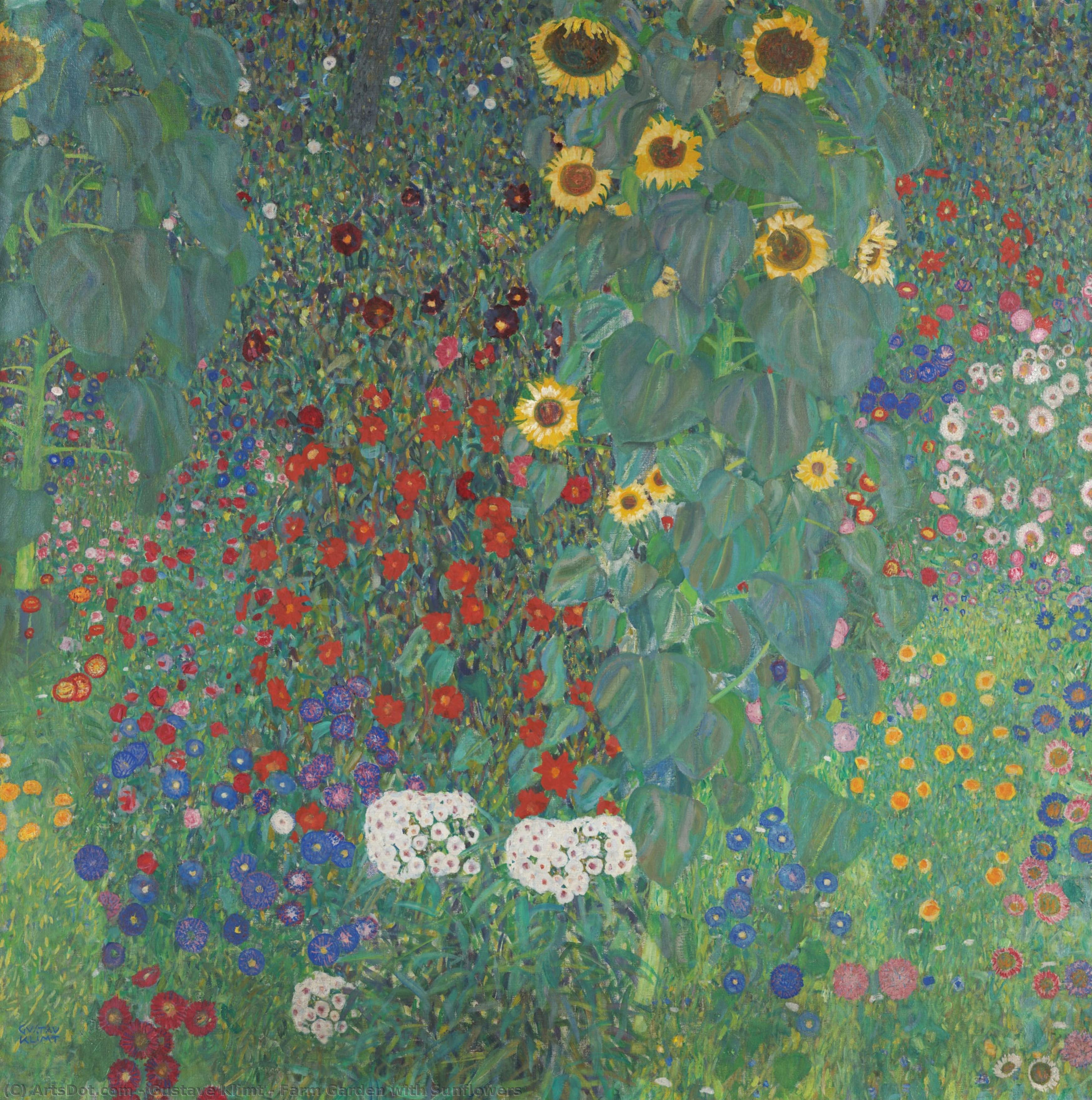
A Vision of Abundance: Gustav Klimt’s “Farm Garden with Sunflowers”
Gustav Klimt's "Farm Garden with Sunflowers," painted in 1907, isn’t merely a depiction of a summer landscape; it’s an immersive experience, a carefully constructed visual poem that embodies the artist’s signature style and his fascination with pattern, color, and the interplay between nature and ornamentation. This painting, housed within the Belvedere Palace in Vienna, offers a glimpse into Klimt's unique approach to landscape – one where depth is deliberately flattened, and the natural world transforms into an elaborate, almost decorative surface.
Klimt’s process reveals a fascinating technique. He employed a square cardboard frame, a self-made tool that guided his hand in capturing the most detailed elements of the Attersee region's scenery. This method resulted in a deliberate reduction of spatial depth; the horizon and sky vanish entirely, creating a mesmerizing mosaic of flowers, foliage, and sunlight. Instead of traditional perspective, Klimt presents a world composed of interlocking geometric shapes and vibrant hues, reminiscent of intricate textile designs – a characteristic that led Viennese writer Hermann Bahr to famously describe Viennese painting as “painted carpets.” This deliberate flattening wasn’t an accident; it was a conscious choice to elevate the decorative qualities of nature, mirroring the artistic trends of the time.
The Golden Phase and Symbolism
“Farm Garden with Sunflowers” firmly places Klimt within his celebrated “Golden Phase,” a period marked by lavish use of gold leaf and an exploration of sensuality and mythology. The painting’s rich palette – dominated by yellows, oranges, reds, and greens – immediately draws the eye, creating a dazzling visual feast. However, beneath this opulent surface lies a complex web of symbolism. The sunflowers themselves are potent emblems of adoration and loyalty, their towering presence suggesting an almost regal status within the garden's composition. The abundance of flowers, each rendered with meticulous detail, speaks to themes of fertility, life’s cyclical nature, and the beauty of the natural world – all viewed through Klimt’s distinctly sensual lens.
Furthermore, the painting reflects Klimt’s broader artistic influences, particularly Japanese art. The flattened perspective, the emphasis on decorative patterns, and the integration of organic forms into geometric designs are hallmarks of Japonisme, a trend that profoundly impacted European artists at the turn of the 20th century. The garden becomes less a realistic representation and more an idealized, almost dreamlike space—a testament to Klimt’s ability to synthesize diverse artistic traditions.
A Window into Vienna's Artistic Landscape
“Farm Garden with Sunflowers” is not just a beautiful painting; it’s a significant artifact within the context of Viennese art history. Klimt’s innovative approach, challenging traditional notions of landscape representation, resonated deeply with his contemporaries, including Max Liebermann, who famously remarked that Viennese painting was “not about paintings, but painted carpets.” The controversy surrounding the painting's depiction of figures – particularly in the "Faculty Paintings" – highlights the tensions between artistic freedom and societal expectations during this period. This work stands as a powerful example of Klimt’s bold experimentation and his willingness to push boundaries, solidifying his place as a pivotal figure in the Vienna Secession movement.
Today, “Farm Garden with Sunflowers” continues to captivate viewers with its vibrant colors, intricate patterns, and evocative symbolism. ArtsDot offers meticulously crafted hand-painted reproductions of this masterpiece, allowing you to bring this iconic work into your home or office – a stunning addition that celebrates the genius of Gustav Klimt.