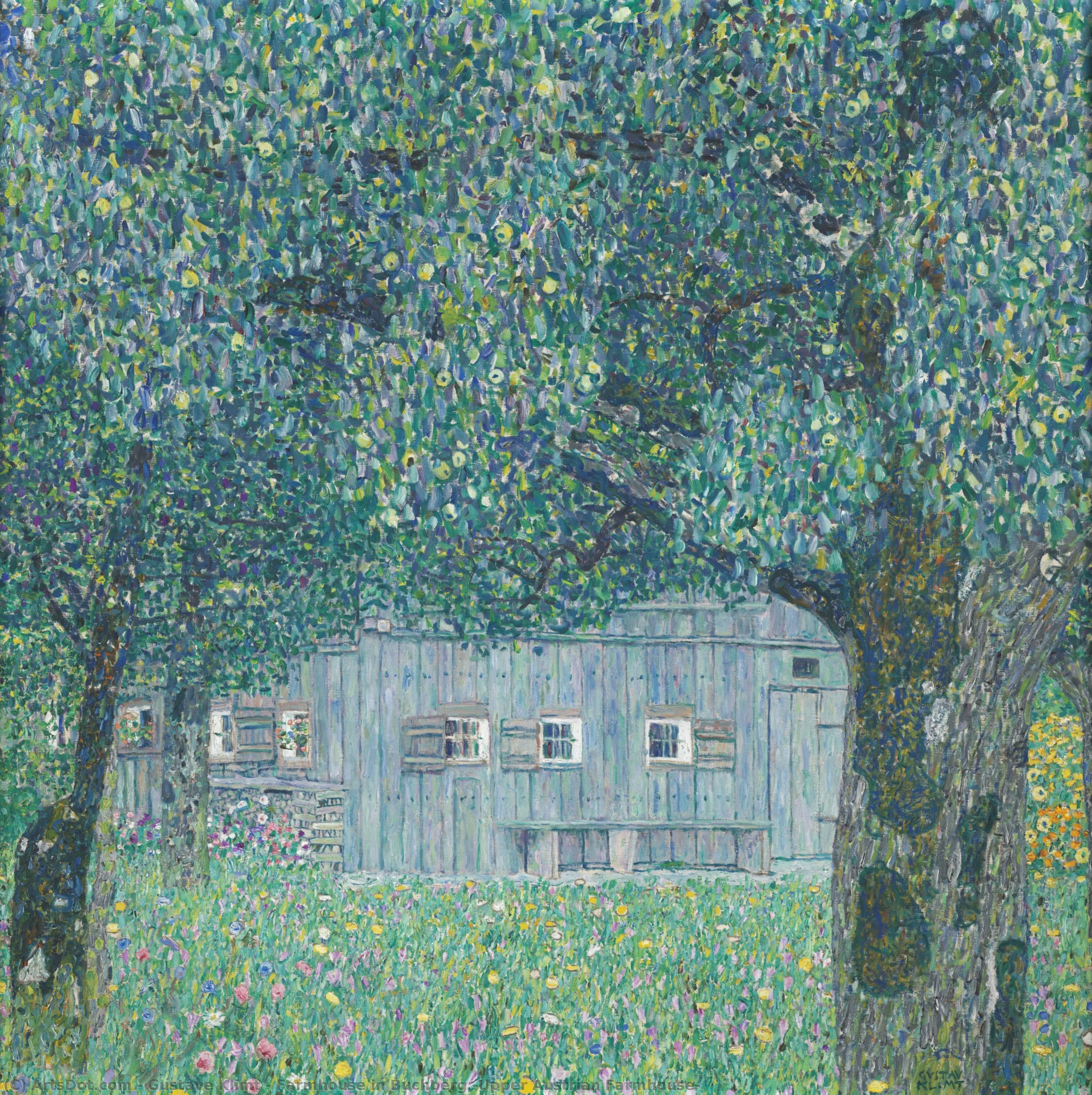
Farmhouse in Buchberg (Upper Austrian Farmhouse): A Pointillist Landscape by Klimt
Gustav Klimt, a celebrated figure of the Art Nouveau movement, presents a captivating departure from his more iconic portraiture and symbolic works with Farmhouse in Buchberg (Upper Austrian Farmhouse). Painted in 1911, this landscape exemplifies Klimt's unique adaptation of pointillism, offering a serene glimpse into rural Austria while showcasing the artist’s technical versatility.
Pointillist Innovation and Technique
Influenced by French and Belgian pointillists exhibited during the Vienna Secession around 1900, Klimt developed his own distinct approach. Unlike his contemporaries who employed uniform dabs of color to blend motifs seamlessly, Klimt strategically utilized pointillism to emphasize specific elements—tree trunks, fruits, and foliage—creating small-scale, irregular mosaics that imbue the landscape with depth and texture. This technique moves beyond mere color mixing; it creates a visual rhythm and a sense of shimmering light.
Compositional Choices and Symbolic Significance
In Farmhouse in Buchberg, Klimt deliberately constructs a flattened, two-dimensional effect. The farmhouse itself is nestled amidst an abundance of fruit trees whose expansive canopies effectively obscure any distant views of the landscape or sky. This intentional elimination of spatial depth and shadows contributes to the motifs’ characteristic flatness, a hallmark of Klimt's landscapes. The composition isn't about capturing realistic perspective; it's about creating a decorative panel, an idealized vision of rural life.
Artistic Context and Art Nouveau Influence
This painting stands as a significant example of Klimt’s contribution to the Art Nouveau movement. The vibrant colors, intricate patterns, and stylized forms are quintessential features of this style, which championed modernity and innovation. Farmhouse in Buchberg demonstrates how Klimt could adapt his artistic techniques to suit diverse subjects, highlighting his remarkable versatility. It also reveals a shift away from purely symbolic representation towards a more observational approach, albeit filtered through the lens of Art Nouveau aesthetics.
Emotional Resonance and Lasting Appeal
Farmhouse in Buchberg evokes a sense of tranquility and idyllic beauty. The painting’s harmonious color palette and carefully arranged composition create a calming atmosphere, inviting viewers to appreciate the simple pleasures of rural life. It's a testament to Klimt’s ability to transform an ordinary scene into something extraordinary, demonstrating his mastery of color, form, and technique. This work offers a refreshing contrast to Klimt’s more opulent and symbolic pieces, revealing another facet of his artistic genius.