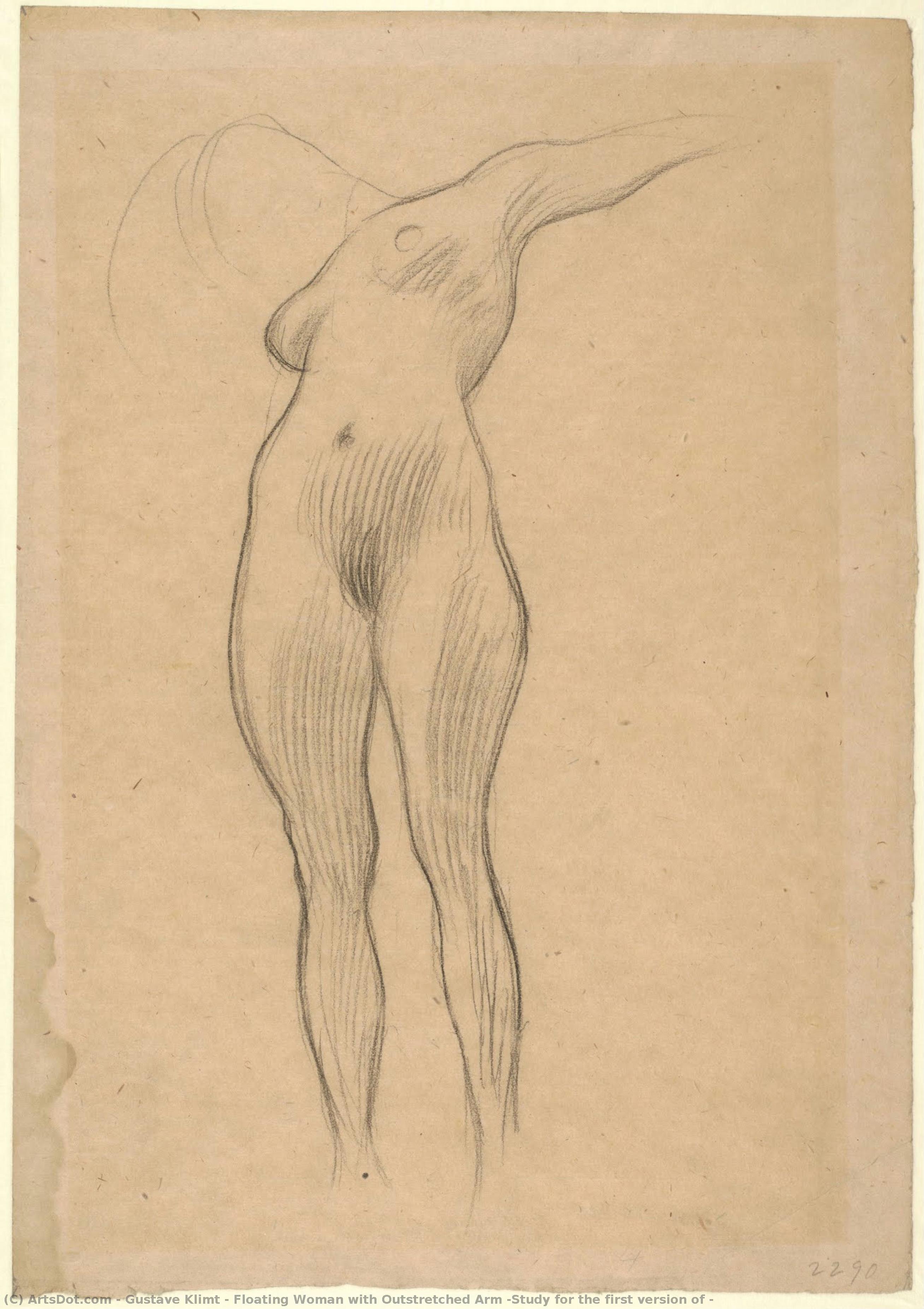
A Study in Serenity: Gustav Klimt’s “Floating Woman with Outstretched Arm”
Gustav Klimt's "Floating Woman with Outstretched Arm," a preparatory study for his iconic 1907-08 painting “Medicine,” offers a poignant glimpse into the artist’s creative process and reveals a profound exploration of femininity, spirituality, and the human condition. Completed in 1901, this chalk drawing—a remarkably intimate work considering Klimt's later opulent murals—captures a moment of intense contemplation before the full explosion of gold and symbolism that would define the final version. It’s not merely a preparatory sketch; it’s a fully realized meditation on grace, vulnerability, and an almost ethereal connection to something beyond the earthly realm.
The composition is strikingly simple yet powerfully evocative. A woman, rendered in Klimt's signature elongated form, floats suspended in mid-air, her body subtly draped with flowing fabrics that hint at a classical influence while simultaneously suggesting a modern sensibility. Her arms are outstretched, palms open as if offering a gesture of supplication or perhaps welcoming an unseen force. The lack of a defined ground plane—the absence of any supporting structure—heightens the sense of weightlessness and disorientation, drawing the viewer into her internal world. The use of chalk lends a delicate fragility to the image, contrasting beautifully with the underlying strength and quiet dignity of the figure.
The Vienna Secession and Klimt’s Artistic Evolution
To fully appreciate “Floating Woman,” one must understand its context within the broader artistic landscape of early 20th-century Vienna. Klimt was a pivotal figure in the Vienna Secession, a group of artists who rejected the conservative academic traditions of the time and sought to forge a new path rooted in symbolism and subjective experience. The Secession’s manifesto, famously declaring “art for art's sake,” signaled a shift away from purely representational painting towards a more expressive and emotionally charged approach. Klimt, however, pushed beyond mere stylistic rebellion; he developed a highly personal visual language characterized by intricate patterns, flattened forms, and the deliberate use of color to convey mood and symbolism.
This study exemplifies this evolution. Prior to his “golden phase,” Klimt explored themes of eroticism and psychological complexity with a darker palette. The muted tones of this drawing—primarily grays and whites—reflect a more introspective mood, foreshadowing the spiritual yearning that would become central to his later work. It’s a transitional piece, demonstrating his experimentation with form and composition before embracing the lavish ornamentation and vibrant hues of “Medicine” and subsequent masterpieces.
Symbolism and the Allure of the Female Figure
Klimt's female figures are rarely straightforward representations; they are often imbued with symbolic meaning. In "Floating Woman," her outstretched arms suggest a reaching for transcendence, a desire to connect with something greater than herself—perhaps divine grace or universal consciousness. The pose itself is reminiscent of classical depictions of supplicants before the gods, but Klimt imbues it with a distinctly modern sensibility, stripping away overt religious iconography and focusing instead on the raw emotion of human longing.
The use of chalk, a medium often associated with sketches and studies, adds to the work’s aura of intimacy and vulnerability. It suggests that this image was created not as a finished product but as a preliminary exploration of ideas—a fleeting moment captured before Klimt fully realized his vision. The simplicity of the drawing belies its profound depth, inviting viewers to contemplate the mysteries of human existence and the enduring power of art to evoke emotion and inspire contemplation.
A Reproduction for Your Space
ArtsDot is proud to offer a meticulously hand-painted reproduction of Gustav Klimt’s “Floating Woman with Outstretched Arm.” Unlike digital prints, our reproductions capture the delicate texture and nuanced tonal range of the original chalk drawing, faithfully recreating Klimt's artistic intent. Each piece is created by skilled artists using traditional techniques, ensuring exceptional quality and longevity. This artwork will not only grace your walls but also serve as a poignant reminder of Klimt’s genius and his enduring exploration of beauty, spirituality, and the human heart. Consider this study as a gateway to understanding the full power and emotional resonance of “Medicine,” a truly iconic work of art.