Discover Gustav Klimt (1862-1918), the Austrian Symbolist master of Art Nouveau! Explore his iconic 'Golden Phase,' sensual portraits, and masterpieces like *The Kiss*. Learn about his life, influences & legacy.
Judith II: A Dance of Sensuality and Gold – Exploring Klimt’s Masterpiece
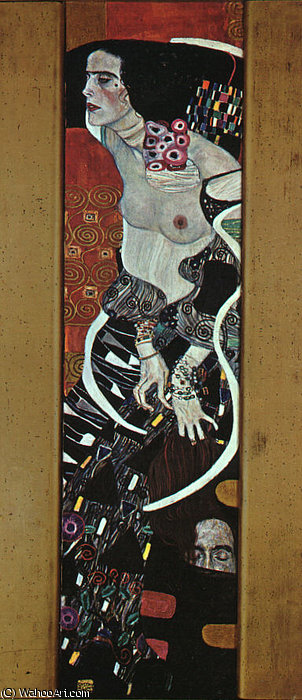
Gustav Klimt's *Judith II*, painted in 1909, stands as a cornerstone of the Vienna Secession movement and arguably his most celebrated work. More than just a portrait, it’s an immersive experience—a visual poem rendered in shimmering gold leaf and vibrant hues that continues to captivate audiences today. This monumental canvas delves into themes of desire, femininity, and pagan ritual, reflecting Klimt's fascination with mythology and symbolism alongside his groundbreaking embrace of Art Nouveau aesthetics.
The Visual Language of Myth and Desire
The painting depicts Judith, a biblical heroine famed for slaying Holofernes, the Assyrian siege commander threatening Jerusalem. However, Klimt reimagines this narrative not as an act of heroic defiance but as a sensual dance—Judith is presented in an abstract form, her torso partially exposed, embodying grace and movement. The artist skillfully employs curvilinear lines and flowing drapery to convey fluidity and dynamism, mirroring the rhythm of music and evoking a feeling of ethereal beauty. This deliberate departure from traditional portraiture underscores Klimt’s ambition to transcend mere representation and communicate deeper emotional truths.
Technique and Material Innovation: Gold Leaf as Symbolic Expression
Klimt's mastery lies in his innovative use of gold leaf—a technique borrowed from Byzantine mosaics—which dominates the composition. This opulent material isn’t merely decorative; it symbolizes divine illumination, fertility, and immortality – concepts central to Klimt’s worldview and deeply rooted in Austro-Hungarian cultural traditions. The meticulous application of gold leaf creates a tactile surface that reflects light exquisitely, enhancing the painting's luminosity and contributing to its mesmerizing visual impact. Alongside gold leaf, Klimt utilizes oil paints with remarkable precision, layering colors to achieve subtle gradations and capturing the nuances of skin tone and fabric texture.
Historical Context: Vienna Secession and Artistic Rebellion
*Judith II* emerged during a period of significant artistic upheaval in Vienna—the Viennese Secession challenged the conservative academic art establishment of the time. Founded in 1907 by Klimt, Emil Schiele, Oskar Kokoschka, and Josef Maria Olbrich, the Secession championed individualism and stylistic experimentation, rejecting historical imitation for fresh visions inspired by Art Nouveau influences. Klimt’s bold aesthetic choices—his sensual imagery, his rejection of conventional compositional rules, and his unapologetic exploration of psychological complexity—represented a decisive break from artistic conventions and solidified Vienna's position as a vanguard of modern art.
Emotional Resonance: A Portrait of Female Power and Vulnerability
Despite its grandeur and symbolic richness, *Judith II* possesses an undeniable emotional core. Klimt captures Judith’s gaze with arresting intensity, conveying both confidence and vulnerability—a paradoxical juxtaposition that speaks to the complexities of female experience. The painting invites contemplation on themes of desire, repression, and transformation, prompting viewers to consider the interplay between beauty and danger. Ultimately, *Judith II* remains a testament to Klimt's artistic genius and his ability to distill profound psychological insights into unforgettable visual imagery.