A Vision in Red and Shadow: The Ethereal Grace of Klimt
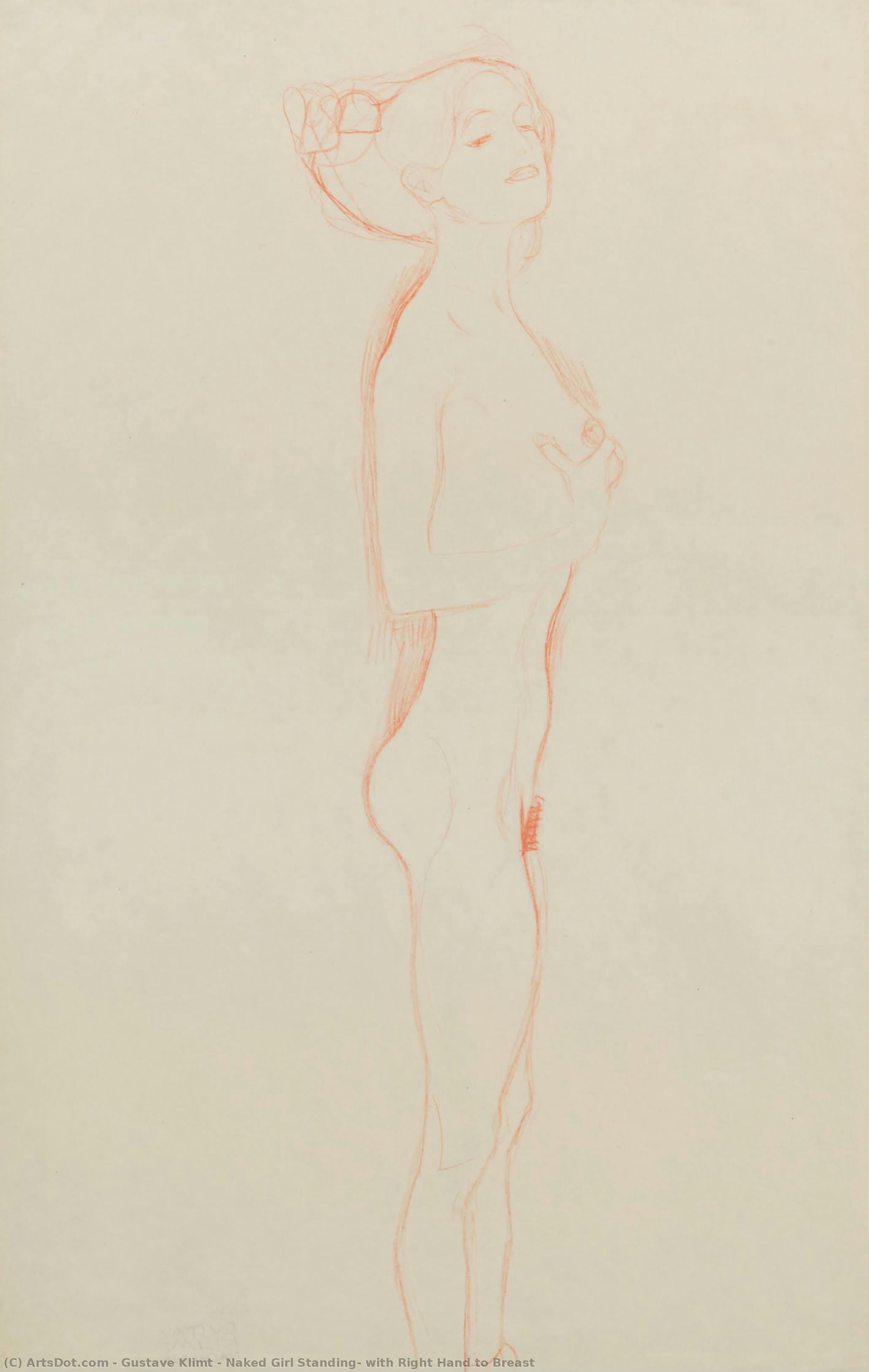
In the quiet intimacy of a single sheet of paper, Gustav Klimt captures a moment of profound vulnerability and strength. Naked Girl Standing, with Right Hand to Breast is not merely a study of the human form; it is an evocative window into the soul of the Austrian Symbolist movement. Created in 1906, this drawing transcends the boundaries of simple sketching, offering instead a rhythmic dance of line and emotion. The subject, a slender female figure, stands with an upright, almost statuesque posture that hints at the influence of ancient Egyptian and Assyrian aesthetics. Her gaze, though partially obscured by the dramatic interplay of light and shadow, carries an intensity that commands the viewer's attention, pulling us into her private, contemplative world.
The technique employed here is a masterclass in economy and impact. Utilizing red crayon on paper, Klimt eschews the heavy layering of his famous "golden phase" to focus on the raw power of contour. The artist uses concentrated strokes along the edges of the body to create a sense of three-dimensionality, making the figure appear to emerge from the white void of the background. This deliberate use of negative space allows the viewer to focus entirely on the sinuous curves and the delicate tension in her hand as it rests against her breast. The palette, dominated by deep reds and stark blacks, lends a dramatic, almost theatrical atmosphere to the piece, transforming a simple nude study into a powerful narrative of existence.
Symbolism and the Spirit of Vienna
To understand this work, one must look toward the cultural heartbeat of 1906 Vienna. This was an era defined by the tension between tradition and the burgeoning modern psyche, a time when the seeds of psychoanalysis were beginning to reshape how humanity viewed desire, fear, and the subconscious. Klimt, a central figure of the Vienna Secession, used his art to break free from academic constraints. In this drawing, the elongated limbs and the upward movement of the head suggest a spiritual aspiration, a yearning to rise above the material world. The way the figure supports herself is both a gesture of self-reliance and a symbol of the delicate balance between fragility and endurance.
For the discerning collector or interior designer, this piece offers a unique opportunity to introduce a sense of historical depth and avant-garde elegance into a space. Unlike larger, more overwhelming canvases, this drawing possesses a quiet, magnetic energy that complements sophisticated, minimalist environments. It serves as a conversation piece that invites contemplation, bridging the gap between classical beauty and modern emotional complexity. Whether placed in a sunlit gallery or a moody, curated study, Klimt’s mastery of line ensures that the artwork remains a timeless focal point, embodying an era of unparalleled artistic revolution.