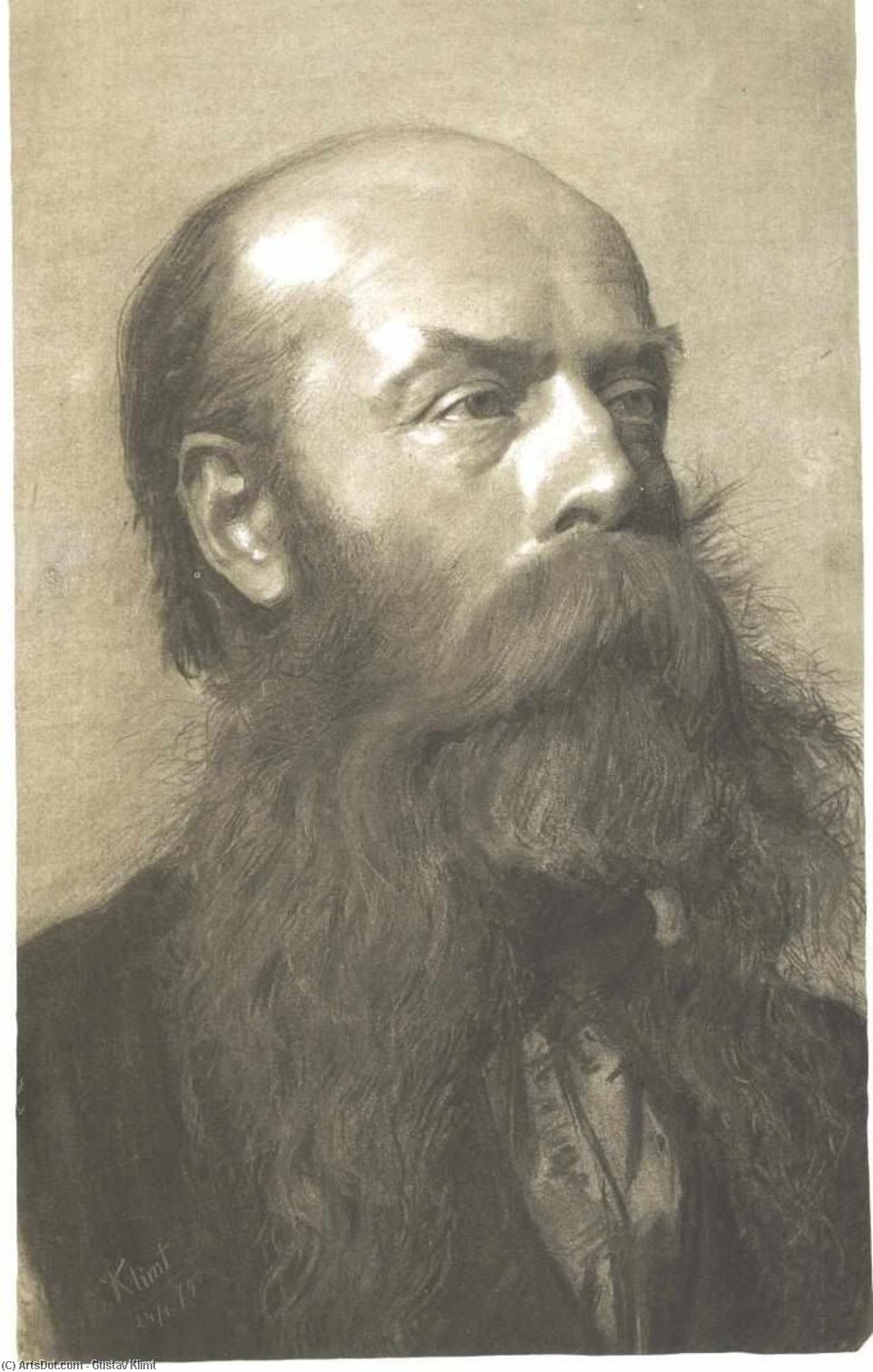
A Portrait Steeped in Shadow and Gold: Gustav Klimt’s ‘Portrait of a Man with Beard in Three Quarter Profil’
Gustav Klimt's 1879 painting, “Portrait of a man with beard in three quarter profil,” is more than just a likeness; it’s a carefully constructed meditation on masculinity, aging, and the quiet dignity of the individual. Emerging from Vienna’s vibrant artistic landscape at the cusp of the Symbolist movement, Klimt here demonstrates an early mastery of realism tempered by a nascent desire to imbue his subjects with deeper meaning. The painting immediately draws the eye with its stark monochrome palette – a deliberate choice that elevates the textures and forms within, reminiscent of drypoint etching or perhaps even woodcut, techniques favored for their ability to capture subtle tonal variations and intricate detail.
The Artist’s Hand: Technique and Material
Close examination reveals Klimt's meticulous approach. The subject, an older gentleman with a long, flowing beard, is rendered with astonishing precision. Hatching and cross-hatching—a hallmark of drypoint—are employed to build up the volume of his face, particularly the strong cheekbones and the textured surface of his beard. Notice how these linear marks create a sense of depth and shadow, suggesting the weight and solidity of his features. The artist skillfully utilizes directional lighting, casting dramatic shadows that accentuate the contours of the face and highlighting the intricate patterns within the fabric draped across his shoulders. The choice of materials—likely a meticulously prepared metal plate for drypoint or an etching stone—contributes significantly to the painting’s tactile quality; one can almost feel the ridges and grooves beneath the surface.
Symbolism in Simplicity: Decoding the Portrait
While seemingly straightforward, “Portrait of a man with beard in three quarter profil” is rich in symbolic undertones. The subject’s expression—a quiet contemplation, perhaps tinged with melancholy—suggests a life lived fully, marked by experience and wisdom. The beard itself, a potent symbol of masculinity, age, and often, authority, anchors the portrait within traditional masculine iconography. The muted color scheme, avoiding bright hues, reinforces this sense of gravitas and seriousness. Klimt’s decision to focus on a three-quarter profile—a common pose in portraiture—allows for a more intimate connection with the subject, inviting the viewer to contemplate his character and inner life. The subtle details – the folds of the clothing, the texture of the fabric – hint at a story beyond what is immediately visible.
A Window into Klimt’s Early Style: Context and Influence
This portrait represents an important transitional phase in Klimt's artistic development. Initially trained within the conservative framework of the Vienna Kunstgewerbeschule, he quickly moved beyond academic conventions, embracing a more expressive and symbolic approach. Influenced by Japanese art—particularly its emphasis on flattened perspectives and decorative patterns—Klimt sought to create works that were both visually arresting and emotionally resonant. The painting’s restrained palette and focus on texture foreshadow the artist's later explorations of gold leaf and opulent ornamentation, hallmarks of his mature style. Further research reveals this work was created during a period when Klimt was experimenting with new techniques and pushing the boundaries of artistic expression, laying the groundwork for his future masterpieces. The painting’s enduring appeal lies in its ability to capture a fleeting moment of human dignity—a testament to the power of portraiture to reveal something profound about the individual within.