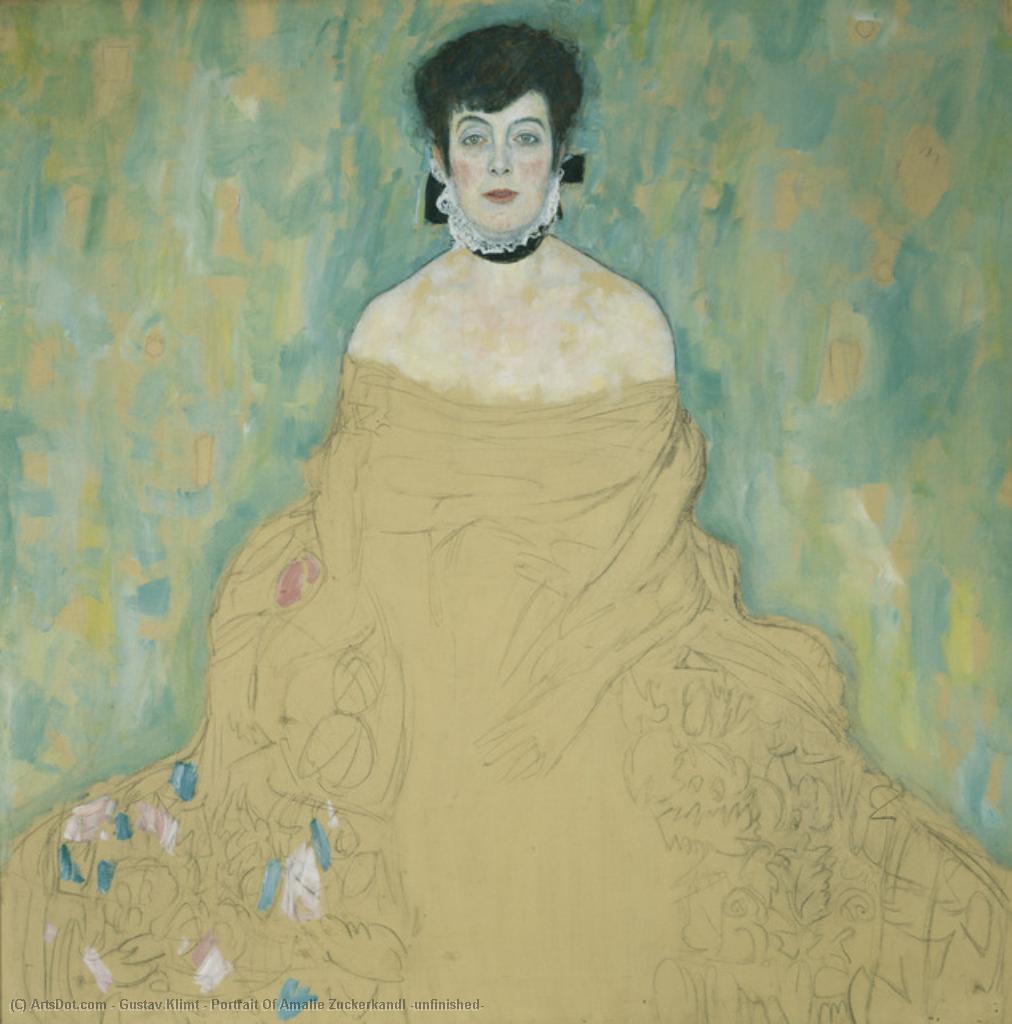
A Glimpse into Klimt’s Process: The Unfinished Portrait of Amalie Zuckerkandl
Gustav Klimt's Portrait of Amalie Zuckerkandl, begun in 1917 and left deliberately unfinished, offers a rare and intimate look into the working method of one of Austria’s most celebrated artists. More than simply an incomplete commission, this painting is a powerful statement on representation, modernity, and the ephemeral nature of beauty.
The Subject and Her World
Amalie Zuckerkandl was a prominent figure in Viennese society – a sophisticated woman connected to intellectual and artistic circles. Her husband, Dr. Otto Zuckerkandl, was a renowned laryngologist who counted Sigmund Freud among his patients. Commissioning Klimt to paint her portrait speaks to the family’s wealth and their embrace of contemporary art. However, the painting's abrupt halt raises questions: Was Amalie dissatisfied? Did Klimt lose interest? Or did he intentionally leave it as a study in form and color?
A Symphony of Color and Texture
The portrait is immediately striking for its vibrant palette and expressive brushwork. Klimt abandons the meticulous detail of his earlier, fully realized works – like the famous Adele Bloch-Bauer I – in favor of a looser, more gestural style. Swirls of emerald green dominate the background, creating an almost abstract field that contrasts with the warmer tones used to depict Amalie’s face and dress. The visible canvas beneath layers of paint adds to the sense of immediacy and raw energy.
Klimt's Style: Beyond the Golden Phase
While Klimt is best known for his “Golden Phase,” characterized by lavish use of gold leaf, this portrait demonstrates a shift in his artistic approach. Created during the latter part of his career and amidst the turmoil of World War I, it reflects a growing preoccupation with psychological depth and emotional intensity. The flattened perspective, characteristic of Art Nouveau, is still present, but here it serves to emphasize the decorative qualities of the paint itself rather than create an illusionistic space.
Symbolism and Emotional Resonance
Though unfinished, the portrait conveys a palpable sense of melancholy. Amalie’s gaze is direct yet distant, her expression hinting at inner complexities. The swirling background can be interpreted as representing the turbulent emotions of the time or perhaps the internal world of the sitter herself. The opulent, though incomplete, drapery suggests wealth and status but also feels somewhat confining – a visual metaphor for the societal expectations placed upon women.
Technique and Materials
Klimt employed oil paints on canvas with a distinctive impasto technique—applying paint thickly to create texture. This is particularly evident in the rendering of Amalie’s dress, where layers of pigment build up to suggest volume and form. The visible brushstrokes are not concealed but celebrated as integral parts of the artwork.
Historical Context: Vienna 1917
1917 was a pivotal year in European history. World War I raged on, casting a shadow over Viennese society. The Austro-Hungarian Empire was crumbling, and traditional values were being questioned. Klimt’s portrait of Amalie Zuckerkandl can be seen as a reflection of this era – a moment of transition and uncertainty captured in paint.
A Lasting Impression
The Portrait of Amalie Zuckerkandl is more than just an unfinished painting; it’s a testament to Klimt's artistic genius and his willingness to experiment. Its raw energy, vibrant colors, and psychological depth continue to captivate viewers today. It serves as a poignant reminder that sometimes, the beauty lies not in completion but in the process itself.
- Artist: Gustav Klimt
- Date: 1917
- Medium: Oil on Canvas
- Location: Österreichische Galerie Belvedere, Vienna, Austria
- Style: Art Nouveau, Symbolism, Modern Portraiture