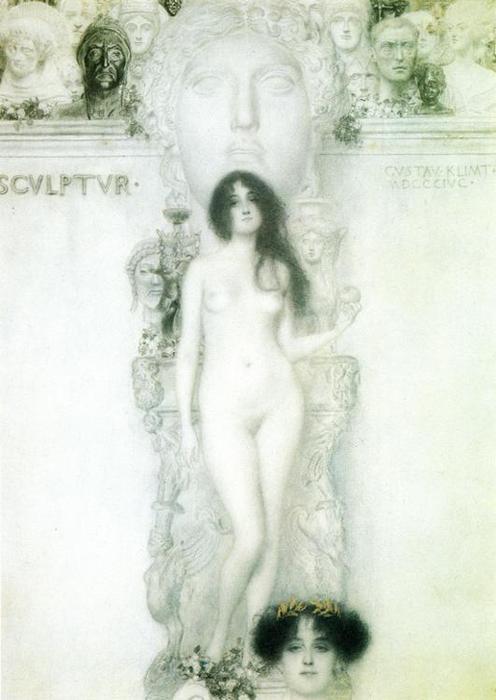
Gustave Klimt’s 1896 monochrome sketch explores neoclassical beauty & romantic drama. A preparatory study for a grand historical painting, showcasing layered composition & textured dry media.
Discover Gustav Klimt (1862-1918), the Austrian Symbolist master of Art Nouveau! Explore his iconic 'Golden Phase,' sensual portraits, and masterpieces like *The Kiss*. Learn about his life, influences & legacy.
A Study in Classical Reverie: Unveiling Klimt’s Preparatory Sketch
This captivating monochromatic drawing offers a rare glimpse into the artistic process of Gustav Klimt, revealing a meticulously crafted study likely preceding a larger, more elaborate composition. Executed in 1896 – a pivotal period bridging his early academic work and the emergence of his iconic “Golden Phase” – this piece showcases Klimt’s mastery of draftsmanship and his enduring fascination with classical themes.
Subject Matter & Compositional Dynamics
The artwork centers around a monumental sculpted head, reminiscent of ancient Roman or Greek statuary, dominating the upper register. This imposing figure is surrounded by several smaller female figures arranged in dynamic poses, creating a layered and complex composition. Architectural fragments – columns and inscribed elements – are interwoven throughout the scene, suggesting an interior space perhaps inspired by historical ruins or museum settings. The arrangement isn’t simply representational; it feels staged, almost theatrical, drawing the viewer into a world of artistic contemplation.
Style & Technique: Academic Roots with Romantic Flourishes
Klimt's technique is primarily dry media – most likely charcoal or graphite – expertly manipulated to achieve a rich textural surface and a nuanced range of tonal values. The extensive use of line work defines forms, establishes depth, and suggests movement within the composition. While rooted in academic realism, evident in the precise rendering of anatomical details and architectural elements, the artwork also displays hints of Romanticism. This is particularly noticeable in the dramatic lighting – strong contrasts between light and shadow that imbue the scene with a sense of emotional intensity.
Historical Context & Klimt’s Artistic Journey
During this period, Klimt was actively engaged in decorating public buildings in Vienna as part of the “Company of Artists.” These commissions often involved allegorical or historical subjects, and this drawing likely served as a preparatory study for such a project. It reflects his early training at the Vienna Kunstgewerbeschule, where he honed his skills in architectural painting and traditional artistic techniques. However, even within this academic framework, Klimt’s unique sensibility is apparent – a foreshadowing of the stylistic innovations that would soon define his career. His exploration of female figures and mythological themes also aligns with broader trends in Symbolist art prevalent at the time.
Symbolism & Emotional Resonance
The artwork evokes a sense of melancholy and contemplation. The central female figure, though partially obscured, appears lost in thought, her pose suggesting introspection or perhaps even sorrow. The juxtaposition of classical sculpture – representing enduring beauty and artistic ideals – with the ephemeral nature of human emotion creates a compelling tension. The fragmented architectural elements could symbolize the passage of time, the decay of civilizations, or the elusive nature of memory. Themes of art, creation, and mythology are subtly interwoven throughout the composition, inviting viewers to interpret its meaning on multiple levels.
Impact & Aesthetic Considerations
This drawing is more than just a preparatory sketch; it’s a work of art in its own right. Its monochromatic palette, dramatic lighting, and intricate details create a visually striking image that would complement a variety of interior styles – from traditional to contemporary. The artwork's size (41 x 31 cm) makes it ideal for display in smaller spaces or as part of a larger gallery wall arrangement. For collectors, this piece offers a unique opportunity to acquire a rare and insightful work by one of the most celebrated artists of the Art Nouveau era. It’s a testament to Klimt's enduring legacy and his profound impact on the art world.