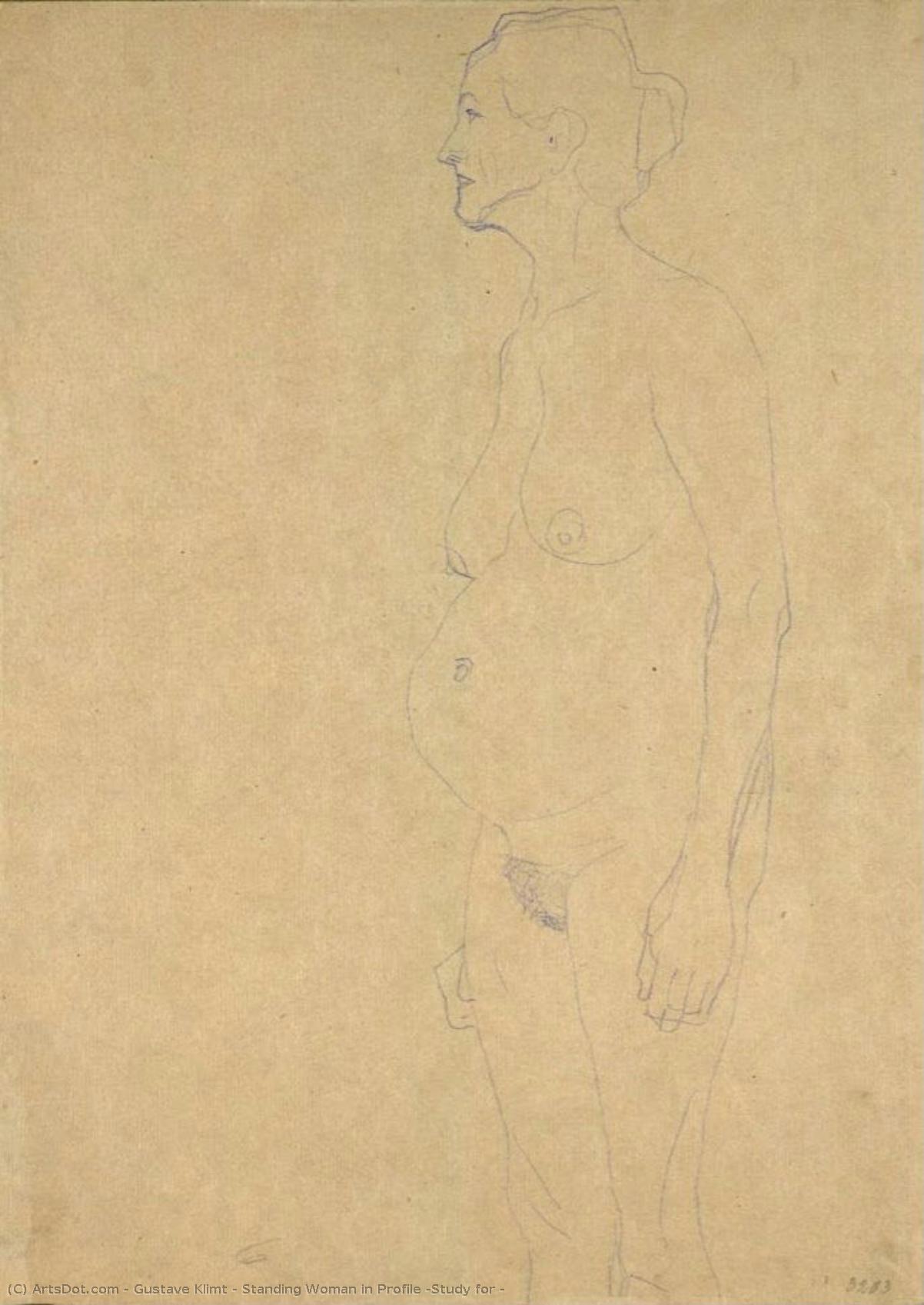
Explore Gustave Klimt’s ‘Standing Woman in Profile,’ a captivating pencil sketch of a nude figure. Admire its simplified realism & geometric lines, reflecting Art Nouveau style.
Discover Gustav Klimt (1862-1918), the Austrian Symbolist master of Art Nouveau! Explore his iconic 'Golden Phase,' sensual portraits, and masterpieces like *The Kiss*. Learn about his life, influences & legacy.
Explore art history's treasures at the Albertina Museum in Vienna! Discover stunning prints, drawings & masterpieces spanning centuries within its unique architectural spaces.
A Glimpse into Klimt’s Preparatory Process: Standing Woman in Profile (1905)
This exquisite pencil sketch offers a rare and intimate look into the working method of Gustav Klimt, one of Austria's most celebrated artists. Created in 1905, *Standing Woman in Profile* is not a finished work intended for display, but rather a foundational study – a vital step in Klimt’s process before embarking on larger, more elaborate compositions. It reveals his masterful draftsmanship and exploration of the human form that would become hallmarks of his iconic style.
Subject & Composition
The artwork depicts a nude female figure rendered in profile. The composition is strikingly simple yet powerfully evocative. Klimt focuses intently on the *elongated silhouette* and graceful posture of the woman, emphasizing her curves with delicate, flowing lines. There’s an inherent elegance in the pose, suggesting both vulnerability and quiet strength. The figure isn't presented as a fully realized portrait but rather as an anatomical investigation – a study of form and proportion.
Style & Technique
The sketch exemplifies Klimt’s transition towards his signature Art Nouveau aesthetic. While rooted in academic training, the work demonstrates a move away from strict realism toward *simplified forms* and elegant linearity. The artist employs predominantly thin pencil lines, varying pressure to create subtle tonal variations that define the figure's volume. Geometric shapes – ovals for the torso and limbs, circles suggesting breasts – are subtly integrated into the organic form, hinting at the decorative elements that would soon dominate his mature work. The textured beige background, likely aged paper, adds a sense of history and intimacy to the piece.
Historical Context & Influences
Created during a pivotal period in Klimt’s career, this study reflects the artistic ferment of Vienna at the turn of the 20th century. Klimt was a leading figure in the *Vienna Secession*, a movement that rejected traditional academic art and embraced new forms of expression. He drew inspiration from Byzantine mosaics – evident in his later use of gold leaf – as well as Japanese prints, which influenced his emphasis on flattened perspective and decorative patterns. This sketch likely served as preparation for larger works, potentially related to the *Stoclet Frieze* or other ambitious projects exploring themes of love, life, and death. Related studies like “Standing Pregnant Woman in Profile” demonstrate Klimt’s iterative approach to figure work.
Symbolism & Emotional Impact
While devoid of overt symbolism, the nude female form itself carries significant weight within Klimt's oeuvre. He frequently depicted women as powerful and enigmatic figures, often imbued with a sense of both sensuality and melancholy. This sketch, in its raw and unadorned state, offers a particularly direct connection to the artist’s exploration of *femininity* and the human condition. The lack of detailed facial features encourages viewers to project their own emotions onto the figure, fostering a personal and introspective experience.
For Collectors & Designers
This work is not merely an aesthetic object; it's a window into the creative mind of a master. A high-quality reproduction would be a stunning addition to any collection, bringing a touch of Klimt’s genius to your space. Its understated elegance and neutral palette make it incredibly versatile – suitable for both modern and traditional interiors. The sketch’s focus on line and form lends itself beautifully to large-scale prints or as part of a curated gallery wall. It's an investment in artistry, history, and timeless beauty.