A Gilded Reverie: Exploring Klimt’s “The Virgin After Gustav Klimt”
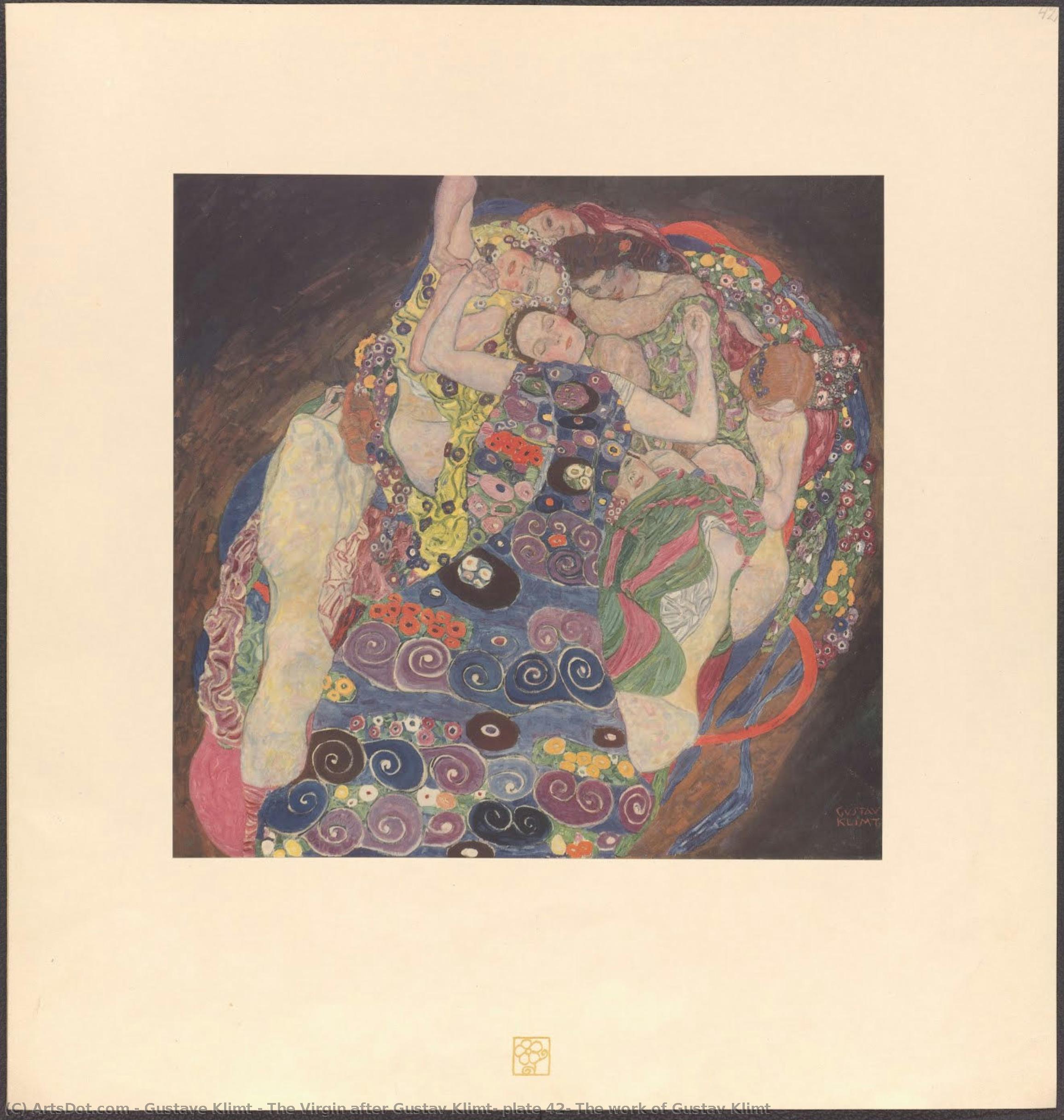
Gustav Klimt's "The Virgin after Gustav Klimt," plate 42 from his seminal collection, is not merely a depiction of the biblical subject; it’s an immersion into a world saturated with shimmering gold, potent symbolism, and a profound exploration of female experience. Born in Baumgarten, Austria, in 1862, Klimt's artistic journey was inextricably linked to his family’s history – his father, Ernst Klimt, a skilled gold engraver – instilled within him an early appreciation for the luxurious texture and transformative power of precious metals. This influence is immediately apparent in this work, where gold leaf isn’t simply decorative but becomes a fundamental element of the painting's very essence, lending it an almost otherworldly quality.
The composition itself is deliberately enigmatic. Three women occupy the canvas, their postures ranging from languid repose to attentive observation. The central figure, lying on her side, embodies a sensual vulnerability, while the seated woman exudes quiet strength and contemplation. Above them all stands a third figure, partially obscured, suggesting a hierarchical dynamic – perhaps representing divine authority or simply the weight of experience. The inclusion of secondary figures, glimpsed in the periphery, adds to the painting’s sense of layered narrative, inviting viewers to become active participants in deciphering its meaning.
Decoding Symbolism: Gold, Fertility, and Female Power
Klimt's masterful use of color and pattern is central to understanding the work’s symbolic weight. The dominant hue, of course, is gold – a material laden with religious significance, representing divinity, immortality, and spiritual enlightenment. However, Klimt subverts traditional associations, imbuing it with an intensely sensual quality. The intricate geometric patterns that adorn the women's robes are not merely decorative; they’re rooted in Byzantine mosaics and Art Nouveau aesthetics, suggesting a connection to ancient traditions of fertility and rebirth. The swirling lines and stylized forms evoke a sense of movement and dynamism, mirroring the cyclical nature of life and death.
Furthermore, the figures themselves can be interpreted through a feminist lens. Klimt’s portrayal challenges conventional representations of the Virgin Mary, presenting her not as a passive icon but as a complex woman grappling with earthly desires and spiritual contemplation. The seated figure, in particular, possesses an assertive gaze, suggesting agency and intellectual engagement – a radical departure from traditional depictions of female piety.
Technique and Artistic Innovation
Klimt’s technique is characterized by its meticulous layering and the innovative use of gold leaf. He built up the surface of the canvas with numerous thin layers of gesso, creating a textured foundation upon which he applied his pigments. The gold leaf was then meticulously adhered to these layers, often using a special adhesive that allowed it to shimmer and reflect light in extraordinary ways. This technique, perfected by Klimt, is what gives “The Virgin” its breathtaking luminosity and tactile richness. He employed a technique known as *rimless painting*, where the edges of the canvas are left exposed, further emphasizing the artwork’s decorative qualities and blurring the boundaries between art and object.
Beyond the gold, Klimt's brushwork is remarkably fluid and expressive, particularly in depicting the drapery. He masterfully captured the way fabric folds and drapes around the figures, creating a sense of movement and volume. This attention to detail, combined with his bold use of color and pattern, distinguishes “The Virgin” as a pivotal work in Klimt’s oeuvre and a significant contribution to the development of Modern Art.
A Timeless Masterpiece: Reproduction and Interior Design
"The Virgin after Gustav Klimt" continues to captivate viewers with its opulent beauty and enigmatic symbolism. ArtsDot offers meticulously crafted, hand-painted reproductions that faithfully capture the original’s luminosity and intricate detail. These high-quality reproductions are ideal for collectors seeking an authentic representation of this iconic artwork or for interior designers looking to infuse a space with Klimt's distinctive style – a touch of gilded elegance and profound artistic contemplation.